
CHICAGO — From the moment Brad Taylor emails the Big Ten’s men’s basketball coaches the upcoming season’s schedule, the countdown begins to the first complaint he receives. Usually, it’s within minutes.
Taylor, the conference’s vice president of basketball administration, keeps a sheet ready for each team with the rationale for its schedule.
“In the three years I’ve been part of it, I don’t think a coach has told me something I didn’t know already,” Taylor said.
Scheduling college basketball games is an unenviable task, with layers of competitive-balance principles, travel concerns and external factors to consider. Every school’s arena juggles men’s and women’s basketball dates, sometimes sports such as hockey or wrestling and other important events like graduations and concerts. Television has its demands, and teams submit requests for specific opponents on certain dates. That information is plugged into a computer program in mid-June, and a working schedule doesn’t appear until August.
Since the Big Ten added four West Coast programs in 2024, Taylor’s job — like the jobs of his colleagues in charge of the Big Ten’s other sports — has gotten more difficult. With schools located on both coasts and road teams facing tipoff times that could range from 9 a.m. to 11 p.m. back in their home time zone, it’s a job that struggles to balance the interests of all constituents.
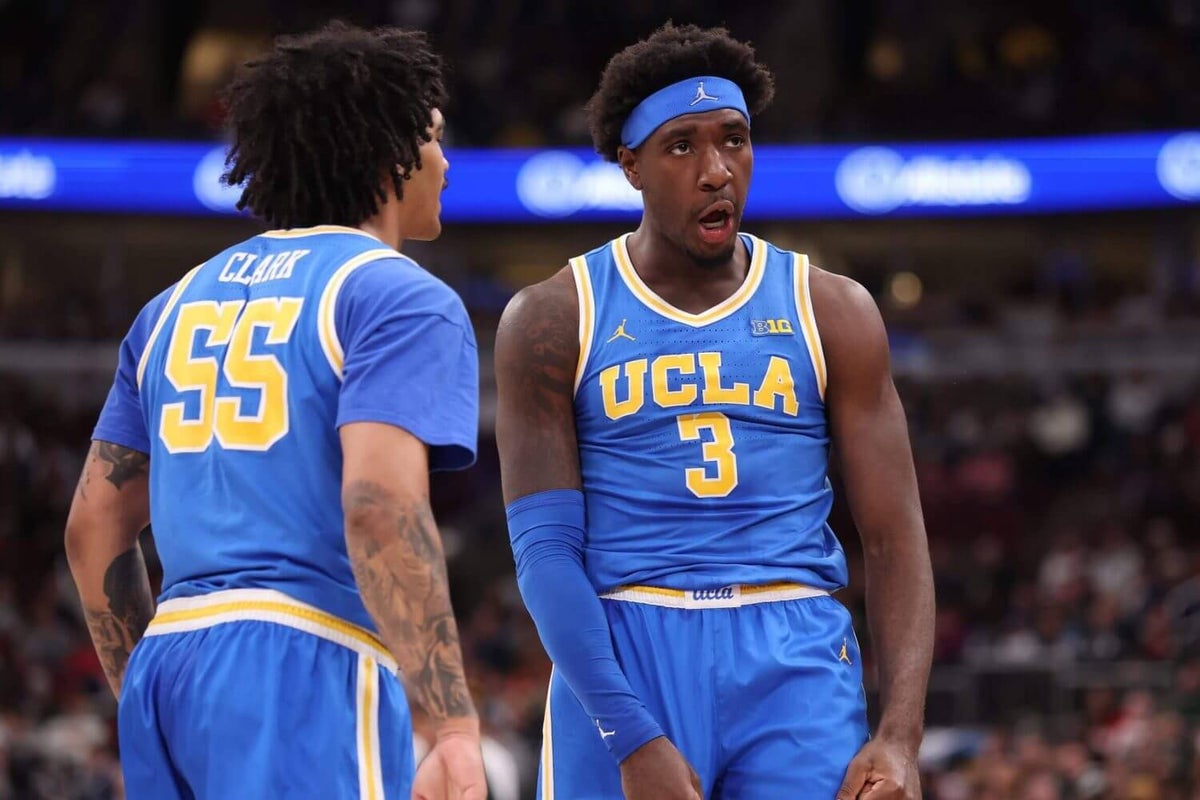
“I don’t know what the answer is,” UCLA coach Mick Cronin said this week at the Big Ten tournament. “I’m not knocking the Big Ten because it is what it is. They’re trying to make it work, but we’re trying to make college sports work right now. They’re trying to patch in new rules to an old system, and they’ve just got to blow it up and start it over.”
If shedding conference labels or realigning major college sports by region aren’t viable options, the schools and leagues need to work within the current structure, which Cronin acknowledges. Through two seasons as an 18-team conference, the Big Ten has altered many of its scheduling principles to accommodate its eastern and western wings, yet there is room for improvement.
Seven of the West Coast teams’ 10 Big Ten road contests take place in the Eastern or Central time zones. For each school, the league schedule combines six of those games into three trips to limit cross-country travel. For example, UCLA played at Iowa on Jan. 3 and then at Wisconsin, which is about a three-hour bus trip, on Jan. 6. Each West Coast school also travels to either Minnesota or Nebraska separately.
West Coast schools usually leave two days before the first game, and with the coaches’ agreed-upon requirement of two days’ preparation per opponent, those trips often last six days. This year, USC requested a three-game road trip, which the league granted. Oregon and Washington each shortened a road trip by one day with a one-day prep, matching the layoff their opponents Indiana and Northwestern had from their previous games.
“We wanted the three-game road trip,” USC coach Eric Musselman said. “I would love a four- or five-game road trip, based on my experience coaching at the NBA level. I think there’s a reason that the NBA and the NHL don’t play two-game road trips across the country.”
Every team that heads to the West Coast plays two games in one swing: either UCLA-USC or Oregon-Washington. The league has also tried to help Rutgers and Maryland by pairing up two road opponents in one excursion. This year, Rutgers flew to Wisconsin on Jan. 17 and then bused to Iowa for its Jan. 20 game. Maryland opted to fly home from Illinois after its Jan. 21 game rather than bus to Michigan State afterward.
“We’ll go to our coaches after the season and say, ‘Hey, we got to reimagine this. What do you all want?’” Taylor said. “We’ve started creating scheduling preferences lists, saying, ‘Hey, tell me how you want your conference schedule basically built and we can try to cater.’”
Cronin has been the Big Ten’s most vocal critic on scheduling, and his Jan. 26 diatribe caught officials off-guard. After beating a 69-67 home win over Purdue, Cronin sarcastically thanked the league “for bringing Purdue here on Thursday night when we don’t get back in L.A. until Saturday night and giving us the team picked to win the league on two days’ rest after five of our first seven on the road.” (Cronin omitted that UCLA was scheduled to play five of its next six games at home and the lone road contest was at Oregon.)
“(UCLA) benefited two years in a row of having some long, extended stretches being in the West Coast area,” Taylor said. “We understand the travel is tough for all teams.”
But nearly everyone agrees travel is more difficult for the West Coast teams, and the results reflect it. UCLA, USC, Oregon and Washington went 7-21 in Big Ten regular-season games outside the Pacific time zone this year. UCLA was 1-6 in the Eastern and Central time zones but 12-1 on the West Coast against Big Ten competition, with its one loss coming by one point in overtime.
“I will say Wisconsin and Iowa are good,” Cronin said. “Ohio State’s good. Michigan, Michigan State, they’re really good teams. It’s not all the travel. I think what concerns me is the totality of the travel. How beat up are we now from all the travel, because we’re gonna have to travel again probably next week (in the NCAA Tournament), too. That’s the biggest concern.”
Conference and school officials have considered their options for making the 20-game schedule work. Should the Big Ten move more league games into December or even November to limit teams’ late-season wear-and-tear? Should it schedule more games during a team’s winter break to cut down on missed class time? Those are among the questions Taylor and the coaches will discuss this offseason. As of now, there’s little consensus, even among the West Coast coaches.
“We need Big Ten games in January and February because football’s over,” Musselman said. “Those games in November and early December are hard for everybody across the country, even the schools that draw great, nonconference games. While football is going on, meaning the NFL and college football, that might take away a little bit.”
Most of the Big Ten’s old-guard programs have major basketball followings and provide some of the country’s most intense atmospheres, especially when school is in session. They make the sport special, even for the visitors.
“You want to play in those environments,” Washington’s Danny Sprinkle said. “When we played Purdue, they didn’t have their students there. It was still rocking, but it’s a different place when they have their students there. We cherish those environments. I don’t know if there’s a perfect way you can do it.”
But the athletes are students, too. Oregon, Washington and UCLA operate on a quarter system, which gives them early fall exams — those three completed fall classes on Dec. 12 — but also early winter terms beginning on Jan. 5. That prompts questions of shifting longer road trips to the holiday break.
“You’re off-base. You care about academics. Nobody else does,” Cronin said. “UCLA has very limited online classes. Our guys go to class. But there are 25 sports at UCLA, not just us. So, I throw in, it’s worse for them (other sports).”
Musselman has tried to persuade Cronin to look at three- or four-game road trips, but Cronin remains leery.
“I just don’t think you have any chance to win that way,” Cronin said. “But he’s been in the NBA, so I’m going to talk to him about it when the season’s over.”
Television will play a role in any scheduling discussion. The league’s basketball draft among its TV partners isn’t as extensive as its football counterpart, but Fox, CBS and NBC/Peacock each make 13 selections. Fox and CBS have NFL rights, which always take precedence over college basketball, so they prefer to ramp up their Big Ten hoops productions beginning in late January and build toward the NCAA Tournament.
The networks don’t necessarily request specific dates for the games they select, just a basic range. Michigan-Michigan State is often chosen No. 1, with a preference for the final weekend. But momentum is brewing for alterations, which the Big Ten and the networks welcome. Late-season nonconference games this year, such as Michigan-Duke in Washington D.C. and Ohio State-Virginia in Nashville, Tenn., were ratings winners, and Taylor said, “There’s gonna be more of those.”
In addition, the Big Ten has explored pulling away from the multi-team events (MTEs) many teams participate in during the season’s first two months and creating their own basketball events. Currently, schools pay six-figure sums to compete in a Thanksgiving week classic or tournament, for which the event, not the league, lines up a television contract.
“We feel that’s a lot of money left on the table when we outsource it to somebody else,” Taylor said.
Taylor understands whatever he does will generate some feedback. It could come from a coach complaining about a stretch of difficult opponents or road contests. Perhaps it’s from a school upset about unfriendly tip times or a lack of weekend games. If the coaches ultimately choose to shift conference games into December, how will the networks react?
“Brad Taylor, he’s got his work cut out for him, no doubt,” Sprinkle said.