
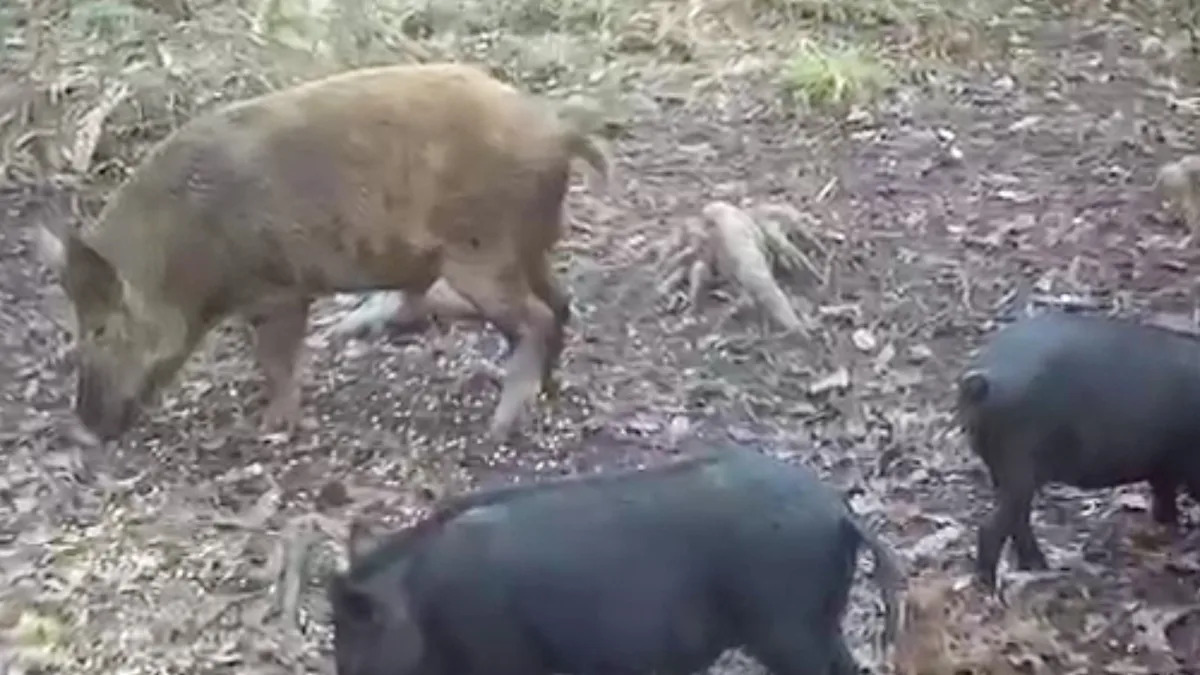
Residents in a neighborhood in St. Augustine, FL, are dealing with a growing feral hog problem around World Golf Village.
In response, the homeowners association has brought in trappers for the two adult pigs and roughly a dozen piglets.
The subdivision’s name is being withheld at the trappers’ request to keep hunters from coming there.
“We’ve been hired to catch the feral hogs. It’s not unusual for feral hogs to invade residential neighborhoods like this in Florida,” Ryan Boyd, president of Quick Catch, tells Realtor.com®.
Piglets weigh roughly 40 to 50 pounds at the start, and full-grown hogs can reach 300 to 400 pounds.
Boyd says feral hogs—which were brought over to Florida by Spanish explorers in 1539—are a common problem in the state and have been for decades.
In fact, Boyd caught his first hog with a homemade snare when he was just 12 years old.
“Ever since then, close wasn’t close enough, I wanted to be Steve Irwin,” he says. “Since I started keeping track eight or nine years ago, I’m at 4,785 hogs.”
How the feral hogs are caught
Boyd says his company first puts out trail cameras to spot the hogs.
“Then once we get the hogs comfortable coming to that location through baiting with deer corn, we put out a trap,” he says.
Boyd says the metal traps are 35 feet across, with two 8-foot gates—and that he can watch what’s happening in the trap through a live video.
“I wait until 10 hogs are in there feeding, then I drop the gates,” he says.
He admits that trapping the feral hogs gives him quite an adrenaline rush. “It’s kind of like a video game,” he says.
Once caught, the meat from the captured hogs in St. Augustine will be donated to charities and shelters.
Feral hogs are a fact of life in Florida
St. Augustine resident Dave Field told Action Jax News he’s frustrated with the constant hog activity in his neighborhood, but his wife says she still loves living there despite the feral hog issue.
Florida real estate agent Cara Ameer says the area around World Golf Village was largely all farmland until it started to become developed with large-tract subdivisions.
“As a result of that, the wildlife that was there has been essentially displaced and trying to figure out where to go. This is what happens when you have the intersection of suburban sprawl and native species,” she says.
Ameer adds that most Floridians are much more concerned with alligators and snakes than they are feral hogs. “People aren’t really thinking about wild hogs until they see them,” she says. “They’re not on most people’s radar.”
Dangers of feral hogs
Feral hogs can be dangerous, although attacks on people are relatively rare.
“They can get violent, especially if you get between a sow and her pigs,” says Boyd.
According to the USDA, feral swine can carry at least 30 diseases and nearly 40 types of parasites that may affect people, pets, livestock, and wildlife.
Boyd says he was bitten by a feral hog in 2015 and has had persistent symptoms since then, including an upset stomach, brain fog, and joint pain.
“I’ve seen over 150 doctors, and no one can tell me what’s wrong,” he says.
Boyd says if you spot feral hogs in your neighborhood, you need to call in a professional who is experienced with wild hogs.
“They’re the smartest animal in the woods,” he says. “They have problem-solving abilities, and they’re only getting smarter and smarter.”