
Follow The Athletic’s tennis coverage of the BNP Paribas Open and more
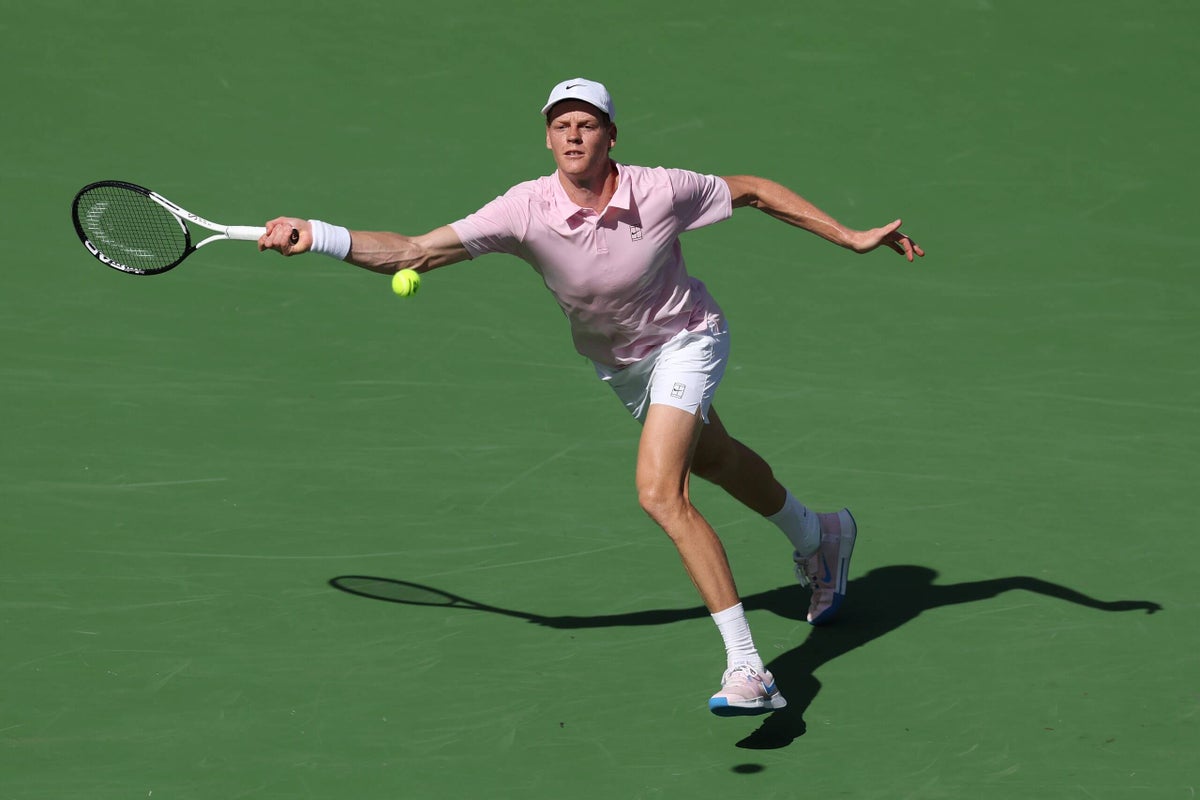
Indian Wells, Calif. — Jannik Sinner beat Daniil Medvedev 7-6(6), 7-6(4) in the BNP Paribas Open final Sunday at Indian Wells Tennis Garden.
The No. 2 seed prevailed over the No. 11 seed in a match ultimately decided by one decision to leave a volley, a shared serving tactic and Sinner’s use of hot conditions that have previously troubled him.
It is Sinner’s first BNP Paribas Open title, and with it he completes the set of all six hard-court ATP Masters 1000s, both hard-court Grand Slam titles and the ATP Tour Finals.
Two of The Athletic’s tennis writers, Charlie Eccleshare and Matt Futterman, analyze the final and what it means for tennis.
How did a first set with nothing to separate the players turn on one shot?
For an hour, Daniil Medvedev stuck to the rallies from the baseline that he would play all day long against every opponent if he had his way.
No one loves doing an impression of a backboard more than Medvedev, before mixing in a hammer forehand or a deadly angled backhand to seal the point. At Indian Wells the past 10 days, he’s been playing further inside the baseline and with more aggressiveness than he has for several years, but he sticks to his core diet.
Against Sinner, forehand and backhand groundstrokes accounted for 90 percent of his shots during the first set. His average the past year was 86 percent. Against Carlos Alcaraz in the semifinals, he went down to 76 percent, because that’s what Alcaraz will do to anyone.
He stuck to the game plan right up to the end of the first-set tiebreak. But then, with Sinner serving down 5-4, Medvedev worked himself into an attacking position, drifting forward to the net as he sent the ball deep into Sinner’s forehand. Sinner ran and hit a looping forehand that came up at just above eye-level for Medvedev.
He looked at it. He tracked it. But his racket didn’t rise to it. High forehand volleys are not one of Medvedev’s core shots, and it showed. He let the ball float by, and when it landed well inside the baseline, the score was 5-5 instead of 6-4, Medvedev, with Sinner still serving. At worst, Medvedev would have had one set point on his serve. Instead, he didn’t get any, and Sinner nicked a key point off another core shot to take the first set.
— Matt Futterman
How did both players exploit the same tactic?
That core shot came from Medvedev’s key tactic on serve: Attack the Sinner forehand with his first delivery.
He served to that wing 77 percent of the time from the deuce side (compared to 51 percent on average over the last year), and 57 percent (compared to 50 percent) on the ad side in the first set.
The tactic worked exceptionally well during this period, especially from the deuce side, with Medvedev winning 9 points of 9 there (including three aces), up until his final service point of the set.
But at 6-6 in the tiebreak, Sinner finally got hold of a forehand return off a first serve. He was helped by a safer delivery, as far from the sideline as any of those previous nine, and at 108 mph it was Medvedev’s slowest first serve of the match up until that point.
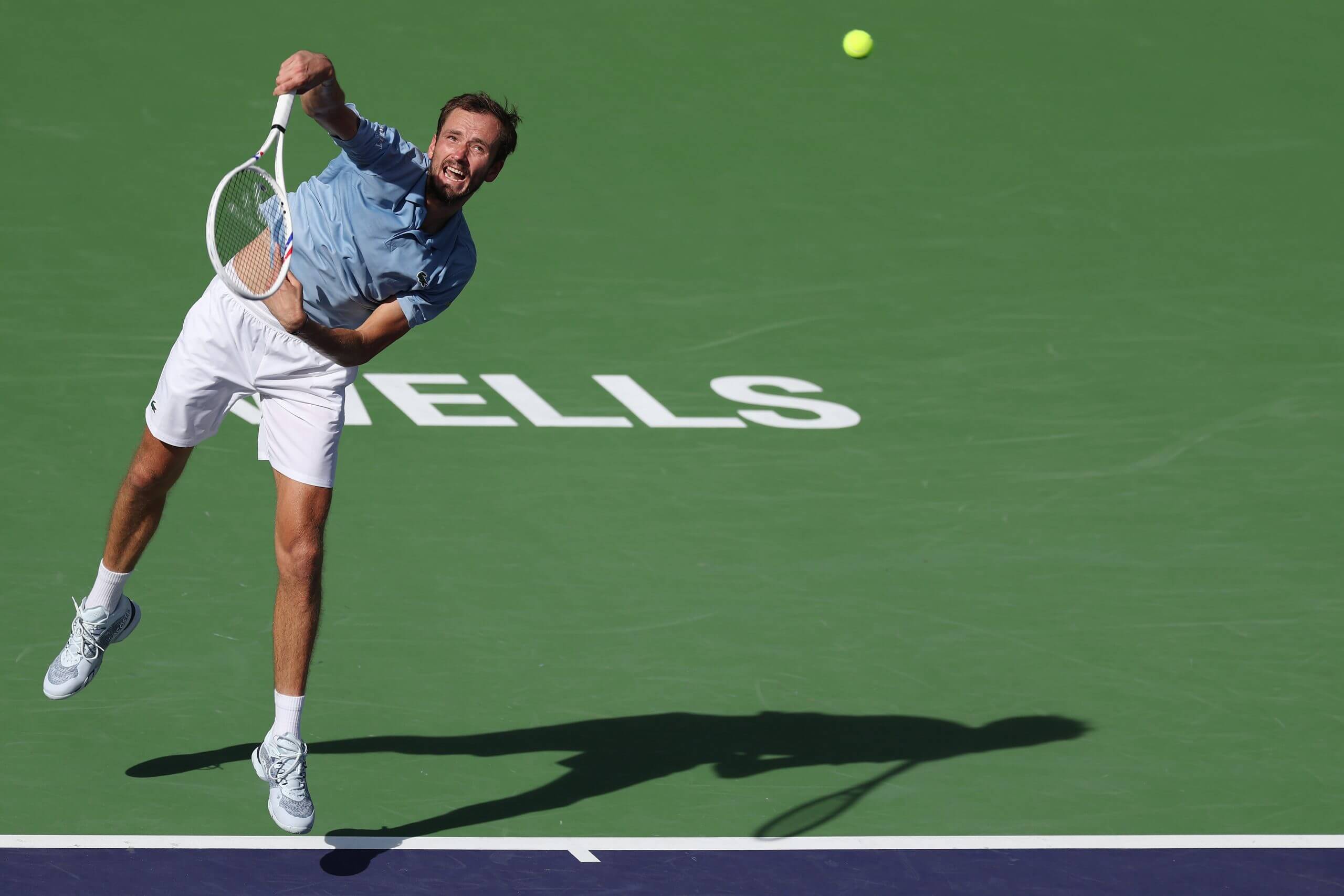
Daniil Medvedev and Jannik Sinner both tried to send their deuce-side serves in the same direction. (Clive Brunskill / Getty Images)
Sinner got enough on the return to force Medvedev into an unconventional (for any other player anyway) inside-out backhand, and from then on he was never in charge of the point. Sinner forced a missed forehand, and in so doing secured the first and only break or mini-break in the first set.
He duly served it out on the next point, having finally cracked a code that had handcuffed him throughout the first set.
Sinner had a similar game plan from the deuce side, with the hot conditions and quicker-than-typical surface at Indian Wells aiding slider serves that arced out of the court and forced the returner way out into the tramlines. The world No. 2 served to Medvedev’s forehand from the deuce side nine times in the first set, and won all nine of the points.
— Charlie Eccleshare
How did Jannik Sinner use his kryptonite?
With the temperature pushing 100 degrees in Indian Wells, there were concerns over how Sinner would cope. He has found extreme heat challenging in the past, including at January’s Australian Open. He was on the point of collapse against Eliot Spizzirri when the tournament’s Heat Stress Scale reached the level required to close the roof on Rod Laver Arena and pause the match, with the American up a break and firmly in control. Sinner recovered to win.
Sinner didn’t seem bothered by the heat Sunday. The desert is drier, with less humidity to weigh players down, and the three-set format (and mostly short rallies against Medvedev) helped him deliver a superb serving display.
He won 33 of his first 34 first-serve points, and ended up with an overall first-serve points won of 91 percent, way up from his previous-year average of 80 percent.
Maybe this is a way Sinner needs to reframe his complicated relationship with heat — that it can help him deliver serving displays that take durability out as a decisive factor.
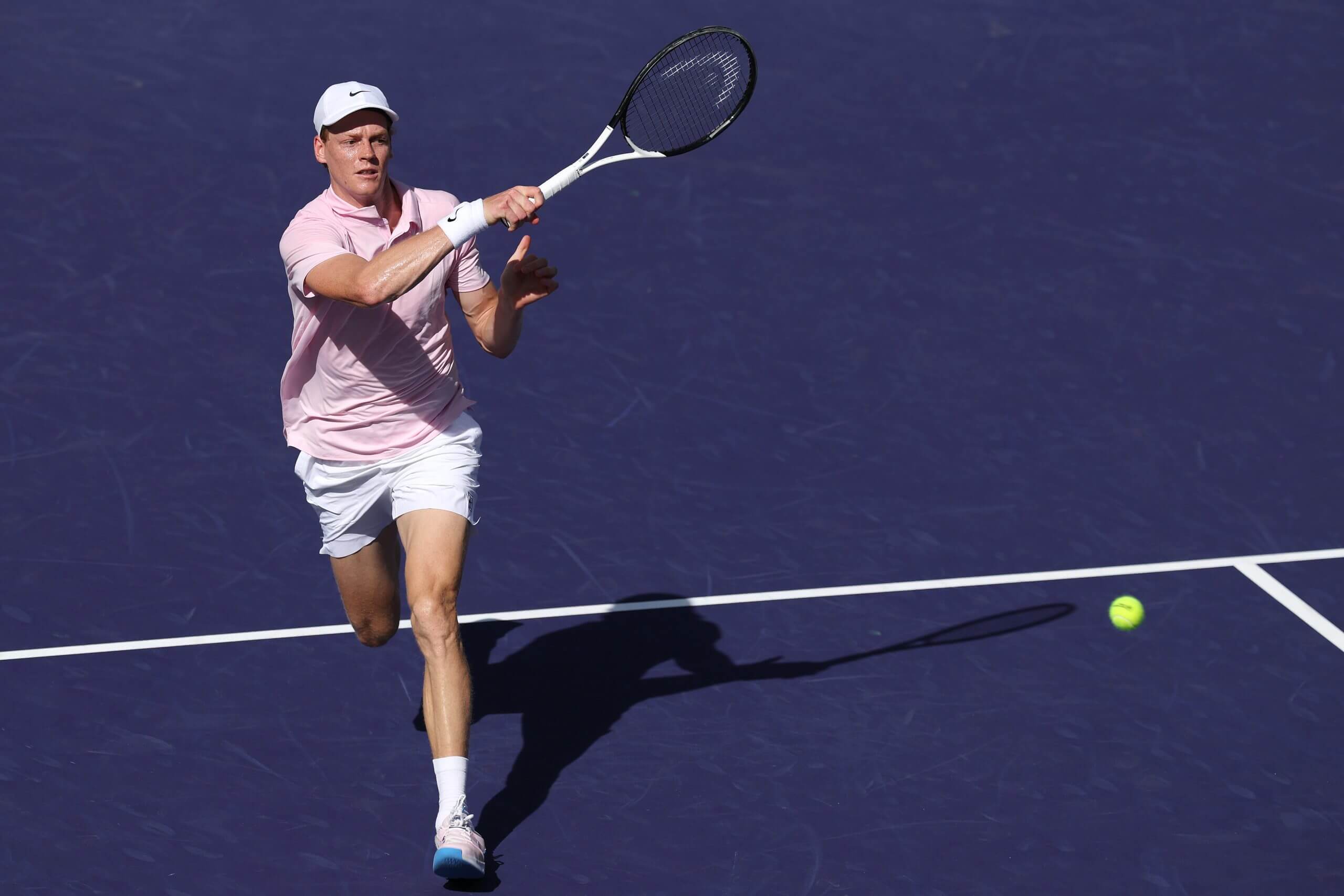
Jannik Sinner used his first serve to get inside the court and take over points throughout the match. (Clive Brunskill / Getty Images)
It certainly wasn’t a match of long rallies, with both players going for the quick kill whenever possible. Medvedev played brilliantly to make the match so close, but ultimately the staccato tennis that the conditions facilitated played into Sinner’s hands.
— Charlie Eccleshare
A boost for the rest of men’s tennis — and a reminder of the task facing them
It’s the big problem for anyone hoping to win one of the biggest titles in men’s tennis these days.
Those are the Grand Slams, the ATP Masters 1000s and the ATP Tour Finals. In most of them, especially the super-important ones, including the BNP Paribas Open, the Madrid Open, the Italian Open and the Cincinnati Open, chances are both Sinner and Alcaraz are in the draw and winning means beating both of them.
If ever it was going to happen, Sunday seemed like the day. Medvedev was in incredible form. He was on a hard court, where he is a self-described “specialist.” He’d knocked off Alcaraz. Sinner had never won Indian Wells.
And when it was over, Sinner, who is probably the best hard-court player in the world not named Carlos Alcaraz, was lifting the trophy for the first time. That’s where tennis is right now. Medvedev went toe-to-toe with him for nearly two hours, didn’t lose his serve and played pretty great bar the second tiebreak. And still.
When was the last time someone beat both of them at one of those events? That was 2023 at the ATP Tour Finals. All it took was Novak Djokovic, the greatest men’s player of all time, in a year when he finished No. 1 and won three Grand Slams.
How did Medvedev’s tournament-defining play desert him at the crucial moment?
When Medvedev went 4-0 up in the second-set tiebreak, and Sinner was shaking out his right hand, a deciding set felt inevitable. Especially when Sinner patted over a second serve, seemingly wary of a second straight double fault.
Medvedev’s return was deep, but he didn’t fully accelerate with the shot like he had been doing for most of the match or the tournament. Sinner, on the other hand, suddenly went for broke, and crunched a forehand return winner off a compliant Medvedev second serve on the next point to keep things close at 4-2. \
Medvedev was then a little unlucky when a backhand approach hit the tape and dropped right into the Sinner hitting zone for a backhand passing-shot winner. The Italian was suddenly revitalized, and when he nailed a tricky overhead into the sun for a 5-4 lead it felt as though Medvedev’s moment might have gone.
So it proved. He can have no regrets over the next point, when he rediscovered his aggressiveness from earlier in the match, only for Sinner to outlast him in a grueling exchange from the back of the court.
And then came one more moment of Sinner magic, cracking a forehand return crosscourt to seal a first Indian Wells title. As with every misstep Medvedev made in the match, it came within the context of a generally brilliant performance.
But that is what the rest of the field are up against when they face Sinner or Alcaraz. Anything other than perfection is mercilessly punished.
— Charlie Eccleshare