
It wasn’t necessarily pretty, but the Detroit Red Wings fighting back to earn a point in Dallas on Saturday night makes a big difference.
Had the Red Wings not gotten that point, they would be coming home beaten up — they were down four regulars, including three centers, due to injuries for the Stars game — and suddenly out of a playoff spot. They’re still without those centers as they return home, but at least for now, they’re still clinging to that playoff spot and any psychological confidence boost that comes with it.
This is going to be a huge homestand. With where the lineup sits, they can’t afford to overlook anyone, regardless, but they have some true swing games on the horizon. Monday versus a rebuilding Calgary Flames team is a must-win, yes, but so are games against fellow playoff hopefuls Montreal (Thursday), Boston (Saturday) and Ottawa (the following Tuesday).
So, as that crucial stretch begins, here’s a look at the players most in the spotlight as the Red Wings look to hold their tepid grip on that final playoff spot while also trying to get healthy.
1. John Gibson
It’s no secret that Gibson has been one of the driving forces of this Red Wings season. After a slow start in his first six weeks in Detroit, Gibson started to click at the beginning of December and has been one of the league’s best goalies ever since, with a .921 save percentage that ranks second in the league in that time frame.
Even at full health, the Red Wings have struggled to score for much of the year — especially at five-on-five — and that made Gibson’s contributions all the more significant. Now, that sense only heightens.
Detroit’s recipe is pretty clear, at least for as long as Dylan Larkin and Andrew Copp are out: The Red Wings are going to have to try to win games 2-1, maybe 3-2. Since very early in Todd McLellan’s tenure, the head coach has described games as a race to three, and that’s never been more true than right now. And that puts a lot on Gibson, fair or not.
It’s important to note that Gibson has left multiple games early in the last two weeks, which is at least a yellow flag. Gibson played just 29 games last season, and 46 the season before that. He’s already up to 44, and you can bet Detroit is going to lean on him heavily with every point so essential.
The notion of keeping him fresh for the playoffs is secondary, with the race so tight, but it’s still unclear what this kind of workload will mean for him. Gibson’s numbers have cooled slightly recently, but he’s still been very good since returning from the Olympic break with a .913 save percentage and 5.09 goals saved above expected in seven starts.
That’s about the minimum of what the Red Wings are going to need from him the rest of the way.
2. The top power-play unit
In each of the last two seasons, the Red Wings knew they could count on one of the league’s best power plays to deliver big, timely goals. That was the case early this season, too. The morning of Jan. 1, Detroit once again had a top-five power play, converting 25.2 percent.
Since then? It has vanished. The Red Wings’ power play ranks 26th in the new year, at just 16.9 percent. Since the start of March, they’re under 10 percent. That’s tough for any team to overcome, but especially for a team that struggles to score at even strength.
Especially with the addition of Justin Faulk, the Red Wings are capable of defending well enough to play low-scoring games. They did for most of this road trip, with late-game mistakes torpedoing one of those efforts against the Florida Panthers. But they still need to find some goals, and it feels like fixing the power play has to be part of the answer.
And while that’s not all on the top unit, that group is certainly the one with the most talent and the most room to step up. Alex DeBrincat and Lucas Raymond are already the focal points of the attack with the man advantage, and that doesn’t change. What may have to change is some of the underlying philosophy, as subtracting Larkin from the bumper spot changes the look of that unit.
Whereas Detroit’s perimeter can snap the puck around with the best of them — from DeBrincat, to Raymond, up top to Moritz Seider and then over to Patrick Kane — getting more traffic to the net for tips and rebounds feels paramount. Those pretty one-timers to DeBrincat and Raymond will of course remain welcome, but spending 30 seconds setting it up may be part of the reason the unit’s conversion rate has fallen off.
Those three wingers are all smaller, but Raymond and DeBrincat still can play around the net, and James van Riemsdyk is a master down there, too. Seider has shown a willingness to let it rip, averaging four shots on goal a game over the last four — nearly double his season average. That’s a start, but taking away goalies’ eyes and getting on rebounds is the next part of the equation.
3. Marco Kasper
Much has been made of Kasper’s sophomore slump, and the counting stats bear that out, but it’s worth noting that since mid-December, Kasper has been back to tilting the ice in the Red Wings’ favor. Detroit is generating 53.8 percent of the five-on-five expected goals with Kasper on the ice since Dec. 10, and 54.39 percent of actual goals, according to Evolving Hockey. Tighten that range to since Jan. 1, and the actual goals share goes up above 60 percent.
That’s the Kasper who inspired so much confidence down the stretch last season, and albeit quietly, he has largely returned. The counting stats still haven’t popped at the same rate, but they’re coming back around, and Kasper is above a half-point per game since mid-January.
Now though, serving as the primary center for Raymond, Detroit will probably need to ask even more of Kasper. And there are signs it’s coming. In March, the Red Wings are generating a staggering 4.23 expected goals per 60 minutes with Kasper on the ice at five-on-five, and less than half that number in actual goals.
Those discrepancies don’t always correct as much as you’d like, especially in small samples, but it’s a sign Kasper is doing the right things. Now it just needs to translate to the scoresheet.
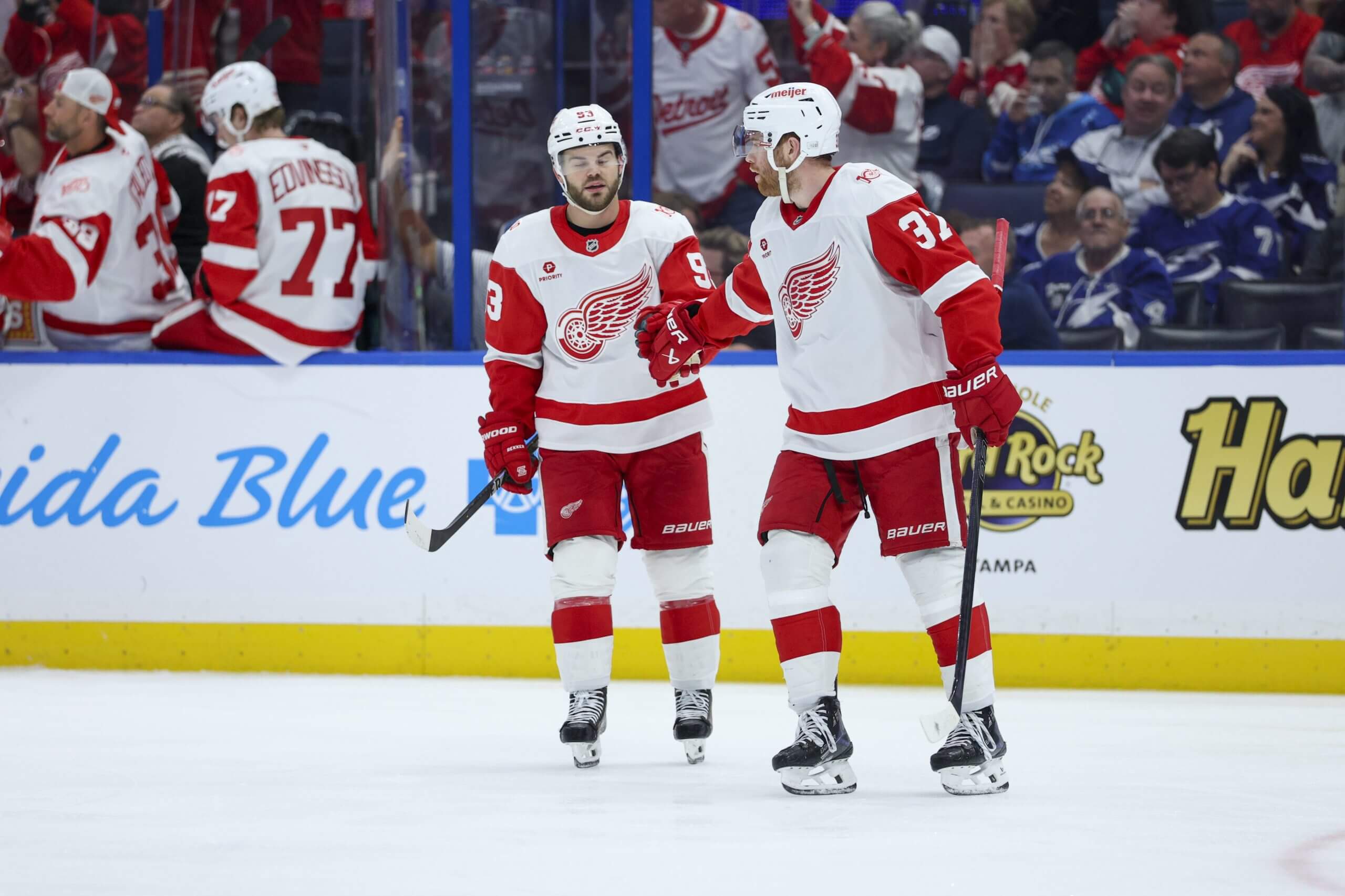
J.T. Compher got boosted up the lineup in the aftermath of Andrew Copp’s injury and has helped the top line stay dangerous. (Nathan Ray Seebeck / Imagn Images)
4. J.T. Compher
I have to give a lot of credit to Compher for his last two games. When Copp went down, Compher was thrust up the lineup to center Kane and DeBrincat, and he’s allowed that line to remain dangerous, bringing a lot of the same elements for them that Copp did.
He also scored Detroit’s lone goal in Tampa, deflecting a DeBrincat shot, and nearly scored the same way in Dallas, tipping a shot just wide. That’s the recipe the Red Wings are going to preach for their scoring, and Compher has led the charge on it these last two games. Good on him.
And of course, going from a checking role to needing to drive offense in the top six makes him one of Detroit’s most important players. But the spotlight on him also holds true in a bigger-picture sense. With the Red Wings’ young centers like Kasper and Nate Danielson maturing, Compher has a chance to leave a lasting impression into the offseason about his place in the hierarchy going into next season.
5. The blue line
Including the entire blue line admittedly feels a bit like cheating, even after basically doing the same thing for the power play. But this isn’t as rote a point as “the defensemen need to be good.” Rather, it’s about Detroit’s defensemen being a locus of offensive creation, with the forward lineup so beaten up.
And this is already happening. Simon Edvinsson’s goal Saturday was mostly a gift from Jake Oettinger, but it doesn’t happen without Edvinsson putting a hard shot on him off a set-up pass from Seider. Earlier in the week, Faulk scored his first goal as a Red Wing, but his 12 goals this season rank fifth among the current Detroit roster. And Seider’s uptick in shot volume is perhaps the biggest piece of the puzzle, creating the opportunities for rebounds and tips from the point.
The Red Wings need those players to take care of their own end first, but they have the ability to contribute offensively, too, and Detroit will need them to.
“We likely aren’t going to have success in a 6-5 game, so we have to check first, check for our chances,” McLellan said. “And the six of them have done a pretty good job. They’re going to have to continue to do that. Now, given the opportunity to join the rush or create from the blue line in the offensive zone, that has to happen as well. … Compensation has to come from many areas, but we can’t forget what our responsibilities are to keep the game in check.”