
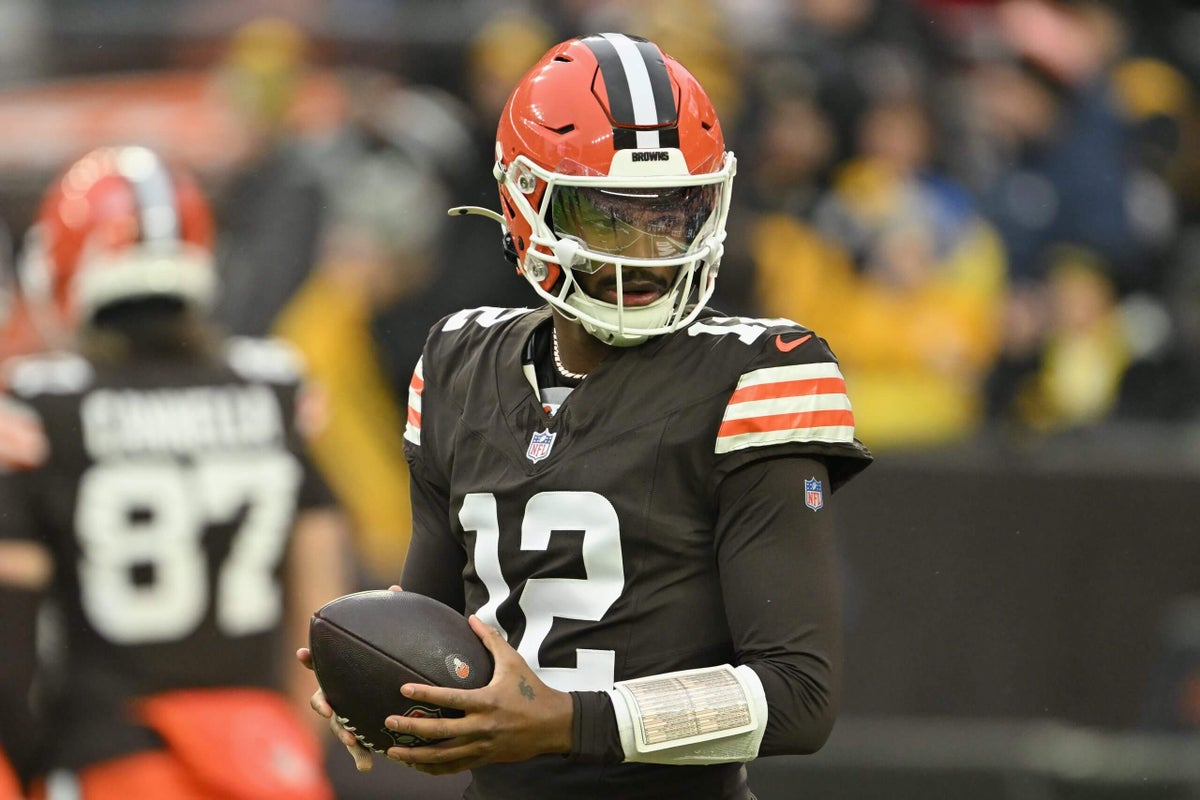
The first week of NFL free agency was a good one for Shedeur Sanders’ chances of claiming the Cleveland Browns’ starting quarterback job this summer.
With the formal offseason program still three weeks away, there’s no certainty about the early depth chart or the team’s plans for its quarterback room. The Browns spent most of their available free-agent resources on replacing departing offensive linemen.
At this still-early point, it seems safe to say that Sanders has at least some runway toward being the starter.
Let’s save the wild takes and proclamations for what’s likely going to be an annual reboot of an open quarterback competition. But let’s also pencil Sanders in as the most likely of the current group to take the race wire-to-wire.
Where it all goes remains to be seen. But Sanders should get the first crack at things as Cleveland proceeds through the offseason. And though the Browns aren’t going to share any of their current evaluations or future thinking publicly, their lack of quarterback activity can be viewed as a partial endorsement of a plan that involves letting Sanders operate as the incumbent and prove to new coach Todd Monken that he’s worthy of further development.
Sanders, 24, started the final seven games of his rookie season and went 3-4. He had good and bad moments, and though the bad seemed more frequent, the supporting cast was not good.
The Browns fired coach Kevin Stefanski for multiple reasons, including a lack of offensive output and player development, so this spring brings a new start. And in what Monken views as an open competition, Sanders is a more talented passer than fellow 2025 rookie Dillon Gabriel and a better long-term option than Deshaun Watson, who’s under contract only for 2026.
Earlier this month, the Browns reworked Watson’s contract to create more than $35 million in salary-cap space, a move made because the team could not afford to cut Watson and absorb a cap hit of around $80 million.
Watson last played in October 2024. He returned to practice for three weeks in December as part of his rehab plan from a twice-torn right Achilles tendon. But Watson did little in 19 starts for the Browns to indicate that he’s suddenly going to post a big season and elevate the offense the way Cleveland hoped he would when general manager Andrew Berry engineered what now stands as one of the worst trades in NFL history four years ago.
Berry remains in charge of the Browns’ roster, and they remain in a perpetual quarterback carousel after having five different starters in 2023, four in 2024 and three last season. Even if the Browns are mostly playing for the future in 2026 — and even if there is some internal belief that Watson would be ready if called upon — Sanders stands as the best current option.
Later this spring, it looks like we’ll get to see what he does with his chances to impress the folks in charge.
The other QB options
Our Browns quarterback tracker took last week off because it’s hard to predict when signings and trades will be made — and they often are made at strange times over the first 30-plus hours of the player movement period.
Though we were leaving open the possibility that the Browns would make a move, the Cleveland quarterback room remaining unchanged a week into free agency is only mildly surprising. Realistic options always seemed few.
Malik Willis got $45 million guaranteed from the Miami Dolphins. Any interest the Browns might have had in Kyler Murray was probably light. And Murray seemed to view the Minnesota Vikings as his best option.
Anthony Richardson wants the Indianapolis Colts to trade him, but that hasn’t happened. There might not be much of a market for Richardson, and he might ultimately prefer a year as a backup. We’ve circled Richardson, who turns 24 in May, as a potential fit for the Browns, but there’s been no movement on that front.
The Browns still have $86 million in cap commitments to Watson after 2026, so he’s going nowhere. It still seems unlikely that both Sanders and Gabriel will be on the team after the way last season went, but Monken wasn’t in charge then.
Watson spent the season in the quarterback room for meetings and most team activities, but he was never going to be a part of things on the field in 2025. So, we’ll see exactly what the dynamics are. But it seems a given that if the Browns don’t bring in another experienced quarterback, they’ll look to add to the room via the draft.
Monken spent three years (2020 to 2022) as offensive coordinator at Georgia, and in that time, he either recruited or coached against many of the quarterbacks in this year’s draft class. Alabama’s Ty Simpson is considered the best of the realistic bunch, with Indiana’s Fernando Mendoza viewed as the sure-fire No. 1 pick.
Monken’s relationship with Simpson’s father, Jason Simpson, goes back more than a decade. By the views of most draftniks, Simpson is going to be picked in the mid-to-late first round. LSU’s Garrett Nussmeier is next, potentially somewhere around pick No. 40. Then the rest of the class involves more of a projection.
In that next group are North Dakota State’s Cole Payton, Penn State’s Drew Allar, Clemson’s Cade Klubnik, Miami’s Carson Beck and Arkansas’ Taylen Green. Beck was a backup at Georgia for all three of Monken’s seasons there. Allar is a native Northeast Ohioan, and both Klubnik and Nussmeier were recruited by Monken on some level.
Over the next two weeks, almost all of the quarterback draft prospects will hold their pro day workouts. Last year, the Browns mostly held private meetings and workouts with quarterback prospects. It makes sense that the new head coach and play caller would be heavily involved with the quarterback evaluations, but we’ll see how things go.
Simpson made a formal pre-draft visit to the Browns’ facility in the first week of March. Presumably, other quarterbacks will also be on the visit schedule.
How to approach the draft
A week ago, the most experienced offensive lineman the Browns had under contract was Tyre Phillips, who has played in 47 career games but spent last season on Cleveland’s practice squad. The longest-tenured offensive linemen on Cleveland’s roster at the start of the player movement period were center Luke Wypler and tackle Dawand Jones, both of whom are entering the fourth and final years of their respective rookie contracts.
Now that the Browns added veteran linemen Tytus Howard, Elgton Jenkins and Zion Johnson, while re-signing Teven Jenkins to another one-year deal, the door is at least mostly open for them to use one of their draft picks — they have four in the top 70 and nine total — on a quarterback if the right one is available. The Browns almost certainly won’t be taking a quarterback at No. 6 in the first round, but they also hold pick Nos. 24, 39 and 70.
Assuming Sanders is the penciled-in starter, wide receiver and left tackle are the two most immediate needs for an offense that will continue to evolve in its personnel makeup and scheme. To go a little deeper, the Browns probably have three offensive line positions set once Elgton Jenkins gets healthy. Harold Fannin Jr. is the clear-cut starting tight end, Quinshon Judkins, once healthy, is the starting running back and Jerry Jeudy is one of the starting receivers.
More help is needed, obviously. The Browns will still draft at least two offensive linemen — at least one whose primary position is tackle. They may or may not select a center. Drafting at least two receivers feels necessary, and another tight end joining the group feels possible.
If the Browns want Simpson, they might have to either use pick No. 24 or do some maneuvering with their two first-round selections. For now, we can fairly say the team could get two necessary and immediate starters with its two first-round picks and then be in the quarterback market. If one of the first-rounders gets used on Simpson, he’d be considered an immediate contender to win the starting job — and certainly the favorite to finish 2026 as the starter.
Projections on Nussmeier are everywhere after he had a bad senior year. Any other passer in this class would be viewed as more of a developmental player than an immediate competitor, but the Browns’ track record on quarterback patience and playing order is as scattered as the depth chart has been.
Another quarterback battle will soon begin to take shape. Next draft season, we might be speculating all over again.