
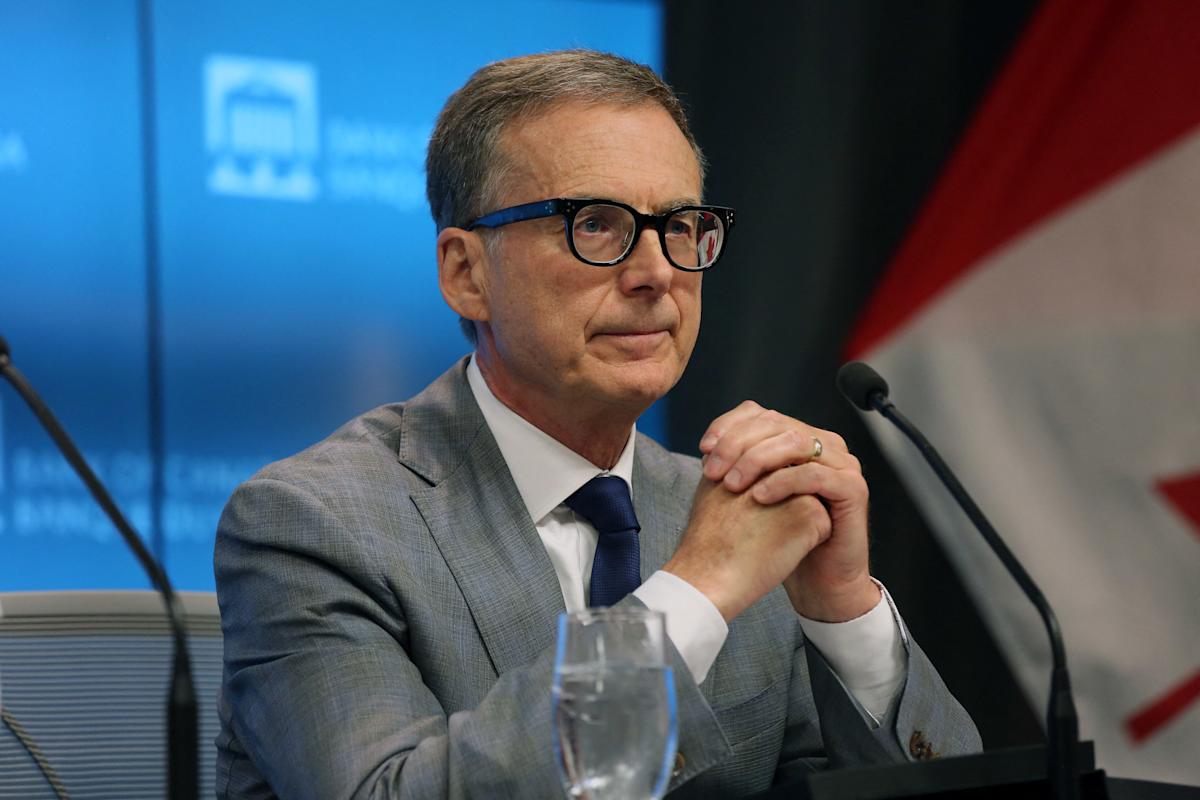
 Economists polled by Reuters were unanimous in their expectations for a hold today. (Photo by Dave Chan / AFP) (Photo by DAVE CHAN/AFP via Getty Images) · DAVE CHAN via Getty Images
The Bank of Canada (BoC) held its overnight interest rate steady at 2.25 per cent on Wednesday in a move widely expected by economists. The announcement comes as the central bank faces a daunting set of risks due to the war in Iran and ongoing uncertainty around the Canada–U.S.–Mexico Agreement.
In opening remarks published ahead of the news conference, Governor Tiff Macklem describes inflation as currently “contained” — but notes that “uncertainty is acute” and the BoC’s path is complex due to the Iran war and structural changes.
“Economic weakness combined with rising inflation is a dilemma for central banks,” the remarks say. “Raising interest rates to slow inflation could further weaken the economy. Easing interest rates to support growth risks pushing inflation well above target. Canada’s outlook is further complicated by structural change—shifting trade relationships, the adoption of AI, and changes in demographics.”
The Bank also addressed how risks increase the longer the conflict in the Middle East continues. “The longer this conflict lasts and the wider it gets, the bigger the risks,” the Governor’s prepared remarks state. “Governing Council will look through the war’s immediate impact on inflation but if energy prices stay high, we will not let their effects broaden and become persistent inflation.”
Economists polled by Reuters were unanimous in their expectations for a hold today. In its late January decision the Bank also held its policy rate stable.
Watch the press conference with Governor Macklem and Senior Deputy Governor Carolyn Rogers beginning at 10:30 a.m. ET.
Follow Yahoo Finance Canada’s live blog for news, updates and analysis of the Bank of Canada’s interest rate announcement below.
LIVE 31 updates
 Bank of Canada faces tough rate call as war risks clash with slowdown
The Bank of Canada is facing a “delicate balancing act” between the war in Iran and a slowing domestic economy, says CPA Canada’s chief economist David-Alexandre Brassard.
“With clear signs of economic weakness and the risk of a deeper slowdown growing, moving pre-emptively on interest rates would be a significant gamble,” he said. “While persistent oil-driven inflation could eventually force the Bank to prioritize price stability, we’re not at that point yet.”
Still, “economic fundamentals” remain weak, with GDP contracting in the fourth quarter, more than 100,000 private-sector jobs lost in 2026, and ongoing struggles in housing and international trade, he said.
 Path of least resistance
Bay Street investment firm Ninepoint Partners says the Bank of Canada’s decision to hold its policy rate in place today was the prudent call.
“For now, the path of least resistance is for them to do nothing,” vice president and portfolio manager Étienne Bordeleau-Labrecque stated in an email.
“If the energy shock from the war subsides and the economy doesn’t reaccelerate, I think we could see cuts later this year.”
Bank of Canada’s inflation tolerance could be tested as risks build
The Bank of Canada is likely to remain in a holding pattern in 2026 due to uncertainty around the Middle East conflict and U.S.-Canada trade policy, according to Oxford Economics.
“With the economy still in excess supply and signs of a deteriorating labour market, we think the BoC will likely wait out the storm and hold the overnight interest rate steady in a slightly stimulative territory at 2.25 per cent for all of 2026,” said Tony Stillo, director of Canada economics and Michael Davenport, senior Canada economist at Oxford Economics.
With inflation expected to climb above three per cent annually in Q2, the BoC’s tolerance for above target inflation will be tested, especially if macroeconomic concerns persist, Stillo added.
“The BoC doesn’t want a repeat of 2022-2023 post-pandemic period, when higher energy prices and global supply disruptions impelled it to aggressively hike interest rates.”
 A dovish lean, but uncertainty dominates: Desjardins Group
Desjardins Group economist Royce Mendes sees a dovish tilt in today’s announcement, noting the BoC’s decision emphasized economic weakness and suggested the risk of energy price inflation spreading “looks contained.”
Mendes noted the BoC’s release lacked key recent language that its policy rate “remains appropriate” provided its outlook remains accurate — language that had signalled the Bank’s comfort with holding steady at the two previous announcements.
That omission should be seen as “a mechanical change that was necessary because of the conditional nature of that forward guidance rather than a hawkish precursor to any near-term rate hikes,” Mendes said, with the Iran war meaning “their January forecasts look completely stale now.”
Given the high uncertainty, Desjardins doesn’t expect a rate change this year, despite the perceived dovishness.
‘The Bank can afford to be patient’: BMO
BMO’s top economist says time is on the side of Bank of Canada policymakers for now, as economic slack tempers inflation risk.
“The Bank can afford to be patient,” Doug Porter wrote following today’s decision. “Looking further out, we continue to believe the case for rate hikes is weak, given the overhang of trade uncertainty.”
At Wednesday’s BoC press conference in Ottawa, the Canada-U.S. trade war was largely overshadowed by the escalating conflict in the Middle East.
Speaking to reporters, Governor Macklem says the bank will be reluctant to let the initial impact of soaring commodity prices linked to the war in the Middle East affect its outlook for rates.
“Governing Council will look through the war’s immediate impact on inflation but if energy prices stay high, we will not let their effects broaden and become persistent inflation,” he said.
“Canada’s outlook is further complicated by structural change, shifting trade relationships, the adoption of AI, and changes in demographics.”
‘We need house prices to come down’: Rogers
“We need house prices to come down so that housing is more affordable,” BoC senior deputy governor Carolyn Rogers told reporters in Ottawa on Wednesday.
“We’ve all been worried about how fast house prices went up in recent years, and now we’re worried about how they’re coming down,” she added. “We do need them to settle down a bit for housing to get more affordable. There isn’t really a path to affordability, particularly in some of our big centres, without house prices correcting a bit.”
BoC sets sights on inflation amid manufacturing, housing turmoil
Canada is currently reeling from different economic impacts, including the influence of tariffs on manufacturing, high housing prices and rising mortgage renewals, while higher oil prices will benefit energy-producing regions.
BoC Governor Tiff Macklem emphasized, however, that the central bank has one target: inflation for the whole country.
“Our job is somewhat limited,” he added.
“Our inflation target is our ultimate beacon.”
War, weaker economy favour a ‘wait-and-see approach’: Monex Canada
The fog of war and a potentially weaker Canadian economy will keep the BoC on the sidelines, according to foreign exchange firm Monex Canada.
“On one side are the downside risks to growth stemming from domestic economic weakness which has become more pronounced since the start of the year. But this must now be weighed against upside inflation pressures resulting from conflict in the Middle East,” Nick Rees, Monex Canada’s head of macro research, wrote on Wednesday.
“For now, that balancing act favours a wait-and-see approach, as we warned it would in our pre-event note. Still, that is arguably more dovish than markets had expected, with the loonie under pressure as a consequence.”
Bank of Canada is using more ‘high-frequency data’: Rogers
BoC senior deputy governor Carolyn Rogers says the central bank is improving its use of “high-frequency” data to monitor the economic impact of fast-moving events like the war in Iran.
“We’ve gotten better at using high-frequency data,” she told reporters on Wednesday.
“That’ll help us detect this potential for prices to move from energy and other goods and services faster, and be able to react faster.”
Bank of Canada to stay on hold through 2026: ATB Financial
Facing a massive balance of uncertainty, the Bank of Canada will remain on hold through 2026. That’s according to ATB Financial economist Mark Parsons.
“We maintain our view that the Bank of Canada will stay on hold this year,” he wrote on Wednesday.
“The Bank is in a tricky spot,” Parsons added. “Keep in mind that even before the war, we weren’t expecting the Bank of Canada to come to the economic rescue by cutting rates. Other policy levers outside its control, like accelerating major projects, will need to be pulled.”
A Middle East war beyond two quarters would support case for rate hikes: Vanguard Canada
With no end in sight to the U.S.-Israel war against Iran, Vanguard Canada says the BoC could stray from the investment giant’s base case for a policy rate hold through 2026.
“If the Middle East conflict were to become protracted and persist for more than two quarters, the Bank of Canada would likely become more inclined to hike rates, as headline inflation could rise by roughly 75 basis points and core inflation by about 30 basis points,” investment strategist Ashish Dewan stated following Wednesday’s rate decision.
“The longer this conflict goes on, there is more potential for wider implications,” BoC Governor Tiff Macklem told reporters in Ottawa on Wednesday.
“Oil and natural gas are not the only commodities that go through the Strait of Hormuz,” he added. “Other petrochemical commodities, fertilizers, in particular, go through it, you know, if they’re blocked, that will have other global impacts.”
No clear debate on cuts or hikes, as ‘unknowable’ factors loom: CIBC
CIBC chief economist Avery Shenfeld says it’s clear from Wednesday’s BoC rate decision that policymakers gave little thought to either a cut or a hike today.
“It gave no indication that there was any debate on either cutting or hiking at this point, in line with its perspective that the implications of the energy price shock will depend critically on how long it persists, which simply is unknowable at this point,” he wrote on Wednesday.
BoC to downplay soaring oil influence on rate path: Corpay
Bank of Canada Governor Tiff Macklem on Wednesdayacknowledged the dual economic impacts of soaring oil prices — a squeeze for consumers, and a boost to energy exports.
However, Karl Schamotta, chief market strategist at Corpay, says the Bank may ultimately downplay this factor when it comes to deciding the path forward for its key rate.
On Wednesday, Macklem said it’s “too early to assess the impact of the (Iran) war on growth in Canada.”
Rate hold gives variable-rate borrowers breathing room, but risks still loom
The Bank of Canada’s rate hold means borrowing costs will remain unchanged, making variable-rate mortgages a tempting option for homebuyers.
“Today’s rate means variable mortgage holders won’t see any immediate change to their payments,” said Leah Zlakin, licensed mortgage broker and LowestRates.ca expert. “That gives homeowners and buyers a bit more stability as they plan their next steps, whether they’re renewing a mortgage or considering entering the market.”
Five-year fixed mortgage rates are currently about 0.35 percentage points higher than variable rates for insured borrowers and about 0.24 percentage points higher for uninsurable borrowers, she adds.
While variable rates can be cheaper than fixed rates now, borrowers should consider that rates could rise in the future, she says.
Housing market pressure to persist as BoC holds rates: Rates.ca
Slow demand in Canada’s housing market is set to continue as the BoC held its key lending rate today, according to an expert from financial product comparison website Rates.ca.
“Today’s rate hold isn’t likely to move the needle on the housing market in any significant way,” mortgage and real estate expert Victor Tran stated following the decision.
“While the hold means stability for variable mortgage rates, fixed mortgage rates are on the rise, which will affect renewals this year,” he added. “The prospect of higher mortgage rates coupled with economic uncertainty and the ongoing affordability crisis are likely to put downward pressure on the housing market.”
Key takeaways from Macklem’s prepared opening statement to be delivered at 10:30 a.m. ET
The Bank of Canada released prepared remarks to be delivered by Governor Tiff Macklem at the Bank’s live press conference at 10:30 a.m. ET today.
Here are some of the highlights:
On the U.S.-Israel war in Iran, and soaring energy prices:
“The war in Iran has added a new layer of uncertainty. Its impact on the global and Canadian economies will depend on how long the conflict lasts and the extent to which it spreads across the Middle East.”
“The longer this conflict lasts and the wider it gets, the bigger the risks. Governing Council will look through the war’s immediate impact on inflation but if energy prices stay high, we will not let their effects broaden and become persistent inflation.”
On inflation:
“Inflation in Canada has been close to the 2% target for more than a year.”
“The recent sharp increase in global energy prices is causing higher prices at the pump, which will push up inflation in the coming months.”
On the Canada-U.S trade war:
“We are continuing to assess the impact of US tariffs and trade policy uncertainty, and how the Canadian economy is adjusting.”
“Canada’s outlook is further complicated by structural change—shifting trade relationships, the adoption of AI, and changes in demographics.”
Price stability emphasized
The last word in the BoC’s statement is about inflation, with little change in language from the previous rate announcement:
“As the outlook evolves, we stand ready to respond as needed. The Bank is committed to ensuring that Canadians continue to have confidence in price stability through this period of global upheaval.”
Iran war impact on economy ‘highly uncertain’
“The war in the Middle East has increased volatility in global energy prices and financial markets, and heightened the risks to the global economy,” the BoC announcement says. “The breadth and duration of the conflict, and hence its economic impacts, are highly uncertain.”
Downside risks to economy, upside inflation risks due to oil: BoC
“With recent data pointing to weaker economic activity and uncertainty elevated, risks to growth look tilted to the downside,” the BoC’s rate announcement says. “At the same time, inflation risks have gone up due to higher energy prices. We will continue to assess the impact of US tariffs and trade policy uncertainty, and how the Canadian economy is adjusting.”
BANK OF CANADA MAINTAINS POLICY RATE AT 2.25 PER CENT IN THIRD CONSECUTIVE RATE HOLD
Correction: Due to a reporting error, a previous version of this story misstated the odds of a December hike from LSEG. It is at 73.2 per cent.