
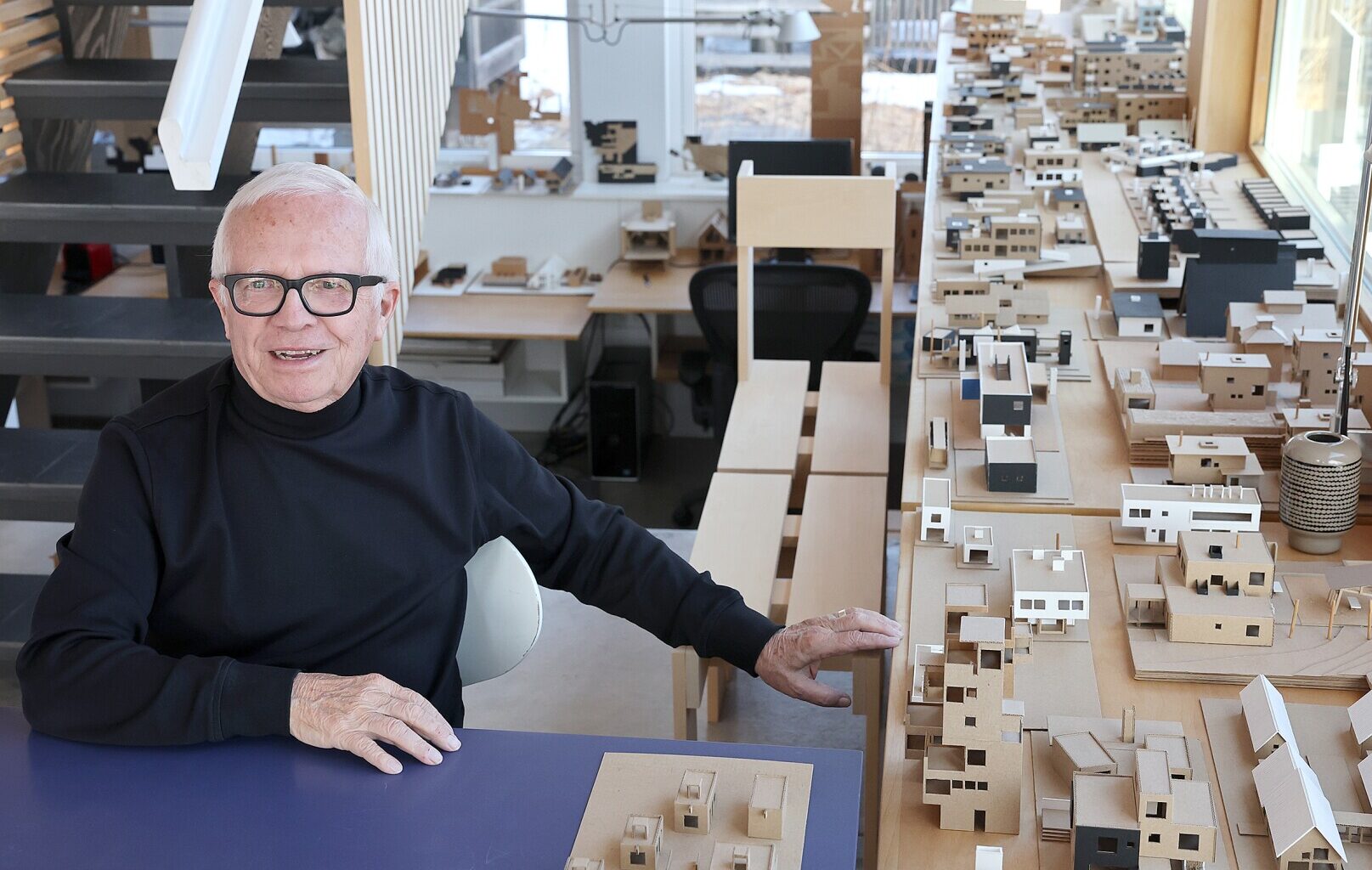
DULUTH — At 80, David Salmela admitted that he has made some concessions to age. He ends each workday at 4 p.m., “and I don’t start until 9” the next morning.
That still constitutes 88% of a full-time job with Salmela Architect, the small firm based in a Central Hillside office where the founder works at a drafting board overlooking the Aerial Lift Bridge. When it’s quitting time, he heads upstairs to the home he shares with his wife, Gladys Salmela.
“If you’re sitting in the sauna, you can see the boats come under the bridge,” David pointed out. Of course the couple’s home has a sauna, and a bathroom wall is adorned with photos of each of their grandchildren enjoying sauna for the first time.
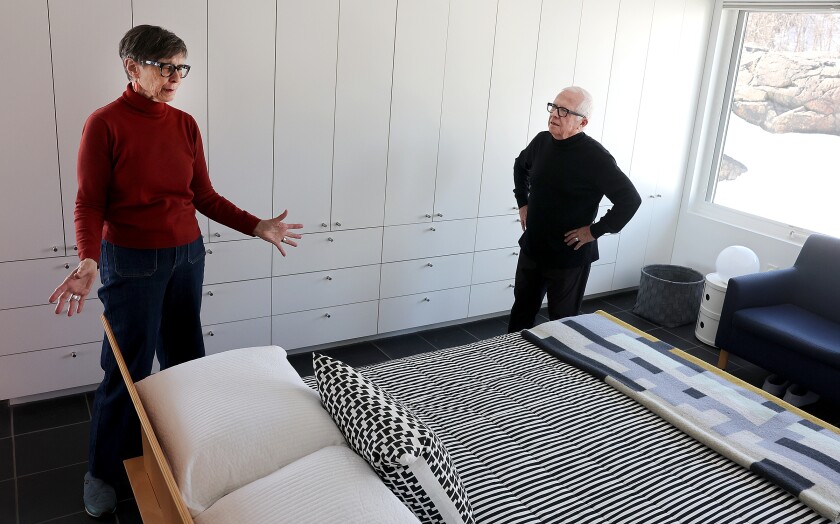
Gladys Salmela, left, talks about placing their bed in the center of their bedroom as her husband, architect David Salmela, listens during a tour of their Duluth home.
Jed Carlson / Duluth Media Group
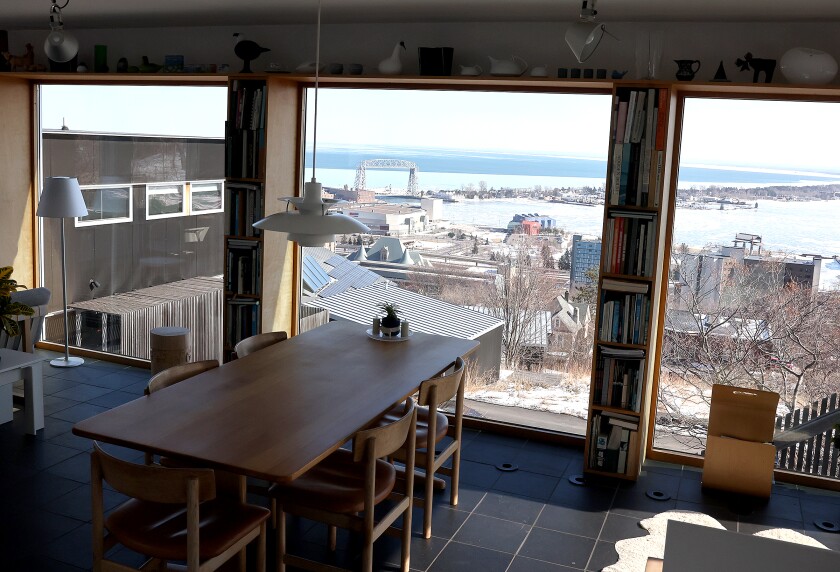
The Aerial Lift Bridge can be seen out of the large windows in the Salmelas’ home.
Jed Carlson / Duluth Media Group
“Five children, five spouses and nine grandchildren,” Gladys enumerated, gesturing to the living room. “Hence the big open space, because when we’re all together, it needs to be a big space.”
The home and office are part of the Clure Development, a residential project along the historic route of Duluth’s Incline Railway. The Clure homes are readily recognizable by their black Richlite Slate siding. That’s the same paper-based material used to make
and it’s become one of David Salmela’s favorite materials.
Richlite’s makers balked when Salmela first proposed using it for exterior siding in the Northland’s extreme conditions.
“They said, ‘We don’t want you to do this … it has no warranty on it!'” he remembered. “I said, ‘Well, it’s so good, it doesn’t need a warranty.'”
Is David Salmela to Richlite what Frank Gehry is to stainless steel? “Maybe!” Salmela laughed at the suggestion. That said, “Frank Gehry is much more programmatically progressive. This was just common sense.”
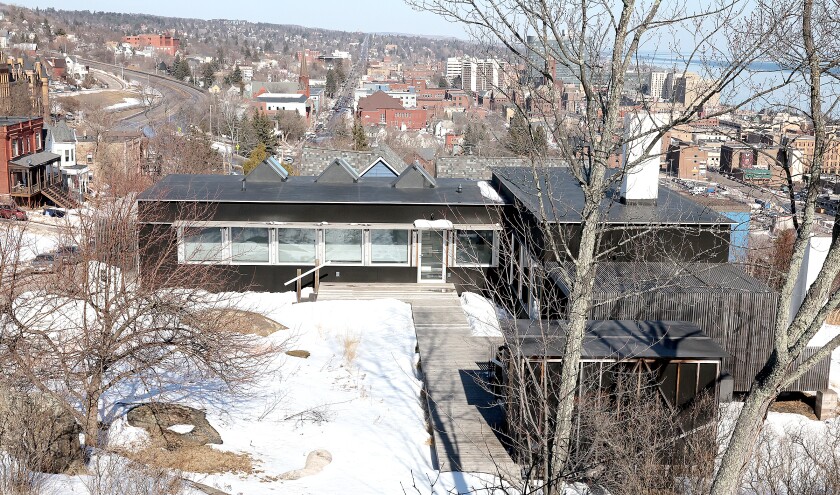
A home designed by architect David Salmela and the Duluth hillside can be seen from the third floor of the architect’s home.
Jed Carlson / Duluth Media Group
Salmela has a knack for creating livable spaces inspired by modernist ideas and his own Finnish culture, suffused with a sense of quiet joy and the occasional touch of whimsy. That gift has brought him international recognition and hundreds of commissions.
“He is arguably the most widely known architect in Minnesota,” said Kai Salmela, David’s son and a fellow architect at the family firm. “He’s definitely one of the most influential architects in the region.”
Raised on a farm in central Minnesota’s “Finnish Triangle,” David Salmela landed his first architecture job in Hibbing in 1969 and lived on the Iron Range until 1989, when he moved to Duluth. Despite his renown, Salmela has never even considered leaving the area.
“Moving to New York City was not something that he grew up ever thinking would be a possibility,” Kai Salmela said. “That’s not something that he would entertain.”
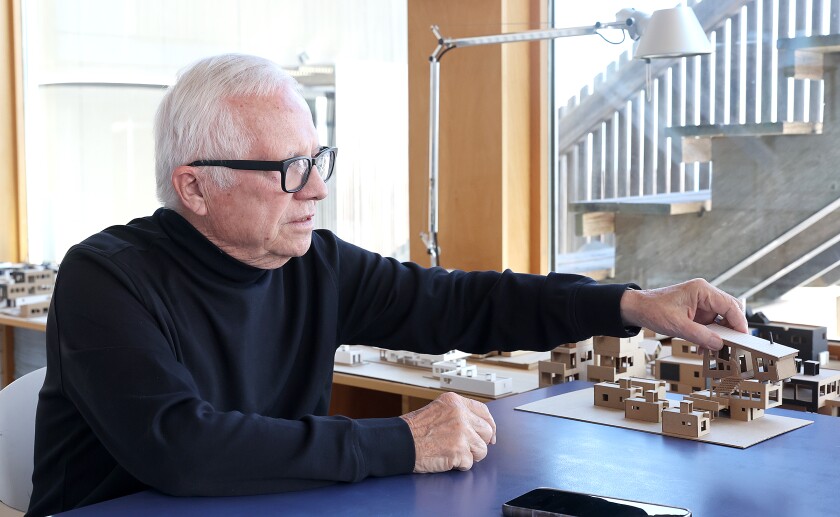
David Salmela talks about a model of a sauna he designed.
Jed Carlson / Duluth Media Group
Being called a “regional architect” might sound like backhanded praise, but it’s something David Salmela has “definitely embraced,” Kai said. Most of David’s work has been in the Upper Midwest, where he has approached his projects with the sensitivity to seasonal swings and rugged landscapes that has more broadly characterized the tradition of Scandinavian modernism.
“The idea is to address the terrain of the land, the culture of the people who came here, the culture of the people who are here now, and a common-sense logic of how to build things and build things affordably,” David Salmela said.
It’s no surprise that, in Kai Salmela’s estimation, one of his father’s most characteristic projects is a sauna.
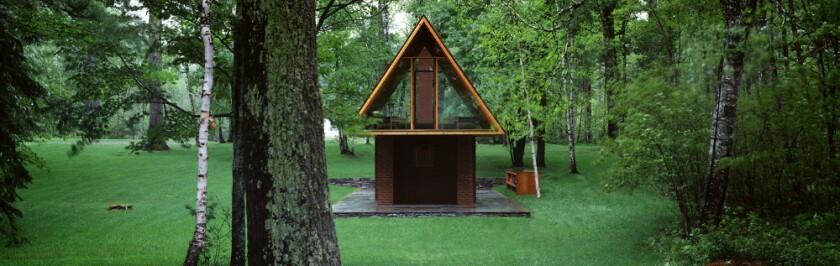
Architect David Salmela’s Emerson Sauna has a triangular cooling room positioned atop a curved brick wall.
Contributed / Salmela Architect
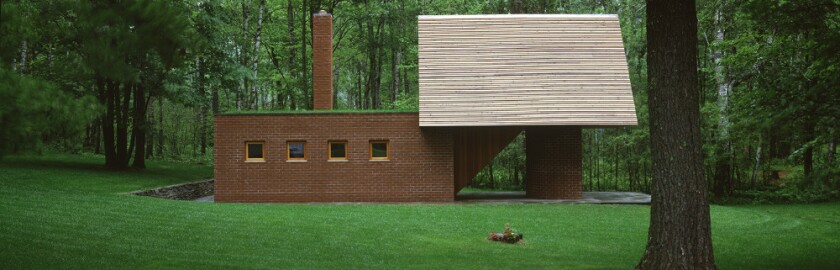
In the Emerson Sauna, a sod roof tops the sauna chamber at left. To the right is a raised, triangular room for cooling or sleeping.
Contributed / Salmela Architect
Built on the private property of a client near Duluth, “it’s made up of three primary geometric volumes,” Kai explained. “A rectangle, which is a sauna; an extruded triangle, which is a roofed cooling structure; and then a half-circular brick form that holds up that cooling porch, and it becomes the outdoor shower.”
To Kai, “the functions of the sauna are expressed in these pure geometric forms in a very functional way … it has this elemental quality to it.”
While David Salmela’s private homes and cabins make strong impressions against a northwoods backdrop, his public buildings tend to be hidden in plain sight. Northlanders may have spotted his
unconventional miniature golf course
at Spirit Mountain, or may have visited the Gooseberry Falls Visitor Center without realizing it was a Salmela design.
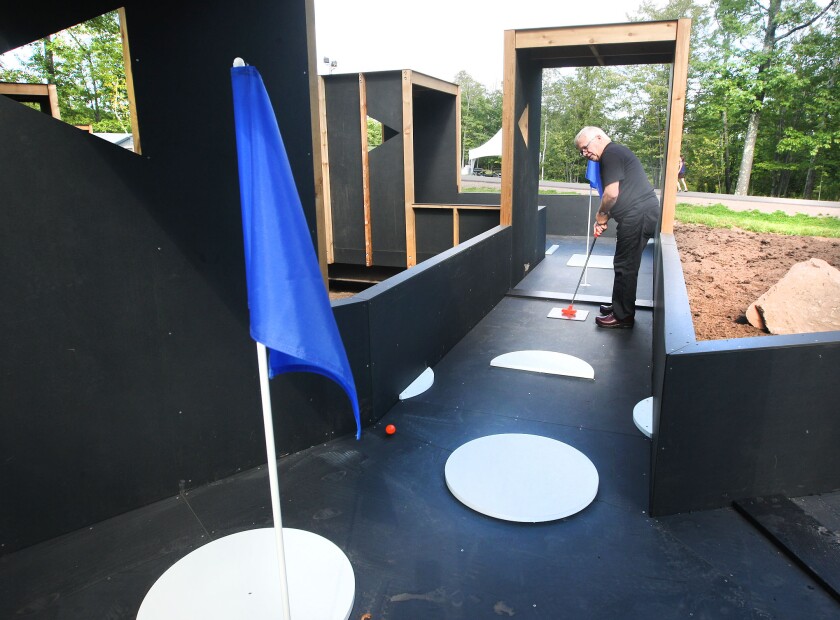
David Salmela plays the miniature golf course he designed at Spirit Mountain, shortly after the course opened in 2011. The walls lining the course function “like a cattle chute,” Salmela said at the time.
Bob King / Duluth Media Group file photo
Among Salmela’s buildings, the one that has likely been seen by the greatest number of people is the former Izzy’s Ice Cream headquarters near Gold Medal Park in downtown Minneapolis. (The building remains, though it closed as an ice cream shop in 2020 and was subsequently sold.)
Salmela reached into his capacious files and produced a newspaper in which an advertisement spotlighting the area features a glimpse of his building tucked into an aerial view. “For a joke, I would show this,” Salmela said. “Look, we even made the newspaper in the Twin Cities!”
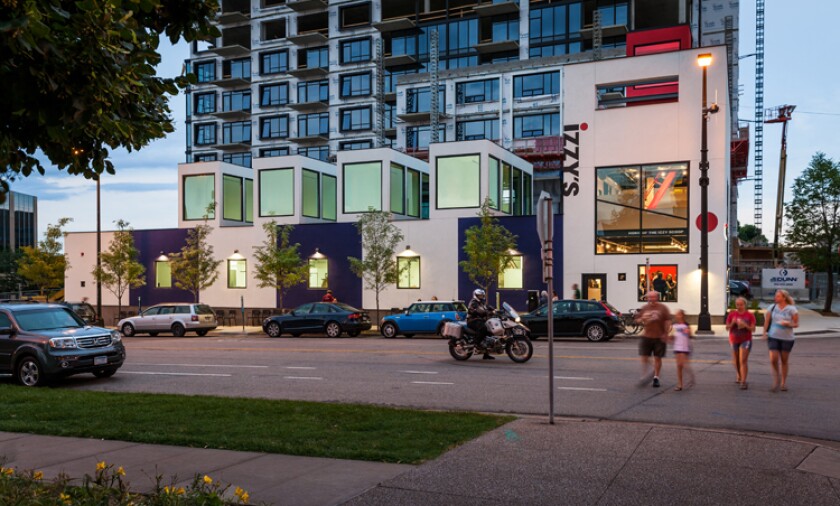
The headquarters and retail location David Salmela designed for Izzy’s Ice Cream in Minneapolis opened in 2013. The building closed amid pandemic pressures in 2020 and was subsequently sold. Fortunately, Salmela said, the new owner “loves the building” and does not want to make inappropriate changes.
Contributed / Salmela Architect
In fact, Salmela has received extensive press coverage in the Twin Cities and well beyond. Still, he cites his Finnish heritage as a basis for his general aversion to publicity.
“Under normal circumstances, my instinct would be not to meet you,” he told a News Tribune reporter. “But my wife said, ‘Well, I think you should.’ And my son said there is an obligation to show what we do … to show what can be done.”
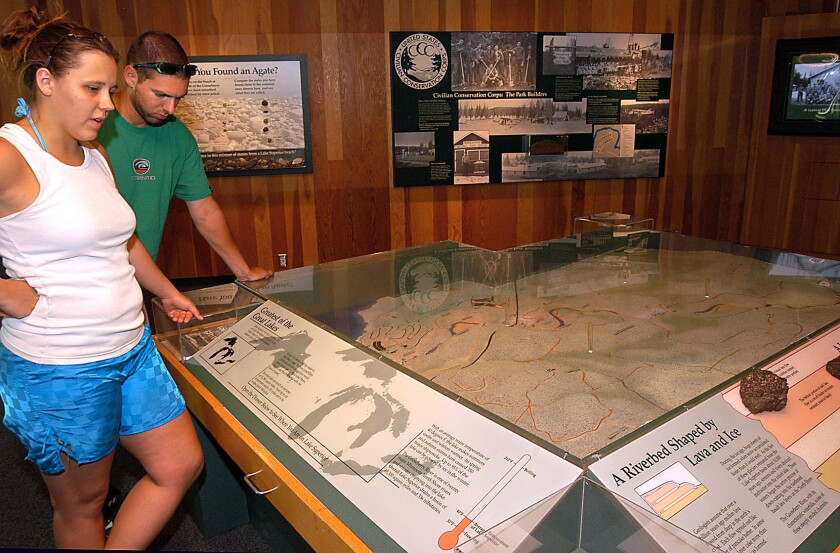
Warm wooden walls line David Salmela’s Joseph N. Alexander Visitor Center, seen here in 2005, at Gooseberry Falls State Park.
Michele Jokinen / Duluth Media Group file photo
To say that Salmela shuns self-promotion is not to say he’s shy.
“He is a man of short stature, but he has a very big and welcoming and optimistic and very curious personality,” Kai Salmela said. “He’s always looking to meet people, talk to strangers, find out about people’s stories.”
Being a good listener is part of what makes David Salmela a great architect, in his son’s estimation. David has a way, said Kai, of “understanding the terrain (and) the climate, and connecting that with the specificity of each person in the (client relationship) and where they come from, and doing it in a way that still has a universality to it.”
David pointed to his Jackson Meadow development in Marine on St. Croix, Minnesota. Over the past quarter-century, Salmela has designed about 100 buildings in the development: some 40 homes and their associated structures.
“The first rule was nothing could be wider than 24 feet wide, and most of the buildings are under that,” he explained. “Then we did a standing metal seam 12/12 pitch roof, and then all the houses were painted white.”
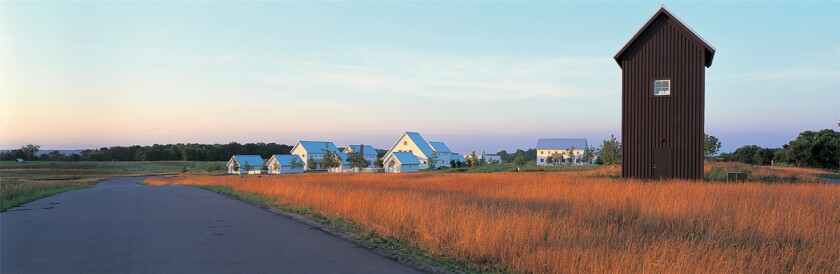
Approximately 100 structures designed by David Salmela constitute the Jackson Meadow community in Marine on St. Croix, Minnesota.
Contributed / Salmela Architect
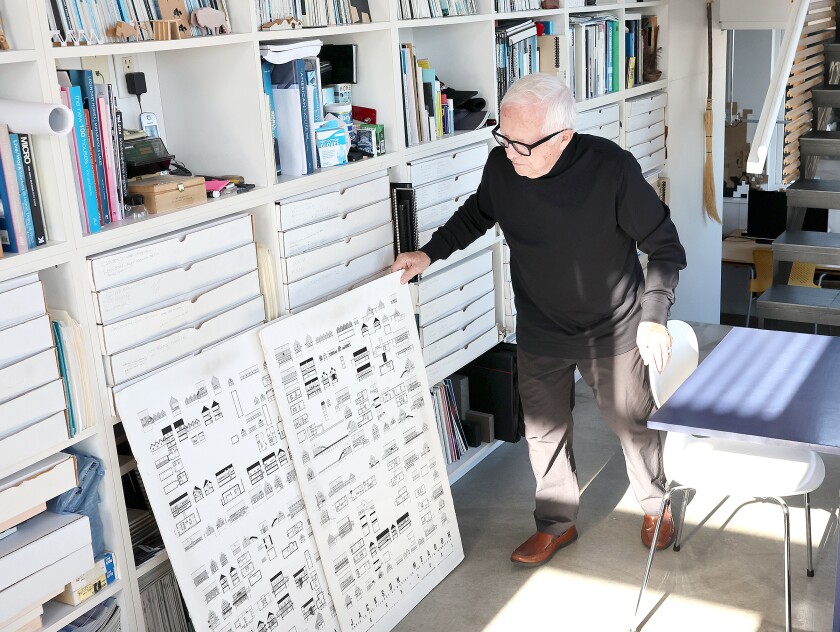
David Salmela moves concept drawings of homes in Jackson Meadow.
Jed Carlson / Duluth Media Group
The idea was not to create a cookie-cutter effect — far from it.
“There is a harmony, but there are no two buildings that are alike,” Salmela said. “They’re all different.”
Locally, the Salmela name isn’t only associated with excellence in architecture — the children and grandchildren of David and Gladys have excelled in both athletic and artistic endeavors.
Kai Salmela and multiple siblings found success in biathlon, with
competing on the national team and Cory Salmela becoming a leading coach in the sport. David Salmela’s grandchildren include Duluth stage stars
and
“Doing things well — for the sake of your own pride and for the sake of doing things well — definitely comes from our father,” Kai Salmela said. “One of my dad’s sayings is, ‘If it’s worth doing, it’s worth overdoing.'”
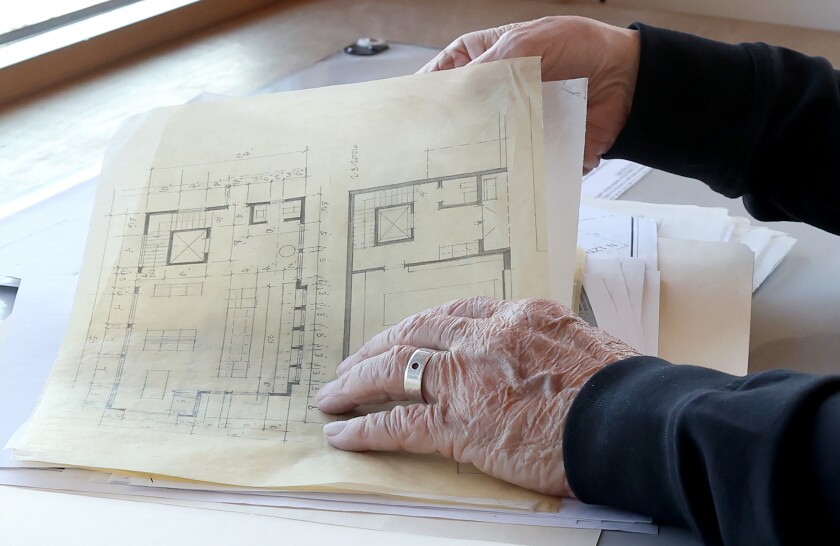
Architect David Salmela leafs through sketches at his desk in his home office in Duluth March 2.
Jed Carlson / Duluth Media Group
What David Salmela did not emphasize was a rush to higher education; he himself does not have an architecture degree. Hired into the profession based on his drafting and engineering experience, Salmela seized opportunities to do design work and soon began winning awards.
“They realized I could do that, and they couldn’t argue it,” Salmela remembered about his years with other firms, designing buildings like the Finnish folk house he created in the 1980s for
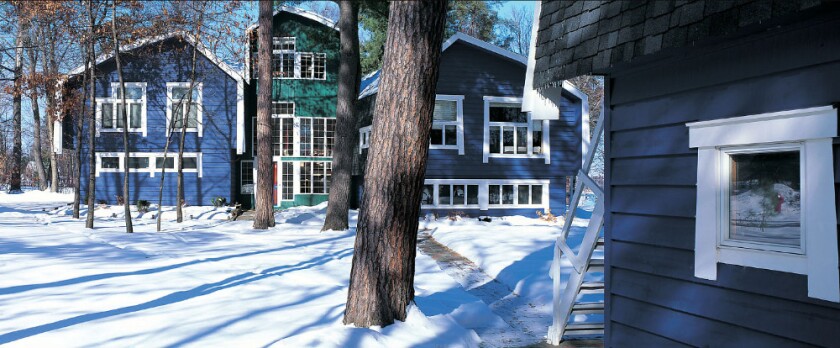
The Wick Studio and House was recognized with an AIA Minnesota Award in 1985, auguring a bright future for architect David Salmela.
Contributed / Salmela Architect
“This won the highest award in Minnesota, and everybody was shocked,” remembered Salmela, who was then still on the Iron Range. “In fact, the Duluth office of the firm, they were kind of p—ed off. Why? … Because no one had won an AIA Minnesota Honor Award outside of the Twin Cities for 25 years.”
Sitting in his office surrounded by working models of his buildings, Salmela could only hazard a guess as to how many structures he has designed. “Somewhere between 500 and 1,000,” he estimated. “It’s really hard to say how many there are, but there are a lot of them, and the key is to try to put meaning into each one.”
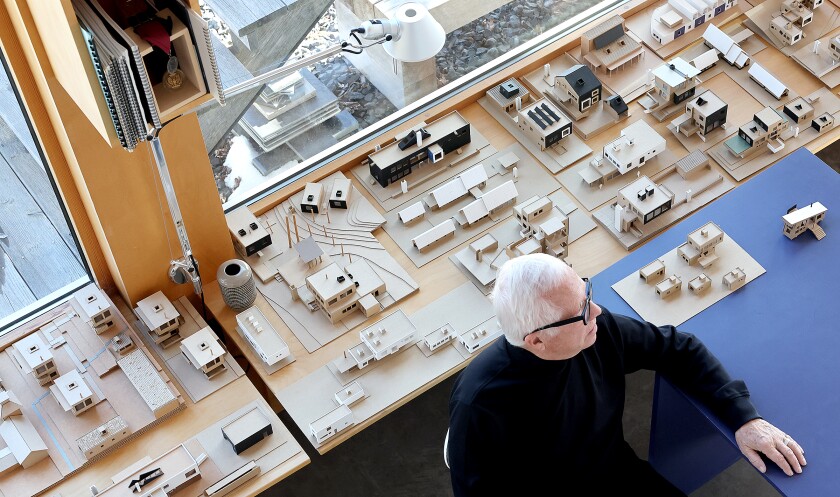
Architect David Salmela is surrounded by models of his designs as he talks about his career in his home office in Duluth March 2.
Jed Carlson / Duluth Media Group
“His influence is recognized globally,” Kai Salmela said. “I’ve come across architecture students from Portugal who say David is one of their favorite architects.”
One of David Salmela’s fond memories involved an AIA Minnesota event at the
he designed for the University of Minnesota Duluth.
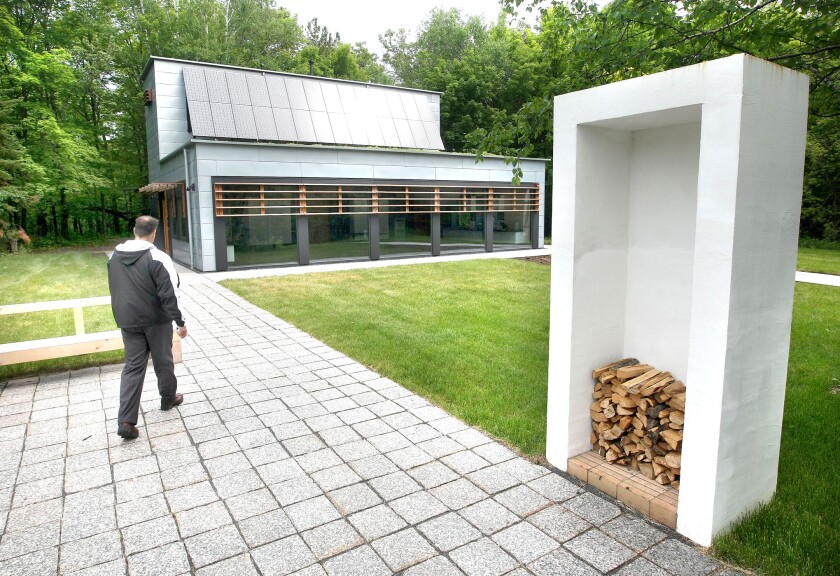
David Salmela designed the University of Minnesota Duluth’s Bagley Outdoor Classroom, seen here at the time of its opening in 2010.
Bob King / Duluth Media Group file photo
“They had a tour to see the building — the architects (did) — and there was a family that came with their kids and they lit a fire in the fireplace and they were sliding down the hill to the pond,” Salmela remembered. His peers “just couldn’t quite believe it. They asked, ‘How much did you pay them to come?'”
The people weren’t models, Salmela explained. They were just ordinary community members making use of a space the Duluth architect had designed for their enjoyment. “They do use it,” said Salmela, with quiet satisfaction.
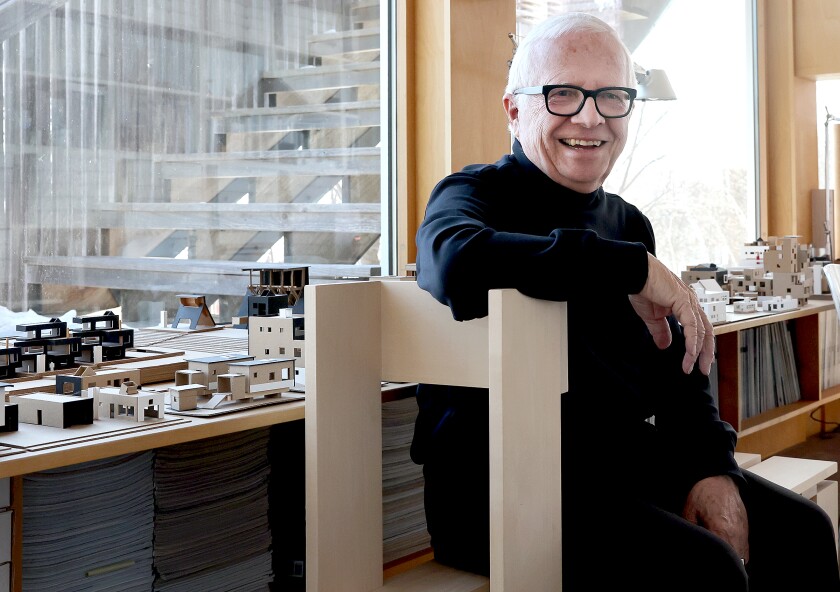
Architect David Salmela smiles as he sits on a bench he designed.
Jed Carlson / Duluth Media Group