
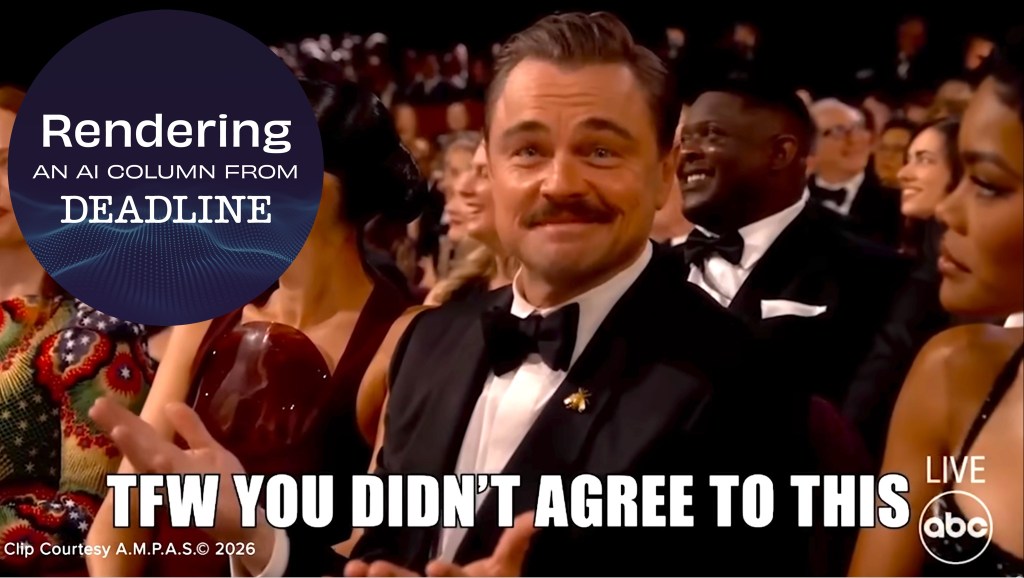
Welcome to Rendering, a Deadline column reporting at the intersection of AI and showbiz. Rendering examines how artificial intelligence is disrupting the entertainment industry, taking you inside key battlegrounds and spotlighting change makers wielding the technology for good and ill. Got a story about AI? Rendering wants to hear from you: jkanter@deadline.com.
Confession: I didn’t watch the Oscars on Sunday night. You may say this is an act of professional negligence for a Deadline journalist, but the reality is, my LA colleagues don’t need a sleepy Brit on hand when they are already dominating at The Dolby Theater.
Slumbering through a global spectacle like the Oscars inevitably means waking to a deluge of news reports, videos, and pictures from the ceremony and its fringes. You can turn to the trusted pixels of Deadline, or any number of our rivals, to digest what went down, but social media usually provides the ultimate dopamine hit.
So when I logged in on Monday morning, I was hungry for viral treats. Conan O’Brien’s gag about the absence of British acting nominees — fun. Leonardo DiCaprio cementing his status as the “King of Memes” — delightful. Kieran Culkin going off script to call out Sean Penn’s no-show — great gear. I’m here for it all.
But when I was inspecting the array of off-stage clips, I found something catching in my brain. A seed of doubt. A sniff of skepticism. A question: Is this real? It’s a question that I need not have asked maybe even as recently as a year ago. But such is the startling sophistication of artificial intelligence, and the reckless abandon with which it is deployed to deceive online, cynicism seems a healthy side-dish to many viral moments.
We’re at the point where a Spanish Instagram user can deepfake photos of Zendaya and Tom Holland’s wedding that are so convincing, they dupe personal associates of the Spider-Man stars. So what chance do we have when grifters turn their attention to the Oscars and get prompting for engagement?
You need not look far for fakery. Let’s start with the Instagram user who fooled Zendaya and Holland stans. He pumped out at least two plausible images from the Academy Awards, including Robert Downey Jr. and Chris Evans huddling up with a proud Michael B. Jordan, and a group photo of Marvel universe actors. Wholesome content, but entirely concocted. The images do not exist on Getty, and contain tell-tale details that reveal their AI origins, not least Pedro Pascal sporting a moustache, which he famously shaved for the 2026 Oscars. The photos’ dubious provenance did not stop them amassing more than 200,000 likes.
Over on the wild west of X/Twitter, a picture of Nicki Minaj walking the red carpet in a MAGA hat went semi-viral (because of course it did!), while others riffed on Timothée Chalamet’s ballet comments by dressing the Marty Supreme actor in a tutu. Both certifiably fake. Others were more imperceptible, like Rihanna on the red carpet with a baby bump. This alone got 7M views, and why? It’s just so basic.
The majority of these examples are harmless, and probably frivolous in a world in which deepfakery is now a war strategy, but they all contribute to a degrading of our collective experience.
The AI dross made me question the authenticity of joyous moments, like Michael B. Jordan celebrating his Best Actor triumph by hugging it out with DiCaprio and then inhaling an In-N-Out Burger. It also casts doubt over genuinely questionable incidents, like Teyana Taylor’s altercation with an Academy security guard.
For me, it’s hard to escape the feeling that AI has ruined the innocent internet fun around events like the Oscars. And it’s depressing to realize that the technology is only getting better, making the fakes harder to fish out. No one wants to delight in these deeply human celebrations, only to be told, in the immortal words of Zendaya, “Babe, they’re AI.”