
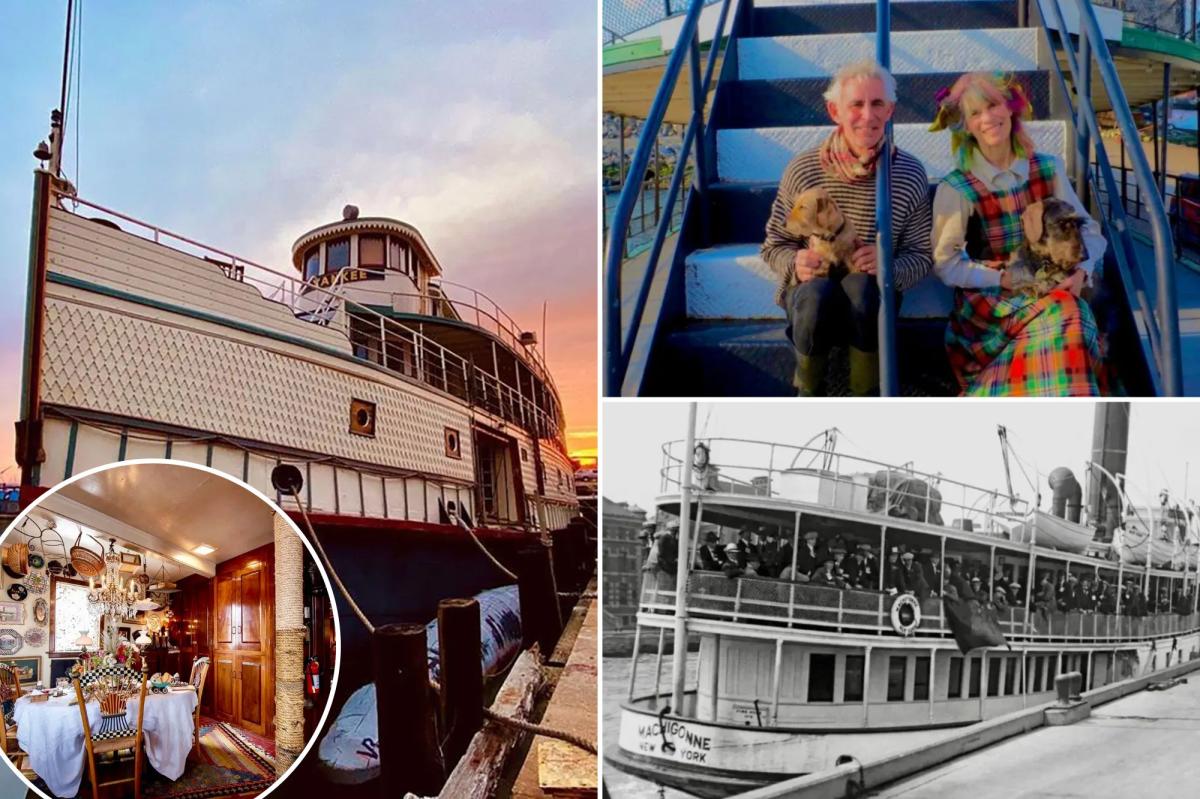
The final voyage of the Yankee Ferry is turning into an elegy.
The storied 1907 vessel — the last surviving Ellis Island ferryboat — is back on the market for $1.25 million after the death earlier this month of designer Victoria MacKenzie-Childs, whose eccentric imagination helped transform the retired steamship into one of the strangest and most romantic homes in New York.
Moored now in Staten Island, the 150-foot iron-hulled boat is part immigrant-history relic, part floating artwork, part family archive.
For nearly a quarter-century, the ferry served as the live-work refuge of MacKenzie-Childs, who died at age 77, and her husband, Richard, the design duo behind the whimsical aesthetic that made their name famous.
The Yankee Ferry, the last surviving Ellis Island ferryboat, is back on the market for $1.25 million following the recent death of designer Victoria MacKenzie-Childs. victoriaandrichardemprise.com
Moored in Staten Island, the 150-foot, 1907 vessel was transformed by Victoria and her husband, Richard MacKenzie-Childs, into a whimsical floating residence and studio after they bought it in 2003. victoriaandrichardemprise.com
What they bought in 2003, for about $300,000, was not just a boat, but a battered survivor with a past stretching from Gilded Age leisure travel to wartime service to the immigrant journey through New York Harbor.
What they created was something far more intimate: a sprawling four-level, roughly 10,000-square-foot vessel layered with pattern, color, oddity and memory.
The ferry also served troops during the World Wars. victoriaandrichardemprise.com
Inside, the scale of the ship still surprises. A former grand salon — once used to entertain passengers in its early 20th-century heyday — now reads like a theatrical ballroom, with soaring ceilings, wide-plank floors and sweeping sightlines across the deck.
Original maritime details remain embedded throughout, from the working wheelhouse to industrial beams and portholes, while the MacKenzie-Childs layered in their signature touches — painted finishes, patterned walls and unexpected materials — turning cavernous communal spaces into something between a historic hall and an immersive art installation.
Now, with Victoria gone and Richard unable to speak after a stroke, the family is confronting the question that has hovered around the ferry for years: who, exactly, takes on a vessel like this next?
Gregor Collins, a close family friend helping with the sale, said the ferry is no longer being marketed through a traditional brokerage and is instead being offered more informally to buyers who understand what it is — and what it demands.
“It’s not officially listed anywhere other than the media and sort of me reaching out to people,” he told The Post.
The boat seen carrying immigrants to Ellis Island in 1923. victoriaandrichardemprise.com
That unusual sales process fits a property that has never belonged comfortably to the ordinary real estate market. The Yankee has been offered on and off for years, sometimes with outside representation, sometimes not. It was initially listed for $3 million, but steadily decreased. The current ask returns it to the same $1.25 million figure it carried more than a decade ago, even as its legend has only grown.
A 1907 survivor that carried millions — and now holds one family’s story
Long before it became a maximalist floating home, the vessel had already lived multiple American lives.
Built in Philadelphia in 1907, it first carried affluent summer passengers in New England waters before being pressed into military use during World War I. Later, in New York Harbor, it transported immigrants to Ellis Island and also carried passengers to Liberty Island.
Most of the ferries that once carried passengers to Ellis Island — which operated until its closure in 1954 — were eventually retired, scrapped or left to decay. The main vessel, aptly named Ellis Island, met a more dramatic fate, sinking in a storm in 1968 before its remains were finally removed decades later in 2009. Now, only The Yankee remains.
By the early 1990s, after years of decline, it had landed on the National Register of Historic Places.
The Yankee had fallen into disrepair when it was acquired by private owner Jim Gallagher, who towed the aging vessel to Pier 25 in Tribeca and began an ambitious restoration.
The historic ship is now being cared for by the couple’s daughter, Heather Mackenzie-Chaplet, who said she hopes its next life will allow more people to experience and celebrate its layered New York story. victoriaandrichardemprise.com
The ferry occupies roughly 10,000 square feet. victoriaandrichardemprise.com
In a rare arrangement, local authorities allowed him to live aboard while carrying out the work, offsetting costs by hosting weddings and private events on the ship. Two years later, the ferry earned a place on the National Register of Historic Places.
In 2003, the MacKenzie-Childses acquired it after financial setbacks left Manhattan property out of reach and after the ship had already endured years of deterioration, displacement and piecemeal restoration.
Heather Mackenzie-Chaplet, Victoria’s daughter, is now living aboard with her husband, Nils, as the family tries to steady the ship and guide it toward whatever comes next. Victoria had dealt with the shipyard to dock their boat for $4,000 a month, according to Collins, with separate upkeep costs not included.
“We’re living here and checking on it,” she told The Post, “and mainly just, you know, trying to make contacts with everybody we need to in order to find out how it’s going to go on to its next chapter in life.”
That next chapter, she hopes, is bigger than a private sale.
“What would make me the happiest would be that it becomes a place where it’s celebrated,” Heather told The Post.
Still, she is pragmatic about the outcome. “If it just is goes on to be somebody’s home, that’s fine as well,” she said.
Mackenzie-Childs and her husband purchased the ferry after they lost their company and couldn’t afford Manhattan real estate. Gregor Collins
Heather Mackenzie-Chaplet (C) with her daughter (L) and mom, Victoria Mackenzie-Childs (R). Courtesy of Heather Mackenzie-Chaplet
They spent decades transforming the deteriorating ship into a whimsical, maximalist home and studio filled with their signature patterns and theatrical touches. victoriaandrichardemprise.com
That flexibility is practical. The Yankee has always required a believer, but also a realist. Owning a 118-year-old metal vessel in salt water is less like buying a trophy townhouse than taking custody of a high-maintenance historic structure that happens to float. Over the years, the ferry’s caretakers have grappled with restoration costs, structural upkeep and rising dockage fees as the ship moved from Tribeca to Hoboken to Brooklyn and eventually Staten Island.
Heather does not sugarcoat it.
“It hasn’t been easy ever,” she said. “It’s a boat, so it’s always sort of battling with the elements. It’s a metal boat sitting in a salt water.”
Even so, the MacKenzie-Childs family never treated the ferry as a burden alone. It was a canvas.
Inside, the couple overlaid the ship’s industrial bones with stripes, florals, rope chairs, painted finishes, salvaged objects and theatrical flourishes that turned cabins and corridors into immersive sets.
The Mackenzie-Childs family on the boat. Courtesy of Heather Mackenzie-Chaplet
Despite its artistic significance, the ferry has long been expensive and difficult to maintain, with high docking fees and ongoing restoration needs. victoriaandrichardemprise.com
The ferry has cycled on and off the market for years, most recently priced around $1.25 million. victoriaandrichardemprise.com
Plumbing parts, piping and utilitarian materials became lamps and decorative gestures.
“They would kind of mix up the definitions” of what counted as refined and what counted as functional, she said, “always with a lot of sense of humor as well,” Heather said.
For the family, the ship was never just a design object. It was lived in, and celebrated on. There were gatherings, and even a children’s theater camp in its earlier downtown days.
The deck. victoriaandrichardemprise.com
The grandchildren of Victoria MacKenzie-Childs seen playing on the pier in front of the Yankee ferry. Courtesy of Heather Mackenzie-Chaplet
Among the traditions she recalled were Epiphany parties full of costumes and laughter, and long meals punctuated by her mother’s love of song.
“She would always have a pile of hymnals next to the table, and we would all sing hymns before eating or after eating, or both,” Heather said.
“It’s not the same, not the same without them on the boat,” Heather said.
Collins said Victoria’s death stunned those close to her. “It was shocking,” he told The Post. “She was such a powerhouse.”
He said Richard is now surrounded by family, while Heather and Nils arrived in New York just days after Victoria died and have remained aboard since early March, caring for the vessel.
The ferry offers multiple dining and living spaces throughout. victoriaandrichardemprise.com
An interior look at the ferry. victoriaandrichardemprise.com
For all its rarity, the Yankee’s appeal may lie less in its specs than in its collision of national history and personal mythology. Few properties can claim to have carried immigrants, soldiers and vacationers before ending up as the fantasy residence of two artists who had already lived through fame, collapse and reinvention. Fewer still can plausibly become a home, museum, event venue, restaurant, boutique hotel or civic attraction depending on who takes the wheel.
Heather, for her part, seems most interested in the idea that the ferry has never stopped adapting.
“It’s been a boat that has really served each generation of people,” she said, and that long sequence of reinvention is “so beautiful to see.”
That may be the most fitting way to understand the Yankee now. Not as a stranded relic, and not merely as an eccentric listing, but as a vessel in transition once again — carrying the imprint of Victoria MacKenzie-Childs, and waiting for someone bold enough to decide what it becomes after her.