
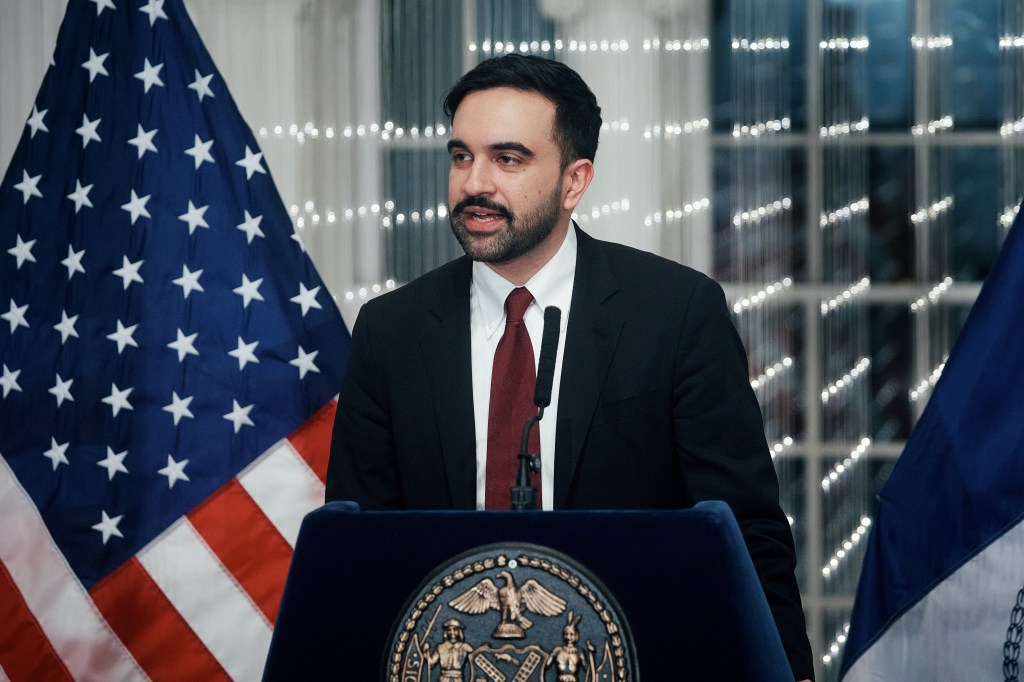
Mayor Mamdani announced a new Office of Community Safety on Thursday — marking a step towards fulfilling his campaign pledge to change how the city responds to mental health crises. But the move is more a reshuffling of existing resources than the implementation a fundamentally new approach.
As a candidate, Mamdani pledged to create a Department of Community Safety to lift responsibility from cops in responding to mental health emergencies while also playing civilian functions in fighting the homelessness and gun violence crises. He said the agency would have around a $1.1 billion annual budget.
The new office, created Thursday through an executive order, includes no new programs, instead realigning organizational charts so that existing city efforts in mental health and violence prevention report to a new Deputy Mayor for Community Safety, Renita Francois.
“This will demand a multifaceted approach to a wide array of challenges across the city. It will require ambition, compassion and competence, and I am lucky, because I can think of no one better prepared to deliver exactly that and assume exactly this responsibility than Renita,” Mamdani said at a pep-rally style announcement at City Hall.
The OCS will begin with a budget of roughly $260 million moved from those existing programs, according to the mayor, though the administration is expected to add more funding in the upcoming executive budget proposal.
Mamdani declined to share how much he’d like to earmark for the office in the upcoming fiscal year’s budget, simply saying the office will have “a budget that will increase.” He also said the office would hire more people in the future, without providing a timeline.
On the campaign trail, Mamdani’s proposal sparked concerns about how mental health response teams would coordinate with the NYPD in potentially violent situations.
Police Commissioner Jessica Tisch — who was not in attendance at the press conference — testified before the City Council Wednesday that in 2024, the most recent year for which data is available, about two percent of 911 calls were determined to be for nonviolent mental health emergencies and eligible for a B-HEARD style response.
“Keeping New Yorkers safe requires more than one approach,” Tisch said in a statement on the new office. “It means making sure people have access to the resources and services they need, whether that’s career training, an afterschool program, or a police response.”
Mamdani didn’t explain whether there’d be a change in how the NYPD responds to mental health calls under the new office, but he said its creation “empowers deputy mayor to create policy changes in B-HEARD.”
Francois first task will be to give an assessment of what is and isn’t working in the programs reporting to her, including B-HEARD, Mamdani said.
OCS will oversee the existing crime victim services, gun violence prevention, hate crimes prevention, domestic and gender-based violence and community mental health offices, per the executive order.
The office will also coordinate the city’s existing 911 mental health response program, B-HEARD, though the program will still operate under Health + Hospitals and the fire department.
From an administrative perspective, the office, created by executive order, is easier for Mamdani to create than a new city agency. Councilmember Lincoln Restler re-introduced a bill to create the department earlier this year and said Thursday he remains “committed to passing legislation.”
The Mamdani administration still intends to pursue creating the agency, City Hall said Thursday — but to create a new department, they need the Council, including Speaker Julie Menin, onboard.
“The Speaker believes that NYPD officers are asked to take on too much responsibility and supports lessening the reliance on officers to respond to mental health calls,” Henry Robins, a spokesperson for the speaker, said in a statement. “She will thoroughly review proposals aimed at safely achieving that goal.”
Francois, who will be the administration’s first Black deputy mayor, will start in the role in the next few weeks, according to City Hall. She’s expected to hire a commissioner for the office to work under her.
The new deputy mayor served as the former executive director of the Mayor’s Action Plan for Neighborhood Safety, an effort under de Blasio to reduce violence and improve safety in NYCHA developments.
In an appearance on a Vital City podcast in January, Francois said leaders should be doing “everything we can to prevent interaction with police” and questioned the city’s spending on the police department.
“We shouldn’t be comfortable spending double-digit billions on police officers when we have so many failing systems that could support them,” Francois said.
The mayor’s move was applauded by Legal Aid, which called for the mayor to divert responses from NYPD officers to peer-led teams.
“We commend Mayor Mamdani for establishing an Office of Community Safety, a critical step toward reforming a system that has long relied too heavily on criminalization and incarceration to respond to New Yorkers in crisis,” Legal Aid said in a statement. “For too long, the criminal legal system has also failed to address the underlying issues and lack of community-based resources that result in people interacting with law enforcement.”
With Rocco Parascandola