
The Athletic has live coverage of the 2026 Men’s March Madness first round.
The NCAA Tournament resumed Friday, featuring 16 more games across four regional sites to determine the final entries into the Round of 32.
Day 1 gave us one big upset (pleased to meet you, Chase Johnston), one massive scare (exhale, Duke fans) and plenty of chalk. What will Day 2 bring? Another mid-major statement from Miami (Ohio)? A bracket-busting upset (or three)?
The Athletic has you covered with Friday’s results and everything you need to know for games later in the day.
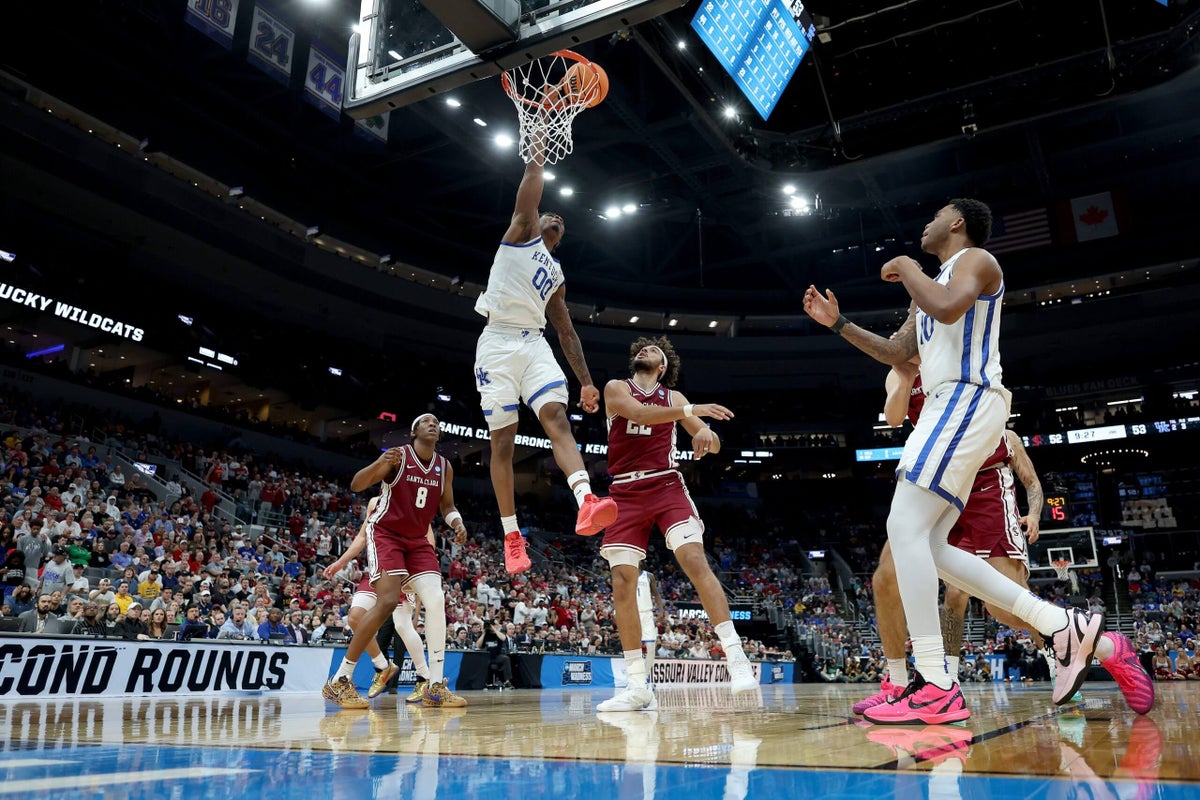
No. 7 Kentucky 89, No. 10 Santa Clara 84
With nine seconds left, Kentucky-Santa Clara was heading to overtime after Otega Oweh’s shot tied the score at 70-70. Down to two seconds, Santa Clara was in jubilation, seemingly wheeling into the second round after an Allen Graves 3-pointer put the Broncos ahead 73-70, and the Wildcats didn’t take a timeout.
The clock hit zero just as Oweh’s tying 3 banked off the glass, though, forcing overtime at 73-73.
It was needed.
In the extra period of the Midwest Regional game, Santa Clara condemned itself to firing 3s on nine of its 10 shots, making only three, while Kentucky was able to attack the paint and outlast the Broncos behind 35 points from Oweh. — Devon Henderson, staff writer
NO. WAY. 😱
WE’RE GOING TO OVERTIME!!! #MarchMadness pic.twitter.com/3n8rDxkY3h
— NCAA March Madness (@MarchMadnessMBB) March 20, 2026
No. 5 Texas Tech 91, No. 12 Akron 71
Texas Tech never trailed but couldn’t pull away until the closing minutes to avoid an upset bid from Akron.
Red Raiders guard Christian Anderson, who left the Big 12 tournament with an injury after slipping on the glass court, made some of the team’s biggest plays. Midway through the second half, he stole the ball and finished with a dunk to extend Texas Tech’s lead to 11. Anderson was one of five Red Raiders who scored at least 14 points in the Midwest Regional win.
The Zips hurt themselves early by missing 13 of their 22 shots inside the arc in the first half. Amani Lyles led Akron with 26 points.
Texas Tech coach Grant McCasland said Thursday defensive rebounding was one of his team’s biggest areas for growth. The Red Raiders finished with 32 on Friday — a notable showing as they try to advance to the Sweet 16 on Sunday against the winner of Alabama-Hofstra. — Matt Baker, senior college sports writer
No. 1 Arizona 92, No. 16 LIU 58
On Thursday, Siena led top-seeded Duke by 13 in the second half and stayed competitive until the final minute. For a No. 16 seed to upset a No. 1, ultimately, the 16th seed probably needs to be miscast with that number. Siena was, but LIU was not. That was evident within Arizona-LIU’s first few seconds, and the Wildcats’ ability to take a 32-point lead after just 23 minutes of the West Regional game.
Arizona coach Tommy Lloyd has never been worse than a No. 4 seed during his five years in Tucson, and he’s been a No. 2 seed or lower in four of those seasons. Still, he’s never advanced the Wildcats past the Sweet 16. This year’s team is arguably the best he’s fielded, but nothing these Wildcats do in San Diego will be considered an accomplishment. Lloyd will have to prove his March mettle if and when Arizona makes it to San Francisco. — Sam Blum, staff writer
No. 3 Virginia 82, No. 14 Wright State 73
Not this time, Cinderella. Despite a first-half deficit and shaky opening 30 minutes, Virginia held off Wright State.
Remarkably, it’s the first NCAA Tournament win for Virginia since it won the national championship in 2019 under coach Tony Bennett. And that came one year after the Hoos became the first No. 1 seed to lose to a No. 16 seed, falling to a 2018 UMBC team coached by current Virginia coach Ryan Odom.
In his first season with the Cavaliers, Odom managed to break a painful cycle of early March Madness exits.
Virginia ripped off separate runs of 9-0 and 11-0 to hold off a frisky Wright State squad that forced 14 turnovers and shot an uncharacteristically efficient 13-for-31 from 3-point range. But the Hoos had too much firepower in the Midwest Regional matchup, shooting 52 percent from the floor and 13 of 26 from deep, led by a 6-for-8 day from Jacari White, who led all scorers with 26 points. The Raiders scored only 3 points over the final 5 1/2 minutes. — Justin Williams, staff writer
No. 4 Alabama 90, No. 13 Hofstra 70
Can anyone stop Labaron Philon Jr. from getting to the rim? Alabama’s sensational sophomore broke open a close game by erupting after halftime for 21 of his game-high 29 points, confounding Hofstra’s defense with a series of slaloms to the rim that showcased his extensive bag of finishes. Without second-leading scorer Aden Holloway, the Crimson Tide needed all of Philon’s production, too, as Alabama overcame an early 10-point deficit.
Philon also snagged eight rebounds and handed out seven assists, making goggles to the bench after a particularly spicy one to set up a London Jemison transition dunk. Freshman forward Amari Allen took on a bigger ballhandling role and contributed 11 points, five rebounds and four assists, while big man Aiden Sherrell was a problem both inside (nine offensive boards) and out (two 3s) while finishing with 15 points and 15 rebounds. The fourth-seeded Tide will play fifth-seeded Texas Tech in Tampa, Fla., on Sunday. — John Hollinger, senior writer
No. 2 Iowa State 108, No. 15 Tennessee State 74
Cyclones star Joshua Jefferson suffered a sprained left ankle early in Friday’s Midwest Regional win. X-rays were negative, and he hasn’t been ruled out for the second round.
All the details of how the Cyclones won are insignificant at this point. All that really matters for Iowa State is Jefferson’s status for Sunday against Kentucky and for the rest of the NCAA Tournament. Jefferson has been ISU’s rock this season, making second-team All-American as a do-everything forward. He averages 16.9 points, 7.6 rebounds and 4.3 assists.
The Cyclones (28-7) still rolled without Jefferson against the overmatched Tigers, led by 25 points from freshman Killyan Toure, 22 off the bench from Nate Heise and 17 from Milan Momcilovic. Toure, whom some teams haven’t guarded lately, is the X-factor for the Cyclones. When he makes shots — as he did on this day (8-for-12 from the field and 2-for-3 from 3) — the Cyclones are one of the best offensive teams in the country. But it’s going to be hard to keep advancing without Jefferson, who returned to the bench in a boot and on crutches. — C.J. Moore, staff writer
An EMPHATIC jam puts the finishing touches on a dominant Cyclone performance 👏#MarchMadness pic.twitter.com/TIWPDdbiwQ
— NCAA March Madness (@MarchMadnessMBB) March 20, 2026
No. 8 Clemson vs. No. 9 Iowa
6:50 p.m. ET, TNT
Don’t expect to see 80 points either way in this game. You might not see 70, either.
Both teams are champions of slow-paced play, with both ranking below 320th in the nation in possessions per game. Clemson ranks 329th with only 67.2 possessions per game, while Iowa averages just 64.8, good for second-to-last (364th) out of the 365 Division I programs in the country.
Both the Tigers and Hawkeyes rank in the bottom half of their respective conferences in scoring. So, understandably, both deploy stifling defenses. Iowa is No. 1 in the Big Ten in scoring defense (66 points allowed per game), while Clemson ranks second (66.7 allowed) in the ACC, behind only top-seeded Duke. And both rank in the top 30 in KenPom in defensive rating.
Iowa senior guard Bennett Stirtz can provide enough scoring pop to be the difference. Despite his team not being an offensive juggernaut, Stirtz is the Big Ten’s fifth-leading scorer at 20.0 points per game. Clemson’s two leading scorers, RJ Godfrey (11.9 points per game) and Carter Welling (10.2), combine to average barely more than Stirtz.
If you’re a fan of guns-blazing offense, this one won’t be for you. Leave it to the basketball purists and disciples of hard-nosed defense. — Devon Henderson, staff writer
No. 7 UCLA vs. No. 10 UCF
7:25 p.m. ET, TBS
UCLA will rise and fall with the players it has healthy. In a 20-game stretch starting Jan. 1 and ending when forward Tyler Bilodeau (17.6 points per game) was injured against Michigan State in the Big Ten tournament quarterfinals, the Bruins had the nation’s No. 3 offense, according to CBS. Questions swirl on whether Bilodeau can return from the knee strain, though star guard Donovan Dent is expected to play after he went out with a right calf strain 10 minutes into the Big Ten semifinals.
Dent has been historically efficient down the stretch, with 78 assists to only six turnovers in his last eight games. His 13-to-1 assist-to-turnover ratio during that period has not been replicated by any NBA or Division I player in the past three decades, per OptaStats. This will also be the senior’s third foray into March Madness after playing in the Big Dance with New Mexico the previous two seasons.
That experience will come in handy against high-powered UCF, which boasts a top-40 offense in KenPom, but is making its first NCAA Tournament appearance in seven years.
Rebounding could be an issue for the Bruins. While UCF only ranks 83rd in the country in rebounds per game (37.2), UCLA is 318th at only 32.3. If the offenses stall out, the Knights may grab an edge via extra possessions. — Devon Henderson, staff writer
No. 4 Kansas vs. No. 13 California Baptist
9:45 p.m. ET, CBS
Watch out for the Lancers. March brings forth diamonds in the rough — legends who etch their names into the annals of basketball history, if only for a fleeting moment.
Think Jack Gohlke for Oakland, dropping 32 points to beat Kentucky in 2024. Think Doug Edert leading Saint Peter’s past, well, Kentucky in 2022 with 20 off the bench, and then beating Murray State and Purdue as well.
Get ready to learn about 5-foot-10 Cal Baptist superstar and WAC Player of the Year, Dominique Daniels Jr. The dynamic point guard averages 23.2 points per game, good for fifth in the country this season. Electric off the dribble with toughness and an ability to score at all three levels, Daniels is more than just a 3-point gunner. He makes just under two 3s a game, and he’ll attack the Jayhawks any way he can.
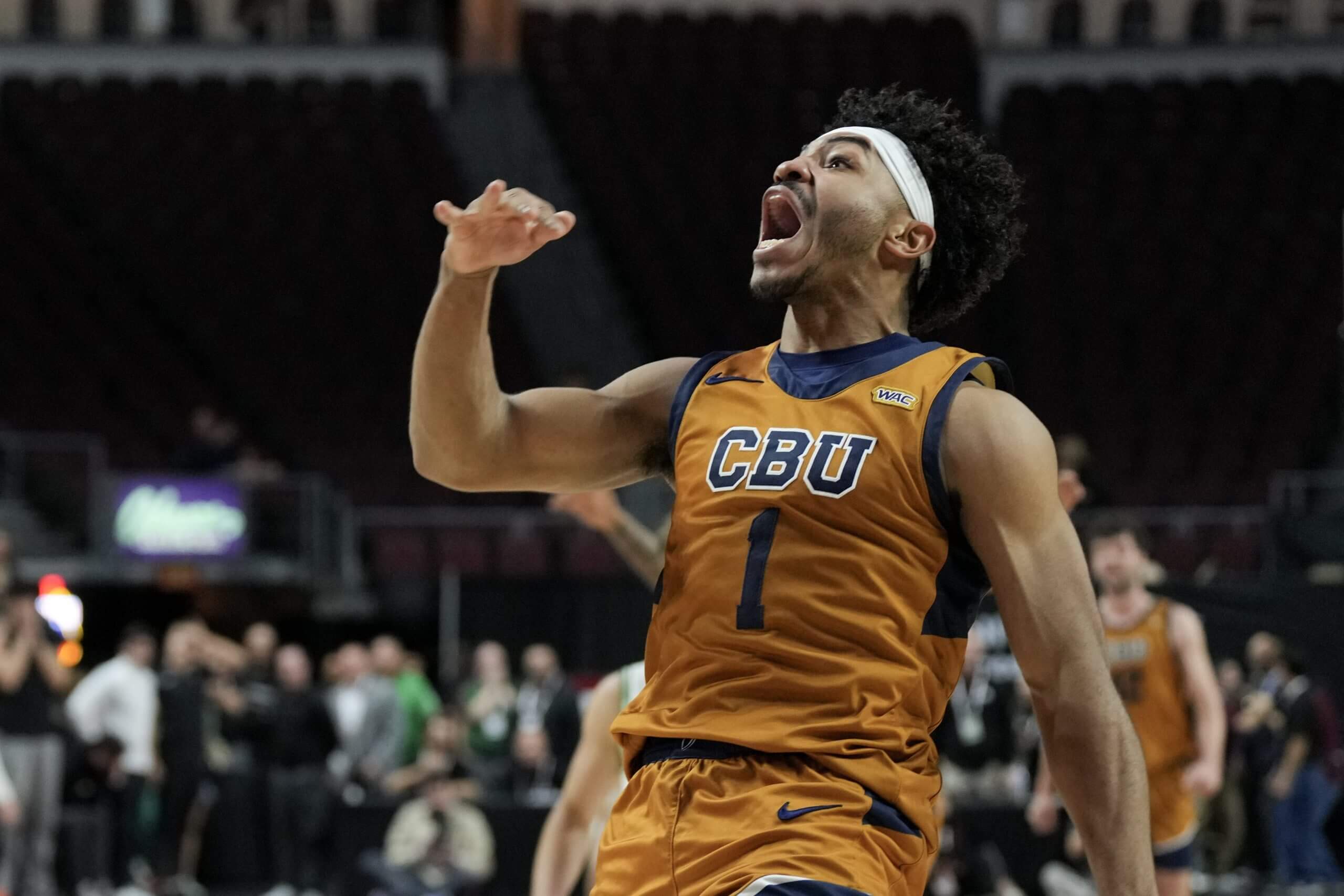
Dominique Daniels Jr. of the California Baptist Lancers celebrates defeating the Utah Valley Wolverines in the WAC championship game. (Candice Ward / Getty Images)
On the flip side, the world wants to know how many minutes Kansas will get out of its own superstar, potential No. 1 draft pick Darryn Peterson. The star guard played in 22 of Kansas’ 33 games this season and played less than 25 minutes in seven of them due to a myriad of injuries. However, he’s rounded into form of late, averaging 31 minutes and 19.2 points a night over the last seven games for the Jayhawks.
The problem is Kansas is 3-4 during that same span, including upset losses to Cincinnati and Arizona State. The blue blood is susceptible to being upset by a mid-major with a superstar scorer and nothing to lose. This will be an interesting one to watch. — Devon Henderson, staff writer
No. 7 Miami (FL) vs. No. 10 Missouri
10:10 p.m. ET, truTV
Miami ranks sixth in the ACC in rebounding, fifth in scoring, and at one point was on a 10-game winning streak. The Hurricanes deploy two strong forces down low in leading scorer Malik Reneau (6-9, 238 pounds, 18.8 points per game) and Ernest Udeh Jr. (6-11, 266 pounds). The Hurricanes are diligent in getting points in the paint. While they rank highly in scoring, they are dead last in the ACC in 3-point attempts per game at 18.9. Expect the Hurricanes to try to bully their way to the second round.
The problem is that the Tigers match Miami in size. Star senior Mark Mitchell leads the team in scoring (18.3), rebounds (5.3) and assists (3.6), and is 6-9, 230. Also roaming the Tigers’ paint is 7-footer Shawn Phillips Jr., who averages 1.5 blocks per game but only 5.1 rebounds.
Despite the size, the Tigers don’t rebound well (fourth-worst in the SEC) and enter the tournament on a three-game losing streak. The Hurricanes will need to get more out of perimeter players Tre Donaldson and Shelton Henderson to outmatch Missouri.
Down low, it’s possible both teams effectively cancel each other out, so whichever team’s outside shooting settles in quicker will be the spark to put it over the edge. — Devon Henderson, staff writer