
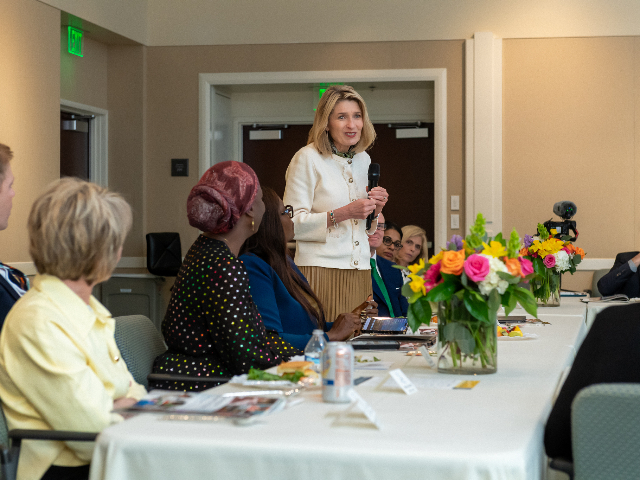
Using the recently released Caring for Those in Need 2025 Report as a backdrop, The Church of Jesus Christ of Latter-day Saints hosted several roundtable discussions in the United States this week for local, national and global humanitarian collaborators of its humanitarian organization, Latter-day Saint Charities. The events were held in Los Angeles, Washington, D.C., and New York City.
According to the report, the Church of Jesus Christ aided those in need in 196 countries and territories, showing its global reach. Church members volunteered 7.4 million hours of service, and expenditures totaled $1.58 billion.
Temple Square is always beautiful in the springtime. Gardeners work to prepare the ground for General Conference.
© 2012 Intellectual Reserve, Inc. All rights reserved.
1 / 2
Download Photos
“This is a beautiful example of the kind of collaboration that we hope to have across political boundaries,” said Relief Society General President Camille N. Johnson, who participated in the roundtable at the Los Angeles Temple Visitors’ Center in Los Angeles, California, on Tuesday, March 17, 2026. The roundtable coincided with the 184th anniversary of the Relief Society, the Church’s organization for women.
“We are brothers and sisters who have needs, and so we will, with joy, recognize those needs and work together shoulder to shoulder to seek to address them,” said President Johnson.
In Los Angeles, the roundtable highlighted the collaborative efforts of nongovernmental agencies (NGOs), churches and governments in addressing global needs. Success stories were shared from Guinea, Myanmar and the Philippines, where projects such as water wells and school infrastructure were implemented.
The meeting concluded with a call for continued collaboration and the introduction of the JustServe app to facilitate local service opportunities.
Tools for Sustainable Peacemaking
The Church of Jesus Christ is working to be a peacemaker through humanitarian giving and collaboration.
On Wednesday, March 18, 2026, the Church Office of Public and International Affairs hosted the first session of its Peacemaking Series, titled “Tools for Sustainable Peacemaking: An Invitation to Learn and Exchange,” at the Milton A. Barlow Center in Washington, D.C.
The opening session focused on humanitarian action as a pathway to peacemaking.
Temple Square is always beautiful in the springtime. Gardeners work to prepare the ground for General Conference.
© 2012 Intellectual Reserve, Inc. All rights reserved.
1 / 2
Download Photos
Sharon Eubank, the outgoing director of Humanitarian Services for the Church, and Elissa Gifford, the incoming director, participated on the panel with global leaders Barron Segar of World Food Program USA, Jess Leinwand of UNICEF USA and Matthew Saxton of ShelterBox USA. Together, they addressed questions about peacemaking and sustainable humanitarian efforts.
Eubank opened the discussion by explaining that the Church’s humanitarian efforts have grown significantly through multilateral partnerships and community engagement. She also emphasized the importance of individual responsibility in peacemaking, noting that small, everyday acts of compassion matter.
“Each of us can make a commitment to build peace,” she said, encouraging attendees to treat others with dignity, learn their names and serve them in meaningful ways.
Gifford reported on key takeaways from the Church’s 2025 report, including hundreds of clean water, emergency relief, health care, education, food security and mobility projects, along with key measures of their impact.
Segar, who has served as the president and CEO of World Food Program USA since 2020, spoke about the importance of involving people in service. He highlighted World Food Program’s Zero Hunger Generation program, which engages young individuals in addressing global hunger. Segar also pointed to the JustServe platform as a way for people to easily find opportunities to help in their own communities. He noted that these kinds of programs and platforms expand impact and unite diverse groups toward a common goal.
As chief legal officer for UNICEF USA, Leinwand addressed the role of trust in peacebuilding, explaining that it begins with consistency and accountability. She described how UNICEF builds trust by delivering essential services such as education, health care and child protection while adhering closely to laws and maintaining transparency.
Saxton, who serves as ShelterBox USA’s vice president of development, discussed how ShelterBox creates programs to build bridges rather than divisions. He stressed the importance of working closely with local collaborators to understand needs and involve communities in generating solutions.
“I would first have to say it’s the communities themselves that are really responsive,” he said.
Eubank said that effective peacemaking starts with listening to communities.
“The solutions don’t exist in our offices,” she said. “They exist in the hearts of the people themselves. Our role is to uncover those needs, provide access to resources and empower communities to implement solutions. That is the essence of sustainable peace.”
Importance of Collaboration
On Thursday, March 19, 2026, the New York Office of Public and International Affairs hosted a roundtable in New York City for more than 20 local, national and global NGO collaborators of Latter-day Saint Charities as well as United Nations officials. The group discussed the importance of collaboration in accomplishing the work of caring for the poor and needy.
Temple Square is always beautiful in the springtime. Gardeners work to prepare the ground for General Conference.
© 2012 Intellectual Reserve, Inc. All rights reserved.
1 / 2
Download Photos
Gifford began the discussion by praising the assembled for their efforts to reach out to those in need. “I’m impressed with the variety of backgrounds you bring to this work. We need diversity of backgrounds,” she said, adding, “Meaningful change rarely happens in isolation – the most meaningful progress happens when we’re working together.”
Simona Cruciani, Political Affairs Officer at the United Nations Office on Genocide Prevention and the Responsibility to Protect, emphasized that the shared value of human dignity for everyone inspires us in spirit and drives us to action as we reach out to others. Paul Skoczylas, WFP director for Private Partnerships Services at the World Food Programme agreed, saying, “compassion is what brings us together.”
Addressing barriers to collaboration, Sarah Bouchie, president and CEO of Helen Keller International, stated that the main barrier to collaboration is competition. “We must avoid focusing on competition,” she said, “moving away from competition has made us more resilient.”
Michael Nyenhuis, president and CEO of UNICEF USA, explained that he felt like being at the roundtable was like “being inside a living Giving Machine,” praising the camaraderie, collaboration and the spirit of goodwill in the room.
Eubank concluded the event by quoting Jacob 2:17, a scripture in the Book of Mormon: “Think of your brethren like unto yourselves, and be familiar with all and free with your substance, that they may be rich like unto you,” and encouraged the assembled to make still greater efforts to reach out, help and lift others.
Later that afternoon, Gifford also highlighted the power of collaboration as evidenced in the Caring Report, at a parallel event held in conjunction with the 70th Commission on the Status of Women at the United Nations. Co-sponsored by The Hunger Project, the event brought together 50 CSW participants for a workshop on how successful collaboration in humanitarian giving ultimately leads to better outcomes for women and girls.
The Church will host several similar Caring roundtable discussions in London, Brussels and Geneva later this month.