

On Christmas Day 2022, a rare and remarkable aurora lit up the Arctic sky, stunning observers and puzzling scientists. Unlike the vibrant, ever-changing displays of typical auroras, this phenomenon appeared as a smooth, featureless green glow. This unique event was the result of what’s known as a “polar rain” aurora — a rare occurrence that had never been seen from Earth before.
What is a ‘Polar Rain’ Aurora?
Normally, auroras are a dazzling light show caused by charged particles from the Sun, known as the solar wind, interacting with Earth’s magnetic field. These particles get trapped in the magnetotail, an extension of Earth’s magnetic field, and are funneled down to the poles. As they collide with molecules in the atmosphere, they produce the iconic green, red, and blue hues.
However, the polar lights that graced the Arctic was different. This “polar rain” aurora was smooth and devoid of the usual pulsating shapes that define traditional auroral displays. The glow covered an extensive area of 2,485 miles (4,000 kilometers) and had no distinct patterns, making it a phenomenon unlike any other. Scientists had never observed such a featureless aurora from the ground before.
How Did This Rare Event Occur?
A team of researchers led by Keisuke Hosokawa from the University of Electro-Communications in Tokyo has uncovered the cause behind this strange sky glow. Their investigation revealed that it was the result of a “rainstorm” of electrons directly from the Sun. These electrons emerged from a coronal hole in the Sun’s atmosphere, an area where the solar wind is especially fast and powerful.
At the time of the event, the usual solar wind was almost nonexistent, leaving a calm region around Earth. The high-energy electrons from the coronal hole traveled across space and connected with Earth’s magnetic field, reaching the north pole without being scattered by the normal solar wind. This was a rare occurrence, as typically the fast-moving solar wind would scatter the high-energy electrons, preventing them from reaching Earth’s atmosphere.
What Makes This Aurora So Unique?
It’s being described as a “polar rain” aurora because of the way the electrons from the Sun’s coronal hole directly impacted Earth’s atmosphere. The electrons in this event were significantly higher in energy than the particles in the regular solar wind, which contributed to the aurora’s pure green color, as high-energy electrons ionize oxygen at lower altitudes, emitting green light.
Another factor that made this polar lights so unusual is the size of the magnetic funnel through which the electrons traveled. The diameter of the funnel was an astonishing 4,600 miles (7,500 kilometers), a size that covered a broader area than Earth’s north pole. This large magnetic funnel caused the aurora to appear smooth and uniform, unlike the typical auroral displays that have distinct patterns or pulsations.
The phenomenon was captured by satellites, including the Special Sensor Ultraviolet Scanning Imager (SSUSI) on the Defense Meteorological Satellite Program (DMSP). The satellites confirmed that the sky phenomenon only appeared above Earth’s north magnetic pole, which was facing the Sun during the Northern Hemisphere winter.
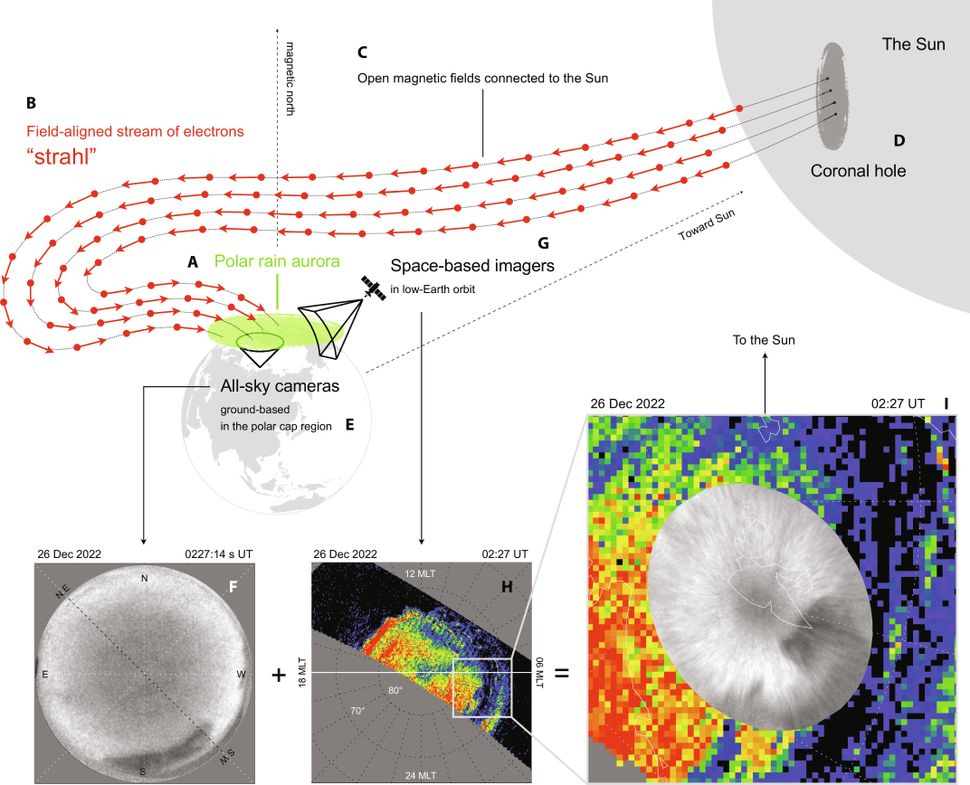
Credit: Science Advances
For most people, the polar lights they’ve seen in the sky are typically the result of regular solar wind. This event, however, was driven by a very specific set of conditions that made it visible from the ground and allowed it to be uniquely smooth and featureless.