

ALBANY — Mark Souza remembers what he describes as the “crash.”
It was 2019 and what started as a normal Friday quickly devolved into chaos, when the then-volunteer emergency medical services coordinator for Fulton County learned the Ambulance Service of Fulton County had ceased operations due to financial pressures.
The news came without warning and sent county officials scrambling. The ambulance service responded to a bulk of EMS calls in the rural county and filling the gap was something that would require immediate coordination and state intervention.
“That took quite a few ambulances” our of service, Souza recalled.
While the situation appears extreme, it’s one that rural EMS officials across New York fear could become more common as providers grapple with a shrinking workforce and growing operating expenses that they say makes balancing budgets difficult amid lagging reimbursement rates from government payers like Medicaid that covers around 40% of the state’s population, or more than 7 million New Yorkers.
A new report released by the state’s Rural Ambulance Services Task Force describes the rural EMS system in New York as “teetering on the brink of collapse” and in need of “urgent government intervention” in order to remain viable.
“New York State’s EMS system is currently in crisis and demands immediate and substantial action,” the report reads.


A recently released report by the New York State Rural Ambulance Services Task Force is the latest in recent years that has the EMS system in New York is facing significant challenges brought on by workforce struggles and revenue shortfalls. The report includes 38 recommendations that address the issues.
Peter R. Barber
The report includes 38 recommendations to stabilize the rural EMS system, including declaring a public health emergency that will allow resources to more easily flow to needed areas, as well as increasing government support for ambulance services. But it’s unclear how much it will cost to implement the recommendations or how quickly the policies can be adopted.
It’s a situation that some say reflects longstanding barriers in attracting workers to rural areas that are exacerbated by a declining population, lack of childcare options and low wages.
“This report only describes what’s been going on for years and years. It’s nothing new,” said Robert Martiniano, the senior program manager at the Center for Health Workforce Solutions based out of the University at Albany.
But others on the frontline argue the issue can be traced back to how EMS operations function in the state. Unlike police and fire services, EMS operations in New York are not considered “essential,” meaning there is no requirement for local governments to provide or fund ambulance services despite wide-spread agreement that they are critical.
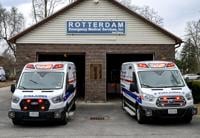
Rotterdam EMS is one of many rural emergency medical service providers facing challenges in New York state. A new report released by the state’s Rural Ambulance Services Task Force found the rural EMS system is on the “brink of collapse” in New York and in need of “immediate and substantial action” in order to remain viable.
Peter R. Barber
“We got here because EMS was never considered an essential service and so the attention to it has never been adequate,” said Dean Romano, a member of the rural ambulance task force and director of Rotterdam EMS.
A LONG-STANDING ISSUE
The latest report builds on a series of reports and studies the state has completed around EMS services in recent years that have found persistent staffing issues and a lack of funding has forced some providers to close their doors or have severely hindered operations, resulting in delayed response or missed calls.
A 2023 report found that the number of certified EMS personnel in the state declined by 13% between 2019 and 2021, falling from around 80,000 to about 70,000. The report also less than half of the certified EMS providers were actually working in the industry.
The report pointed to a decline in volunteerism, lack of public funding and “poor understanding of the EMS system by elected officials and the public,” along with a lack of transparency and accountability from EMS agencies as contributing factors.
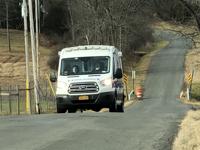
Bill Williams/Columbia-Greene Media An ambulance rushes to Triform Camphill Community in Livingston, after a resident was struck by a truck.
“New York State’s emergency medical services are in trouble,” the report reads.
A separate report released in 2024 found the number of ambulance services across the state decreased by 9% over the 10-year period between 2012 and 2022, falling from 1,078 to 982.
In response, New York has taken steps to address the issues, including investing $72 million to bolster Medicaid EMS rates and $90 million to support personnel and resources to support rural EMS initiatives.
Gov. Kathy Hochul has also signed legislation allowing ambulance services to be reimbursed by Medicaid when treating patients on-scene or transporting to medical settings that are not hospital. Previously, providers were only reimbursed when transporting Medicaid patients to a general hospital setting.
A spokesperson for the state’s Department of Health said that many of the steps the New York has taken align with recommendations in the report.
“The Department is committed to further advancing care of the rural community through our EMS providers,” the statement reads.

Dean Romano, executive director of Rotterdam EMS, served on the New York State Rural Ambulance Services Task Force, which recently released a new report that the rural EMS system in New York is on the brink of collapse.
Peter R. Barber
EXISTING BARRIERS
But others said the issues facing EMS providers are reflective of longstanding workforce barriers, particularly in rural communities.
Martiniano said in many rural areas, population decline coupled with a declining birth rate has made it difficult to attract new workers, and a lack of childcare can prevent others from entering the workforce.
“If there’s nobody we can pull into the pipeline that’s an issue,” he said.
In Essex County in the heart of the Adirondacks, EMS Coordinator Jody Whitney said workforce issues are among the greatest challenges facing EMS operations.
For years the county’s 13 ambulance services relied on volunteers, but an aging workforce and changing lifestyles have shifted the model to rely more on paid staff. The transition, Whitney said, has taken place amid a statewide shortage of certified EMS personnel.
Around 26% of the county’s population is over the age of 65, the equivalent of about one in four of 37,000 residents
Whitney also said childcare and housing are also major barriers that have been difficult to overcome.
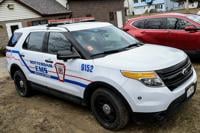
One of Rotterdam Emergency Medical Services advanced life support ‘fly cars’ at the east station on Cardiff Road Thursday, March 19, 2026.
Peter R. Barber
“These regional workforce barriers directly impact our recruitment and retention efforts,” she said. “We view EMS stability as part of a larger community health picture that includes housing and childcare; you cannot have one without the others.”
Then there are competing jobs like in the retail industry that Martiniano said offer a similar wage and less stress.
“Additionally if you work at Burger King or McDonalds or Target or Walmart, you get a 10% discount,” he said.
AN OUTDATED MODEL
But those on the frontline argue the current EMS model is simply outdated and in need of an overhaul.
In New York, EMS operations vary by community, with some contracting out ambulance operations to third-party providers or funding their own services as part of annual budgets. Others have created special tax districts in a bid to provide stable funding to support faster response times and a stable workforce.
In Fulton County, county lawmakers adopted a new model that includes contracting with four ambulance providers at a price of $800,000 annually that Souza said has stabilized operations since the collapse six years ago.

State Assemblyman Angelo Santabarbara, D-Rotterdam, sponsored legislation to create the New York State Rural Ambulance Services Task Force. The group recently released a report that found the rural EMS system in New York is on the “brink of collapse” and calls for immediate intervention. Santabarbara said he is pushing for changes this legislative session to begin addressing the concerns.
Provided photo
The model has proven effective, according to Souza, who now serves as the county’s full-time EMS coordinator. There have been no missed calls or issues with delayed response time since the system was implemented around four years ago.
“I’m not saying it’s perfect, but we’re fairly stable,” Souza said.
But for many, the only funding stream comes from fees collected through services, which vary widely by insurance providers and fall well short of what’s needed to cover operational expenses for those on Medicare and Medicaid.
Aiden O’Connor Jr., a member of the rural ambulance task force and executive director of the Greenport Rescue Squad in Hudson, said it cost about $830 for one of his ambulances to respond to a call. But the service only receives around $630 for transporting a patient on Medicare and just over $300 for those on Medicaid.
With a bulk of the department’s nearly 4,000 annual calls being patients on government-run insurance, that leaves a major funding shortfall that the agency is forced to either absorb or seek out alternative funding streams that are not always guaranteed, O’Connor said.
“It’s completely lopsided,” he said. “That money then has to come from somewhere else, and usually that’s grants and municipal funding, meaning towns and villages and the community help pay that.”
O’Connor said the current reimbursement model doesn’t take into account the cost for readiness, noting that ambulance services must be ready to respond to an emergency around the clock, even if a call doesn’t come in.
“If you have a community that only does 500 calls versus a community that does thousands, you have the same fixed costs, but now you don’t have the reimbursement model,” he said. “So, it’s been flawed, I would say, from the very beginning.”
A PATH FORWARD
Those on the frontlines argue that government support is needed to ensure ambulance operations can remain viable.
But officials differ on what that funding stream should look like.
Christopher Koetzle, the executive director of the New York State Association of Towns, is advocating for a regional or county approach that he believes will allow for greater collaboration while removing the potential burden on cash-strapped towns.
“We oppose legislation that would deem this as a critical service and then place the mandate on local governments because that is just another mandate on local governments without addressing all the issues related to why it’s an unaffordable service to provide,” said Koetzle, who previously served as the longtime elected town supervisor in the Schenectady County Town of Glenville.
State Assemblyman Angelo Santabarbara, D-Rotterdam, believes immediate action is needed and believes lawmakers should begin addressing the issue as part of ongoing budget negotiations.
Santabarbara, who sponsored the legislation to form the rural ambulance task force, believes lawmakers should look to increase lagging Medicaid reimbursement rates this year and should also take steps to declare EMS an essential service and set aside state funds to directly support ambulance operations.
Counties and other municipalities should be able to make their own decisions on whether to fund EMS services, he said.
“If people are serious about protecting public safety in all parts of the state, including rural areas, then stabilizing EMS must be part of this year’s budget,” Santabarbara said. “If we wait, it’s going to make the problem harder and it’s certainly going to be more expensive.”
In Duanesburg, a rural town in Schenectady County, the local ambulance provider has evolved in recent years from an all-volunteer force to one that is made up of paid professionals. The switch occurred during the pandemic, when volunteerism dropped and missed calls were on the rise.
Last year, the town created a special tax district to fund around $550,000 of the operation’s annual budget of $825,000. The steady stream has eased budget constraints, according to Peter Brodie, the chief of Duanesburg Ambulance.
Brodie said response times have also dropped and there have been no missed calls since the agency moved to a career model. It’s a change that he said has been noticeable in the community, but one that wouldn’t have been possible without their support.
“The more you pay for preparedness, the better off you’re going to be,” he said.
New York State Rural Ambulance Services Task Force