
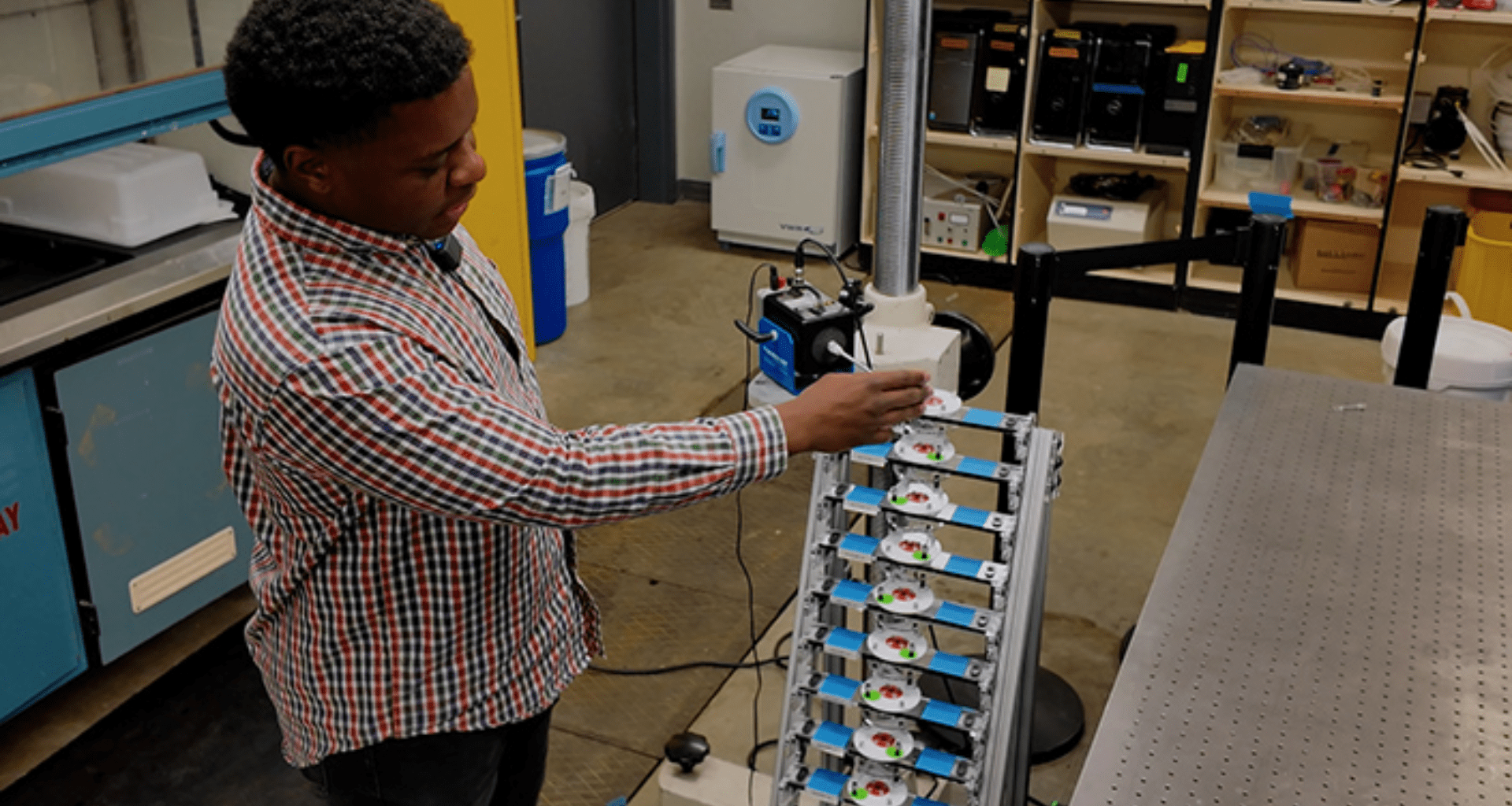
Researchers have uncovered a way to control material behavior using sound. In a study published in Nature Communications, the team explains how specific acoustic wave frequencies can reliably move tiny localized features called mechanical kinks, which dictate whether parts of a material are soft or stiff.
Mechanical kinks function as boundaries between two distinct internal states within the same material. On either side, the atoms or building blocks may be identical, but their three-dimensional orientation differs.
This small structural change can produce vastly different mechanical properties. Kinks are critical in determining where a material deforms, appearing in situations such as metals bending permanently or DNA strands separating.
Controlling kinks with sound may enable adaptive materials
Controlling the tiny features known as kinks has long fascinated materials scientists because shifting them can reshape how a material behaves, such as changing which regions are soft or stiff. However, achieving precise control has been challenging. In most materials, kinks face energy barriers that hold them in place.
“Previous experiments showed that sound waves could move kinks, but the motion was often unpredictable and chaotic,” said Nicholas Boechler, co-corresponding author of the study and professor in the Department of Mechanical and Aerospace Engineering at the UC San Diego Jacobs School of Engineering.
Boeschler and his team discovered a method to precisely control the movement of kinks using sound waves. They created a material model where shifting a kink requires no energy, a rare and unusual property. This was achieved by designing the material so that its mechanical behavior depends on its internal structure rather than its chemical composition.
In this model, the location of the kink determines the material’s stiffness. The region around the kink is always soft, while stiffness increases progressively away from it. Moving the kink to one end makes that side soft and the opposite end stiff; placing it at the center softens the middle and stiffens both edges.
Sound waves allow step-by-step control of material kinks
Boechler described the discovery as creating an acoustic “tractor beam” that can shift a kink and alter how a material feels, forming controllable stiffness gradients on demand. Thanks to the model material’s lack of energy barriers, the team could move the kink not only reliably but in precise, incremental steps.
Sending sound waves from one side pulls the kink toward the source, Boechler explained. A small acoustic pulse nudges the kink slightly, and each subsequent pulse moves it further. In effect, the researchers have developed a way to remotely control the material’s internal state.
To test their idea, the team built a life-sized model made of stacked, rotating disks connected by springs. Each disk stood in for an atom, and the springs acted like atomic bonds. One disk, set up differently, represented the kink. Short bursts of sound waves nudged the kink a few disks at a time toward the sound source. Repeated pulses moved it step by step, while longer vibrations pulled the kink across the whole chain, flipping which side was soft and which was stiff.
The study demonstrates that researchers can achieve unprecedented control over material kinks using sound, even if only by pulling them. Only specific frequencies trigger movement, and computer simulations show that sound waves transfer enough momentum to move the kink despite partial reflection. This work highlights a promising path for precisely tuning material stiffness and shaping mechanical properties on demand.