
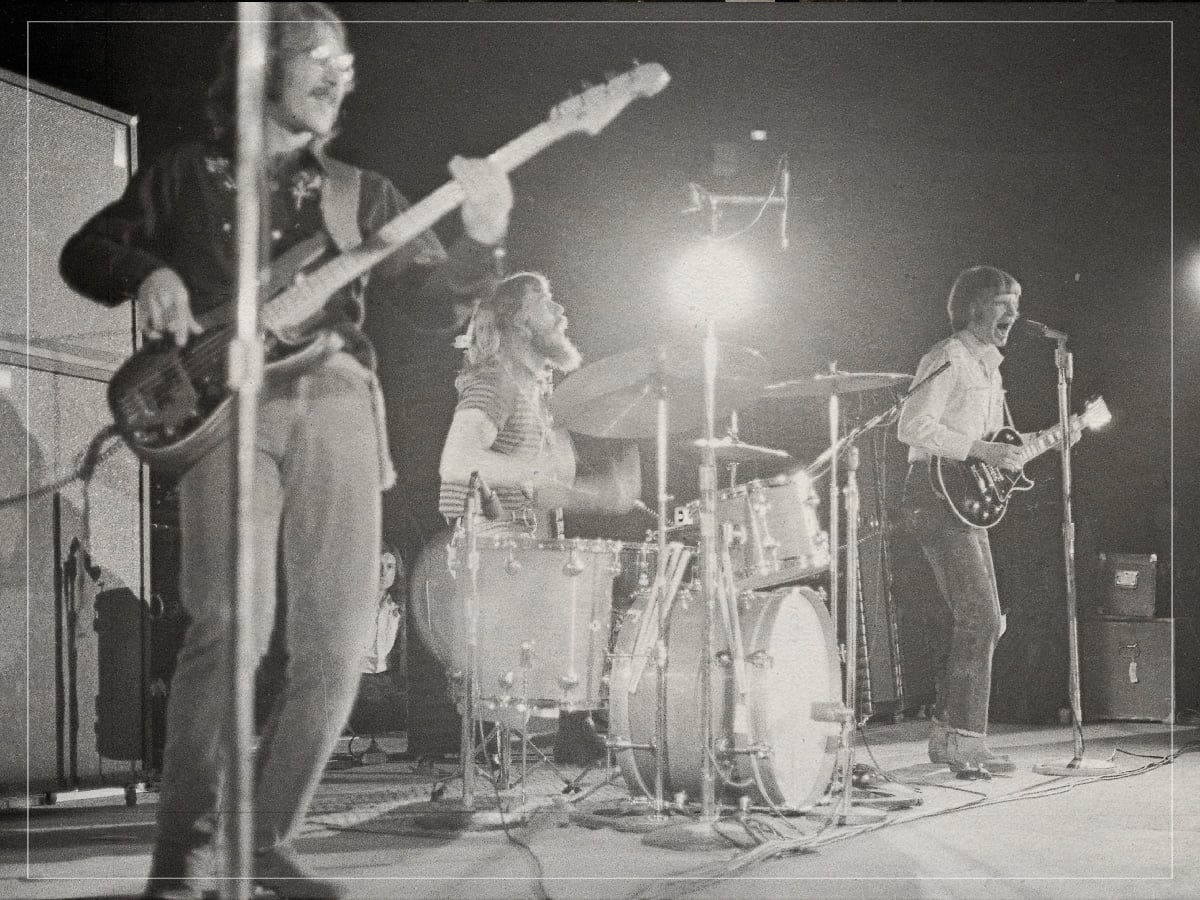
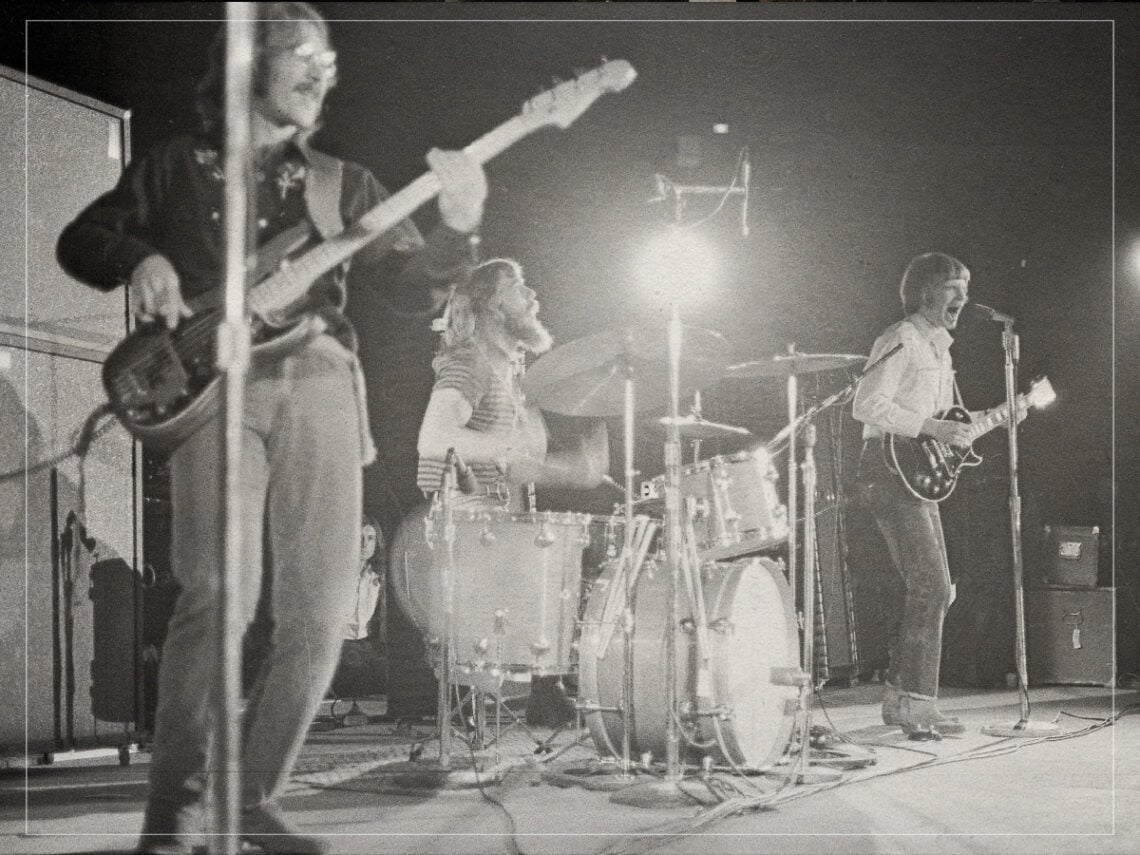
(Credits: Far Out / Cal Montney / Los Angeles Times / UCLA Library)
Tue 24 March 2026 22:00, UK
It’s not without irony that the song John Fogerty wants to be remembered for, ’Have You Ever Seen the Rain’, marks the end of an era of tempestuous dominance for Creedence Clearwater Revival.
The song arrived in January, 1971. In a prolific two-year period prior to that point, the band had holed up in California, rattled off swampy riffs, and scored a whopping nine top ten hits. The group even outsold The Beatles’ swansong in 1970. So, it seemed inevitable that they would seize the Fab Four’s fabled vacated mantle. That’s not how things worked out.
The family band broke up over half a century ago after enjoying a solitary year of peak success. However, since then, their popularity has continued to be in a state of constant revival. The band uphold a spiritual sense of the 1960s and all that entails. From the tempestuous end that led to a long-running feud to the visceral vitality of their music, they are an emblem of the revolutionary American zeitgeist that held sway in the ’60s, and that remains a thrilling force to behold.
“Creedence Clearwater Revival … were progressive and anachronistic at the same time,” Bruce Springsteen once said. “An unapologetic throwback to the golden era of rock ‘n’ roll, they broke ranks with their peers on the progressive, psychedelic San Francisco scene. Their approach was basic and uncompromising, holding true to the band members’ working-class origins.”
The Boss, who was deeply inspired by the blue-collar all-American sound of the band, concluded his Rock & Rock Hall of Fame induction speech by expressing, “I stand here tonight still envious of that music’s power and its simplicity.” It’s that ethos that ensures the songs still stand up as timeless classics today. And those songs were borne from an equally rudimentary way of working.
 (Credits: Far Out / Press)
It was no secret to anyone that John Fogerty was the creative driving force behind the band, writing the songs in their entirety. In fact, this was so well known that in the aftermath of their split, a rumour even arose that John Fogerty not only wrote every element of the songs, he also played every element, too. It came to be gospel in certain circles that essentially throughout the group’s tenure, Tom Fogerty, Stu Cook, and Doug Clifford had been nothing but touring musicians.
The fandom even became so feverish about this that it was implied that, as their kindly leader, John would record with the group, before returning to the studio later that evening to dub himself over their apparently substandard work. This claim became so widespread that it eventually made its way around to the former plaid-shirted frontman.
In 1993, he sharply dismissed it. “Probably ninety-nine percent of the tracks we did as a quartet are played live with all four guys playing at the same room,” the gravelly singer told Rolling Stone. “I’ve heard the rumor over the years that ‘after they left the studio, John went in and re-recorded all the parts.’ No. I think the charm of what you hear on those records is four guys really playing.”
In truth, that zip and fizz of four guys riffing in the moment became such a paradigm of their Beatles-rivalling success, that the other members figured that they should lean into it even further. Aggrieved by John Fogerty’s creative stronghold, the trio lingering in his looming shadow wanted to make the group more of an ensemble.
But the frontman made a 180-degree pivot on this irked demand, and instated himself as their manager as well as the creative driving force. “John was brilliant at all the musical things, but he had no experience at managing, particularly at the level we were involved at,” Clifford told Louder Sound. “It was a critical mistake, and ultimately it broke up the band.”
Did it really spell the end of ‘CCR’?
But, in yet another 180-degree pivot, John Fogerty figured it was actually the inverse of him taking control that led to their demise. After all, surely the group could’ve patched up the fractures with untold dollar bills and adulaiton if they had continued to be hailed as the American successors to The Beatles, the band vitally keeping the counterculture ethos alive?
But, in a classic case of the press building bands up just to knock them down, word had gotten out of a compromise within Creedence. When Tom Fogerty left the band in 1971, in a bid for diplomacy and to keep things glued together, John finally acquiesced and welcomed further contributions from the remaining members.
This might have been a political bid to ensure that their final record, Mardi Gras, would actually come to fruition, but when word was leaked to the press, this tactic was seen as a group selling out. This was particularly damning for Creedence.
After all, Springsteen had praised them for being “uncompromising”, breaking “ranks” from their peers, and embodying an “unapologetic” working-class entity who stood aside from the industry. In an age when most American bands were trying to blend into the British Invasion sound unnoticed, Creedence crucially did things their own way. Now, it seemed they were turning their back on that.
For a legion of American rock fans, many of which were now wielding pens at various publications, this felt less like a mild acquiescence from John Fogerty to ensure the survival of Mardi Gras, and more like a symbolic betrayal of the anarchistic and uncommercial roots of the counterculture scene that was teetering on the precipice of certain demise thanks the drummed-up follow out from the Manson Family murders, and other ‘end of the ‘60s’ revisionisms.
So, the writing was already on the wall, and when the band released their final record, Rolling Stone infamously described it as “the worst album ever made by a major rock band.” It wasn’t. It wasn’t even close to that. But that sort of wasn’t the point anyway. Simply put, it was worse than a lot of what had come before from a band who seemed like a visceral unit without compromise. And that was the point.
So, in the backwash of the death of the closest thing there’s truly been to an ‘American Beatles’, what was the crucial mistake: John Fogerty overplaying his hand or the exact opposite of that?
