
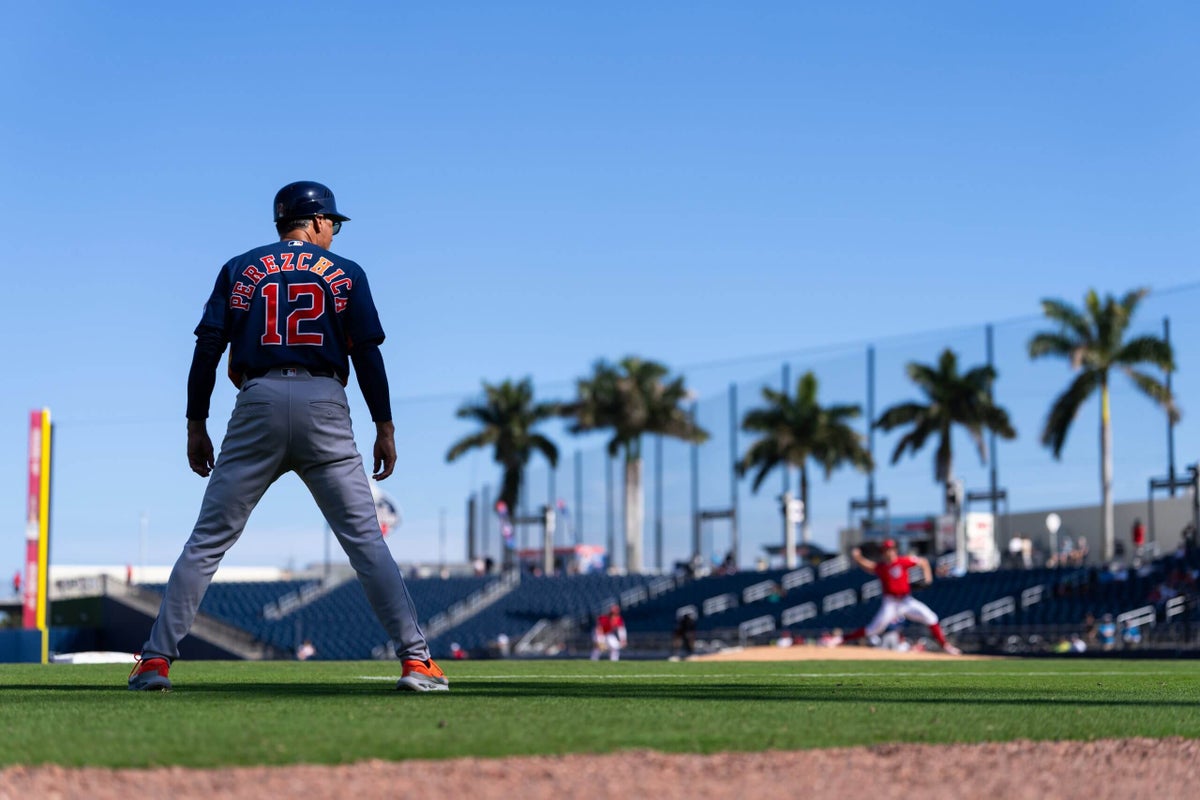
On Opening Day this week, some Major League Baseball coaches are going to take their positions on the field worried for their safety because of a rule change that they say raises the risk they’ll be struck by line drives.
“It’s dangerous right now,” said 76-year-old Dave McKay of the Arizona Diamondbacks, who’s about to begin his 36th straight season as a first-base coach in the big leagues. “It really is.”
Teams complained to the league last year that first- and third-base coaches were veering outside their designated areas to get a better look at pitch grips, a potential competitive advantage for the hitting team if the coach can relay that information to the batter. MLB this year decided to clamp down by revising and enforcing a rule it had almost always ignored: coaches now have to stay inside their designated boxes in foul territory, and umpires are newly going to police their movement.
But in an age of 100-mph fastballs, and exit velocities off the bat that sometimes eclipse 120 mph, some coaches fear they’re now in harm’s way when batters rip screaming foul balls. The rule book, created in a bygone era, calls for the farthest edge of a coach’s box to be 90 feet from home plate.
“That’s a dangerous situation,” said Cleveland Guardians first-base coach Sandy Alomar Jr., who is entering his 17th season on the Guardians’ staff. “Imagine José (Ramírez) hits a ball 115 mph, pull side. You don’t have time to react.”
Base coaches in the past often drifted farther out, toward the outfield.
“Every third base coach, we’ve all been talking about how you’re constantly in danger,” said Chicago Cubs third-base coach Quintin Berry. “You never get a chance to get out of there. You can’t get out of harm’s way, ever. And I get what they’re trying to do. But you’re not going to stop anything by putting people in a box.”
Many managers and coaches empathize with the desire to clean up wrongdoing. But some also worry the league has introduced a different problem along the way.
“I saw (Pirates third base coach) Tony Beasley get smoked the other day against us. I’m not all-in on it,” New York Yankees manager Aaron Boone said. “Where we can avoid sign stealing, that kind of stuff, I get it. Yes, in a perfect world, I want that. But they’re in harm’s way, bottom line. I don’t love it.”
MLB is standing by its new enforcement, a decision it discussed in advance with MLB managers, but not coaches en masse.
Last year, the league office determined via tracking data that base coaches often liberally moved toward the outfield without runners on base, a choice the league believes was rooted in an ulterior motive.
“Throughout last season, including the playoffs, one of the most consistent complaints that we heard from clubs was base coaches leaving the coaches’ boxes in order to identify pitch grips,” MLB said in a statement to The Athletic. “We raised the issue with major-league managers at the winter meetings, and after hearing very clearly that they wanted us to take action, we agreed with the Players Association to increase enforcement of the coaches’ boxes and the penalties for non-compliance.
“We will continue to monitor the enforcement of the rule throughout the season.”
The Players Association declined comment.
As drawn on the field, the coaching boxes — positioned in foul territory near to first and third base — look like a three-sided bracket, closed off in every direction except backwards, away from the baseline. In its statement, MLB emphasized the freedom the coaches have to move in that direction: away from the field of play, and toward the dugout.
“We have communicated to all 30 clubs that the base coaches are permitted to set up as far away from the foul line towards the stands as they like if they have safety concerns,” the league’s statement continued.
But coaches are skeptical that allowance is sufficient.
“It doesn’t matter if you bring it closer to the dugout,” said Boston Red Sox first-base coach José Flores, formerly a third-base coach in the big leagues. “If we’re still 95 or 90 feet away, it’s still dangerous. So, we’re just thinking 100 feet, 115 feet away from the batter.”
Said McKay: “Why even coach first base if you’re all the way back toward the dugout? I can’t do anything back there. I’ve been doing this for 40-something years. I know where I have to be in order to do my job.”
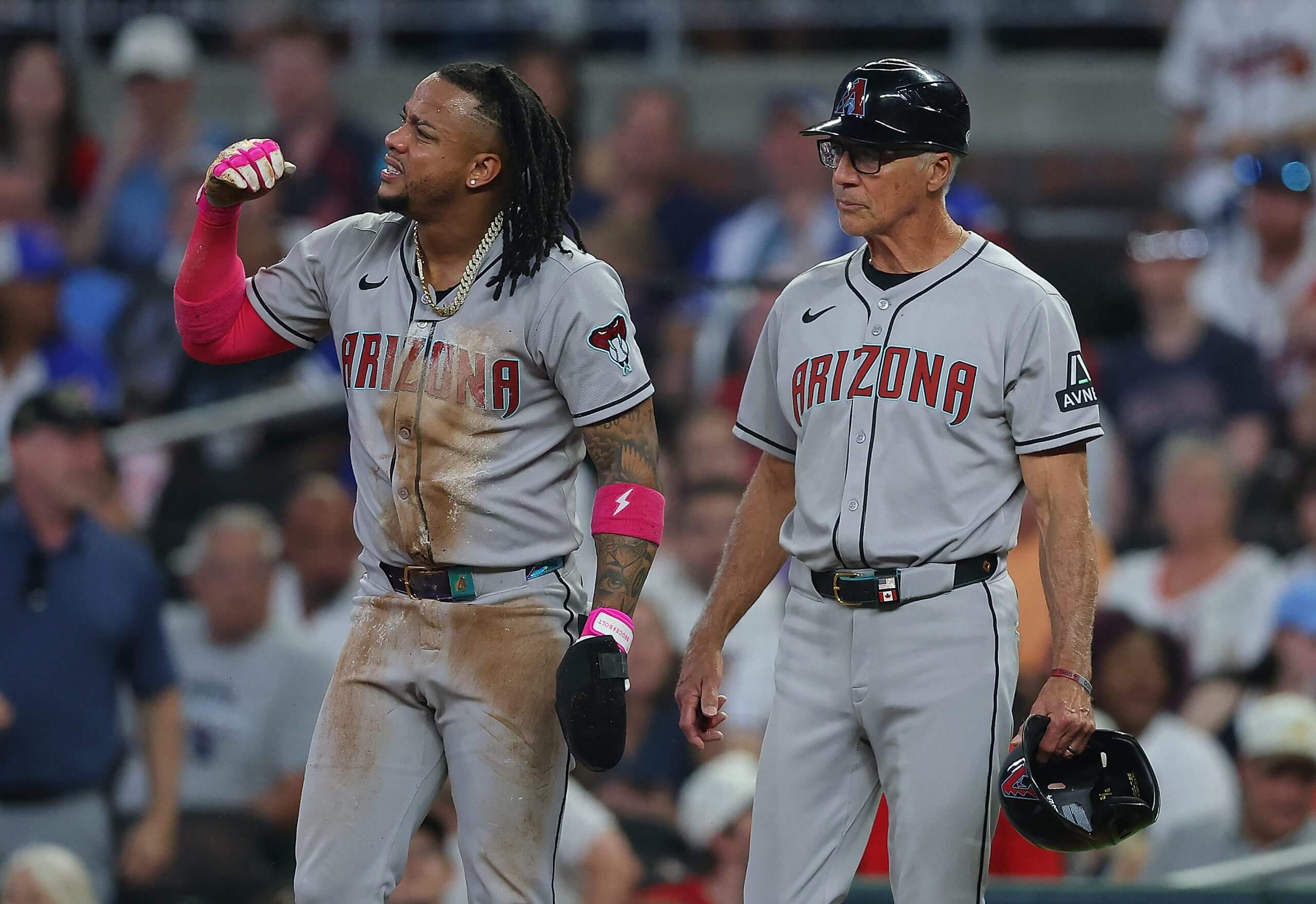
Diamondbacks first base coach Dave McKay, shown here with infielder Ketel Marte, has tried to raise awareness on the issue. (Kevin C. Cox / Getty Images)
Baseball has already had a batted-ball tragedy involving a coach. In 2007, Mike Coolbaugh, a first-base coach in the minor leagues, died after being struck by a line drive. He was 35. MLB subsequently mandated helmets for coaches.
The league has also increased the amount of netting inside stadiums to protect fans in the stands. Linda Goldbloom, a 79-year-old fan, died after being struck in the head by a foul ball during a game at Dodger Stadium in 2018.
Some MLB officials believe the current situation leaves them between a rock and a hard place. The league has taken heat in the past for not proactively doing enough to prevent on-field rule-breaking, including during the electronic sign-stealing scandals.
But coaches aren’t convinced the league is effectively serving its end goal.
“The reality is, if there’s anything out there being given as far as pitch tipping, guys are going to get it regardless, whether you’re in the box or out of the box,” Berry of the Cubs said.
Baseball’s rules continue to allow coaches and players to try to figure out what a pitcher is throwing and then signal to their hitters what’s coming, so long as they’re not aided by banned electronics. The difference now is that coaches can’t leave the box to gather intel. Complaints about coaches inching up the base lines grew loud enough that umpires warned the Los Angeles Dodgers and Toronto Blue Jays before Game 7 of last year’s World Series to cease any roaming.
“There’s always been a little bit of a floating third-base and first-base box,” Detroit Tigers manager A.J. Hinch said. “The fact that they have firmly put parameters on that for everyone, hopefully will make the topic a non-topic. The hardest part of that is safety for the coaches.”
MLB said that tracking data from its Hawk-Eye cameras showed third-base coaches last season often migrated closer to home plate when a runner was on second base. That observation suggested to MLB that coaches’ safety concerns apparently lessened depending on the baseball situation.
But there’s no shortage of voices concerned for safety as this regular season begins.
“The most important role of the base coach is to be in a position to help the runners out and make good decisions on the base,” Cubs manager Craig Counsell said. “That’s their job. How can they do that job safely? That’s what we should be figuring out.”
Alomar of the Guardians and Flores of the Red Sox both likened being a base coach now to a fielder wearing no glove while playing infield-in — a defensive alignment that puts defenders closer to home plate and the swinging batter. The league’s new enforcement, Flores said, amounts to doing so “for 125 pitches per game.”
“MLB is the one that decides what we do and don’t do,” Flores said. “Talking to our colleagues from other teams, we’ve all come to the conclusion that it’s extremely dangerous.”
Even going 10 feet farther away from the plate could help, Flores said, suggesting it wouldn’t give coaches any greater advantage.
“What you can see from 100 feet … it’s not going to change any part of the game,” Flores said. “We’ve seen a bunch of balls getting hit throughout the course of spring training that coaches have been very close to getting hit — myself being one of them.”
McKay of the Diamondbacks said he tried to talk to the league about his concerns, including Michael Hill, the league’s senior vice president for on-field operations, to no avail.
“I know they’re trying to do the right thing,” McKay said. “I thought it would have been great if you got together with the base coaches and talked to the base coaches about all this. There are some people you say obviously are cheating. I don’t even know what they’re doing.
“But you’re jeopardizing guys like myself and other first base and third base coaches who aren’t cheating. You’re putting them in harm’s way. That’s a problem. Someone’s going to get hit, and it’s not going to be an accident. Because you’ve been told.”
Coaches on one National League team all had a similar refrain: These boxes were drawn up a century ago. Batters hit the ball much harder today. Why shouldn’t the rule be updated?
One base coach who spoke on the condition of anonymity said he’d like to see a diagonal line drawn from the far edge of the coach’s box. It would run toward the stands in right-field for first-base coaches, or the stands in left-field for third-base coaches. In essence, for every step a coach takes away from the plate, they’d have to take a similar step backward, as well, theoretically minimizing any improvement in their view of the pitcher.
McKay thinks to better their understanding, MLB officials should take a pitching machine and have it fire 100 mph fastballs at a protective screen near a coach’s box.
“Watch how quickly that ball gets there,” McKay said. “We’re not talking about 115 mph. We’re talking about 100. Have that ball shot at you. Take a look at that. And you’ll say, wow, that ball gets there pretty damn quick.”
“They insist the box is not going to move. So either you get in there, or get out altogether.”
Ultimately, the distressed coaches hope MLB will heed their concerns and make a change.
“Hopefully we come to a little bit of an adjustment before the season starts or maybe early in the season where no one’s at risk and everyone is at peace with whatever this rule is for,” Yankees third-base coach Luis Rojas said.
And if not, some base coaches might seek body armor.
“I’m trying to come out with a pad that I can block (with),” Alomar said, motioning like he was punching upward to deflect an oncoming ball.
— With reports from The Athletic‘s Matt Gelb, Chad Jennings, Zack Meisel and Cody Stavenhagen.