
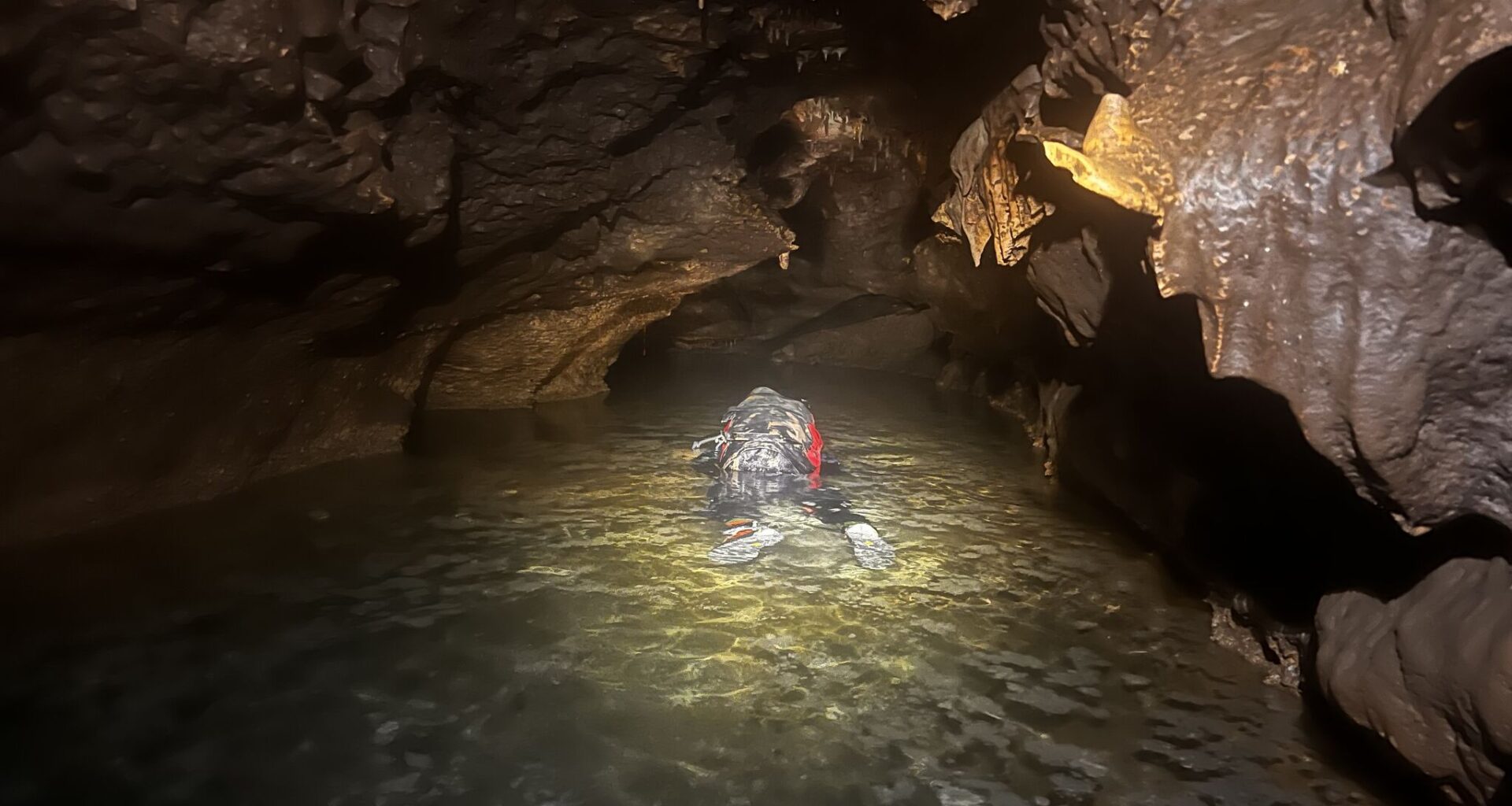
With a wet suit and goggles, paleontologist John Young searches for fossils in the stream that flows through Bender’s Cave.
John Moretti
A team of researchers wading through an underground stream in Central Texas didn’t expect to find bones everywhere, but that’s exactly what they saw. Fossils from a giant tortoise, a lion-sized armadillo relative and other Ice Age animals have been discovered inside Bender’s Cave—a water-filled cave in Comal County that had never been studied for fossils before.

“There were fossils everywhere, just everywhere, in a way that I haven’t seen in any other cave,” said John Moretti, a University of Texas at Austin paleontologist who led the research. “It was just bones all over the floor.”
Article continues below this ad
With a wet suit and goggles, paleontologist John Moretti searches for fossils in the stream that flows through Bender’s Cave.
John Moretti
Moretti discovered shell fragments and armor plates scattered along the bottom of the cave while snorkeling through its submerged passages. The remains are believed to have washed into the cave thousands of years ago through sinkholes during flooding and erosion events, where they stayed largely untouched.
The findings, published in March in the journal Quaternary Research, point to an unusual mix of animals in Central Texas, including a pampathere, an extinct armored mammal related to modern armadillos, along with giant tortoises, saber-toothed cats, camels, mastodons and a giant ground sloth.
That combination stood out to researchers. Some of those animals are typically tied to warmer climates, while others are more often associated with forested environments.
Article continues below this ad
“This site is showing us something different, and that’s really important because of all the work that’s been done in this region,” Moretti said. “If it is interglacial in age, it’s a new window into the past and into a landscape, environment, and animal community that we haven’t observed in this part of Texas before.”
An artist’s interpretation of mammals that lived during the last Ice Age. Fossils from similar species of an armadillo-like pampathere (bottom left) and giant ground sloth (background) were among those found in a recent study of a Texas water cave.
Adapted from artwork by Jaime Chirinos
Based on the fossil mix and how it compares to other sites, researchers believe the bones may date back to the last interglacial period, a warmer stretch of the Ice Age roughly 100,000 years ago.
Article continues below this ad
At that time, Central Texas likely looked very different. During colder glacial periods, the region was largely open grassland. But mastodons and ground sloths typically lived in wooded environments, and giant tortoises and pampatheres needed warmer conditions to survive. Together, those clues point to a landscape that was both warmer and more forested than what came later.
Left: A fossil claw from the giant ground sloth Megalonyx found in a Texas water cave. Scale bar is two centimeters. Right: A single scale from the shell of a pampathere, an armadillo relative, found in a Texas water cave. These scales would have come together to form a protective shield-like covering for the animal. Scale bar is one centimeter.
John Moretti
The fossils themselves tell part of that story. They are polished, rounded and coated in a similar reddish mineral layer, suggesting they were carried into the cave during the same flooding events and deposited together.
Even so, pinning down an exact age is difficult. The cave lacks the kinds of sediment layers that usually help scientists precisely date fossils, so researchers are relying on environmental clues and comparisons with other Ice Age sites across Texas.
Article continues below this ad
Those comparisons have already revealed something unexpected. Fossils from Bender’s Cave more closely match sites in North Texas and along the Gulf Coast that are known to date to interglacial periods, rather than other sites in Central Texas. When Moretti analyzed fossil similarities across the state, Bender’s Cave grouped with those warmer-climate sites.
Paleontologist John Moretti (left) and caver John Young after exploring Bender’s Cave, a Texas water cave that holds an abundance of Ice Age fossils. The fossils may date back to a warming interglacial period that occurred around 100,000 years ago. Fossils from this time period have not been found in Central Texas before.
John Moretti
For scientists, the discovery is a reminder that even well-studied parts of Texas can still hold surprises.
“Some of the fossils that John has come across are species that we didn’t think would occur in this part of Texas,” said David Ledesma, a St. Edward’s University professor who was not involved in the study. “That we’re still learning new things and finding new things is quite exciting.”
Article continues below this ad
The work also depends on access. Many caves in Texas are located on private property, including Bender’s Cave, making cooperation between landowners and researchers critical.
“These connections and partnerships make possible a lot of the natural science that gets done in Texas,” Moretti said. “It takes contributions from everyone — not just scientists at universities — to learn about the natural world we live in and depend on.”