
Unions want state leaders to sweeten their retirement packages. What would it cost and what would it achieve?
By Sam Mellins / New York Focus
 Unions want to roll back Cuomo-era changes to the pensions of state employees. Photo: Darren McGee/Office of the Governor.
This story originally appeared in New York Focus, a nonprofit news publication investigating power in New York. Sign up for their newsletter here.
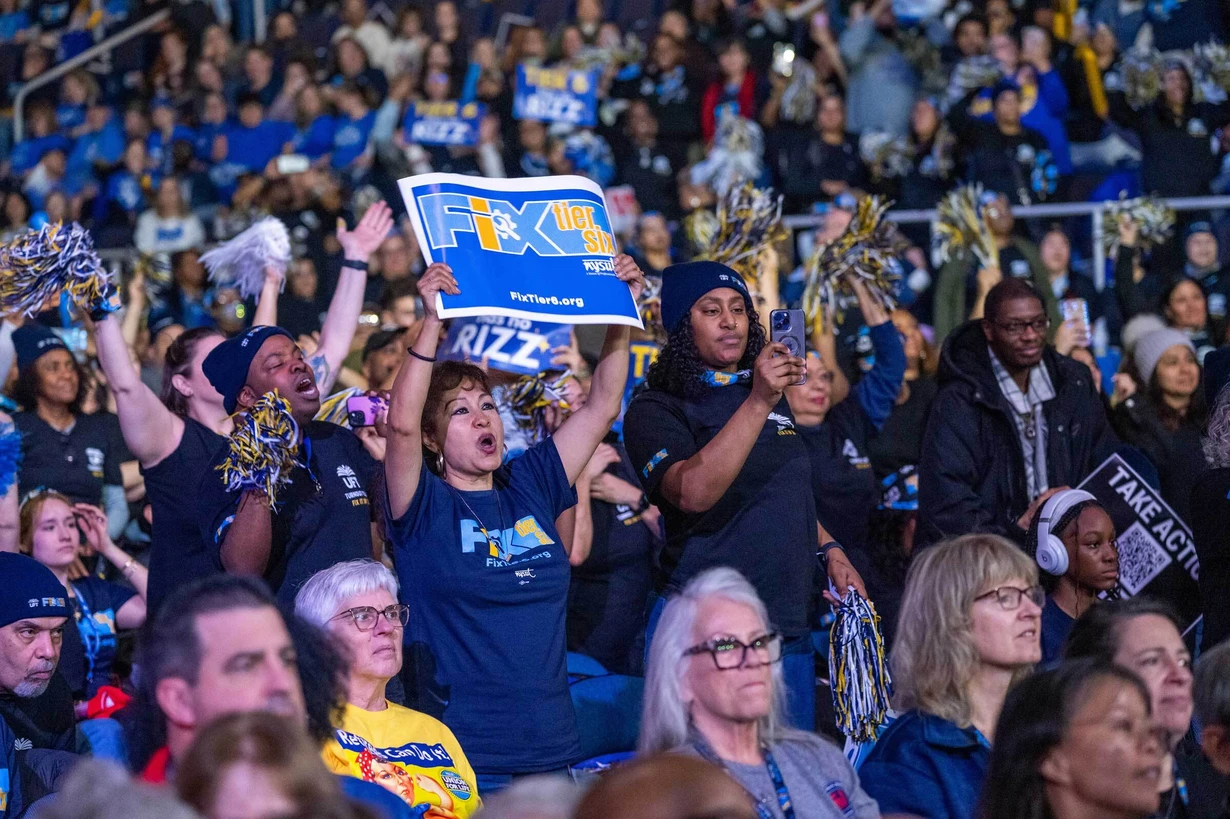
If you were in Albany on March 8, you might have felt the ground shake under your feet as 15,000 public sector union members chanted: “Fix Tier 6!”
It’s a cry for state leaders to boost the pensions of government employees. In 2012, the state created a new pension plan, called “Tier 6,” that had less generous benefits and required more years of work compared to previous plans. Then-Governor Andrew Cuomo claimed the change would save state and local governments $80 billion over three decades.
Now, New York’s top unions want to roll back those changes. They argue it would help keep workers in the public sector, but it won’t come cheap: In dollar terms, it could end up being one of the biggest decisions made in this year’s budget.
The campaign has emerged as a major issue in negotiations around the state budget, which is due on April 1. Here’s what you need to know.
What do the unions want?
The “Fix Tier 6” agenda contains multiple planks, including lowering the age where workers can retire with full pensions, boosting payments, and reducing employee contributions.
Different unions have different priorities. For the New York State United Teachers, the leading player in the Fix Tier 6 campaign, the top goal is lowering the retirement age to 55, down from 63.
“That’s the thing that we believe is impacting retention for our early-career educators,” NYSUT President Melinda Person told New York Focus.
The Public Employees Federation, which represents a wide range of government positions, says its top priority is lowering the amount taken out of workers’ salaries — currently between 3 and 6 percent — to pay for their pensions.
“Because of the affordability crisis, putting money into people’s pockets now makes a difference,” PEF Vice President Randi DiAntonio said.
The unions argue that boosting pensions would help attract and retain qualified workers, and cut down on costs for overtime and consultants.
More people work for state and local government in New York now than in 2012, when Tier 6 was enacted, but staffing shortfalls vary by agency.
DiAntonio said the recruiting and retention concerns are most acute at agencies like the Department of Corrections and Community Supervision, which runs state prisons. The department has been in turmoil since a three-week wildcat strike last year, and this year’s proposed state budget allocates over $500 million to have the National Guard help staff prisons.
Teacher shortages are relatively rare in New York right now, but NYSUT warns that a wave of upcoming retirements, and low enrollment in teacher training programs, could lead to scarcity in the next decade.
Would boosting pensions improve state government?
Union leaders say so.
New York AFL-CIO President Mario Cilento said in a statement to New York Focus that Tier 6 “has created a recruitment and retention crisis” due to “unprecedented mandatory overtime” and “constant hiring, training, and backfilling of vacant positions.”
But there may be more cost-effective ways to attract and retain employees.
Several studies have found that public employees value pensions less than salaries or other benefits like job security and health insurance, that boosting pensions can accelerate retirement, and that pensions may not help retain higher-performing workers.
One of the studies, based on a Wisconsin law that cut teacher salaries and pensions, found that teachers respond four times less to pension changes than to salary changes when deciding whether to remain in their jobs.

Hochul said she’s “fighting for a fairer pension plan” but didn’t provide specifics. Photo: Darren McGee/Office of the Governor.
Boosting pensions “would do something” to keep workers, said David Schleicher, a Yale Law School professor who studies state fiscal systems, “but it’s not clear to me that it is the most or even a mildly efficient method for doing so.”
Boosting pensions does have one advantage for today’s politicians, though. While wage increases require immediate payment, the full bill for a pension boost won’t come due for years.
What would the changes cost?
It’s unclear. The union leaders that New York Focus spoke with didn’t have precise cost estimates for their proposals.
Person, the NYSUT president, said that lowering the retirement age would likely cost somewhere between $100 million and $700 million annually.
“We don’t know what the deal is yet. So it’s hard to nail down a number,” she said.
Subscribe to our free weekly newsletters
The state Senate and Assembly budget proposals also didn’t provide specific figures, despite their support for boosting pensions.
Some budget watchdogs see this as irresponsible.
“We expect cost estimates in every part of normal life,” said Ken Girardin, a fellow at the Manhattan Institute, a conservative think tank. “And yet lawmakers are capable of this cognitive dissonance to endorse a policy proposal when they don’t know the cost.”
Unions say the state can afford the changes, pointing to the strong financial condition of New York’s pension funds.
Supporters of Tier 6 argue that it has helped keep New York’s pension funds healthy even as the amount that New York pays for pensions has exploded, from $1 billion a year in 2000 to more than $15 billion post-pandemic. As life expectancies climb, many workers who retire at 55 are expected to collect pensions for longer than they spent working.
Where do state leaders stand?
New York’s top lawmakers have all endorsed the campaign in general, but have been vague about which reforms they actually support.
At the “Fix Tier 6” rally, Assembly Speaker Carl Heastie said he is “one of the biggest advocates” of getting rid of Tier 6, and that “this is the year we need to blow that shit away.”
Governor Kathy Hochul also spoke at the rally, where she said she’s “fighting for a fairer pension plan,” but didn’t endorse any specific proposal.
And in a video message played at the rally, Senate Majority Leader Andrea Stewart Cousins said that Senate Democrats are “receptive” to Tier 6 reforms, but likewise, didn’t say what exactly should change.
Even several Republicans — generally union skeptics — have supported the push.
Person is optimistic that legislators will go big. “We want to be able to go back to our members and say, ‘This is enough of a signal for you to stay. Please don’t leave public service.’”
posted 2 days ago – March 25, 2026