
The sonographer at the crisis pregnancy center recorded the details of Kaylee Hall’s pregnancy. Likely due in the middle of June. Fetal heart rate measured at 156 beats per minute. The box for intrauterine pregnancy marked as “yes.”
An OB-GYN who works with the center would later say the sonogram was “educational.”
It was also wrong.
Three days after Abundant Life Pregnancy Resource Center in Athens, Texas, gave her that sonogram, Hall was in emergency surgery for an ectopic pregnancy. The embryo she was carrying was not implanted in her uterus, contrary to what the center’s sonographer had told her.
Instead, the embryo was growing inside her right fallopian tube, a placement that made the pregnancy unviable and posed a significant threat to Hall’s health — and life — if left untreated.
Business Briefing
Abundant Life’s executive director, Amanda Pruitt, initially responded to an email from The Dallas Morning News, but declined an interview and did not respond to emailed follow-up questions or a call to the center.
Hall’s case brings this question into focus: Do pregnancy centers, with their primary mission of preventing abortion, also provide high-quality care to the people who walk through their doors?
It’s a question that’s been asked before. In recent years, there have been numerous similar media reports: A string of inaccurate ultrasounds and other medical care in Florida, by a woman with no active medical professional license. A missed ectopic pregnancy in Massachusetts, misinformation about an ectopic pregnancy in St. Louis, and an ultrasound of a bladder instead of a uterus in Wisconsin.
Research, too, has found that a majority of crisis pregnancy centers convey inaccurate or misleading health information in their messaging or their websites, including inaccurate or misleading information about abortion risks, contraception and condoms.
Abortion opponents say pregnancy centers are a clear net positive to their communities. Amy O’Donnell, the executive director of Texas Alliance for Life, sees ultrasounds specifically as literal lifesavers.
“It has been proven that ultrasounds save lives,” O’Donnell said. “When women and their partners … see their unborn child on the screen, they — many times — choose life.”
If there are issues at individual pregnancy centers, said Texas Right to Life president John Seago, the state has enforcement mechanisms in place already. The various licensure boards, such as the Texas Medical Board and the Texas Board of Nursing, are already responsible for regulating medical professionals no matter where they provide care.
Some doctors and reproductive rights advocates worry that pregnancy centers can skirt those rules, either through political power or by framing services as “non-diagnostic” or otherwise exempt from rules that govern medical care.
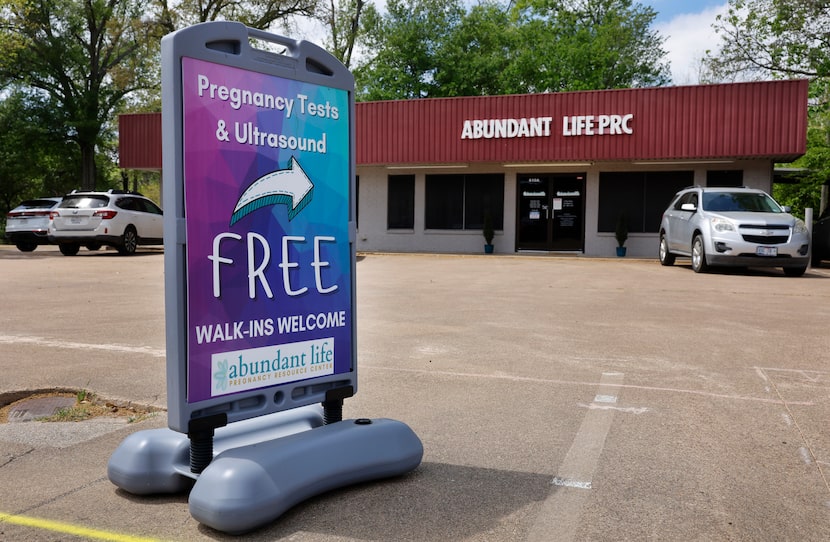
A sign for free walk-in pregnancy tests and ultrasounds draws attention to Abundant Life Pregnancy Resource Center in Athens, Texas, March 26, 2026.
Tom Fox / Staff Photographer
It’s not clear what stance the center takes in Hall’s case. However, an OB-GYN who works with the center, Dr. Lourell Sutliff, responded by text to The News’ question about whether the center has any plans to fix its ultrasound process to avoid a repeat of Hall’s situation.
“Clients acknowledge that these scans are performed for educational purposes only,” Sutliff texted, “there is nothing to fix.”
Hall said she appreciates the good that Abundant Life has done for the community in Athens. The free diapers, the parenting classes. But she disagrees that there’s nothing to fix. She and her primary care doctor both filed complaints about Abundant Life with the Texas Medical Board, but have not heard back.
As she waits, Hall worries about the women still being seen at Abundant Life. She worries that what happened to her might happen again.
The ultrasound
It was October when Hall found out she was pregnant, through an at-home test.
It was her third pregnancy: The first was a baby girl, born full-term and healthy in August 2024. The second pregnancy ended in miscarriage, in April 2025.
The third pregnancy was meant to be Hall’s “rainbow baby,” a term parents sometimes use for a child born after a previous loss of a pregnancy or infant.
Hall was excited to be pregnant again, excited for the possibility of another child to raise. She made an appointment at Abundant Life to confirm the pregnancy.
Hall has a regular physician, too, but she wanted more immediate pregnancy confirmation because she was considering applying for Texas’ Medicaid for Pregnant Women program. It would’ve taken about an extra week, Hall said, to get an appointment with her primary care physician.
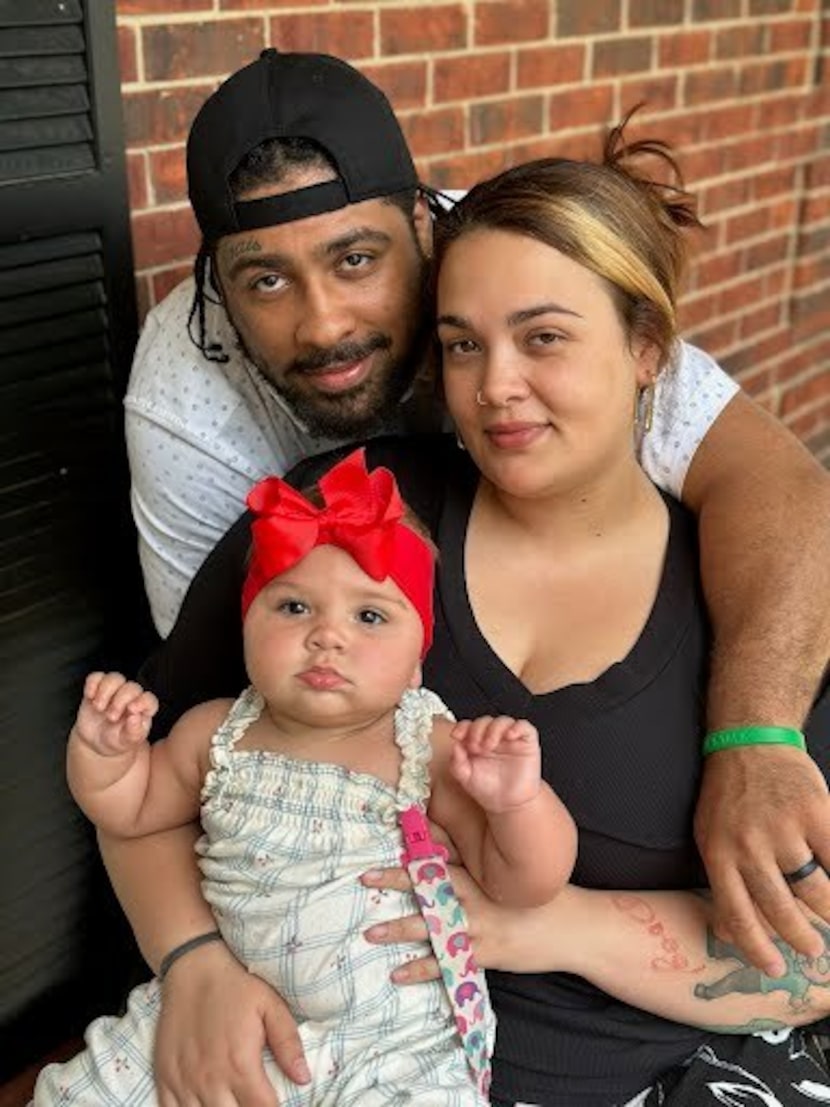
Kaylee and Devin Hall with their daughter, Brielle.
Courtesy of Kaylee Hall
A worker at Abundant Life did an ultrasound on Hall. That day, according to both Hall’s recollection and her visit records, the sonographer recorded the pregnancy as intrauterine. Hall said the worker also told her repeatedly that the pregnancy was normal and healthy.
When Hall left the clinic, she was walking on clouds.
A day later, on a Tuesday, Hall received a call from Abundant Life. The ultrasound images weren’t high enough quality, the caller told her. Could she come in for new ultrasound images the next week, on Monday?
Hall said she asked, in two separate calls with center workers, if she should be concerned. The center’s executive director, Hall said, assured her there was nothing to worry about.
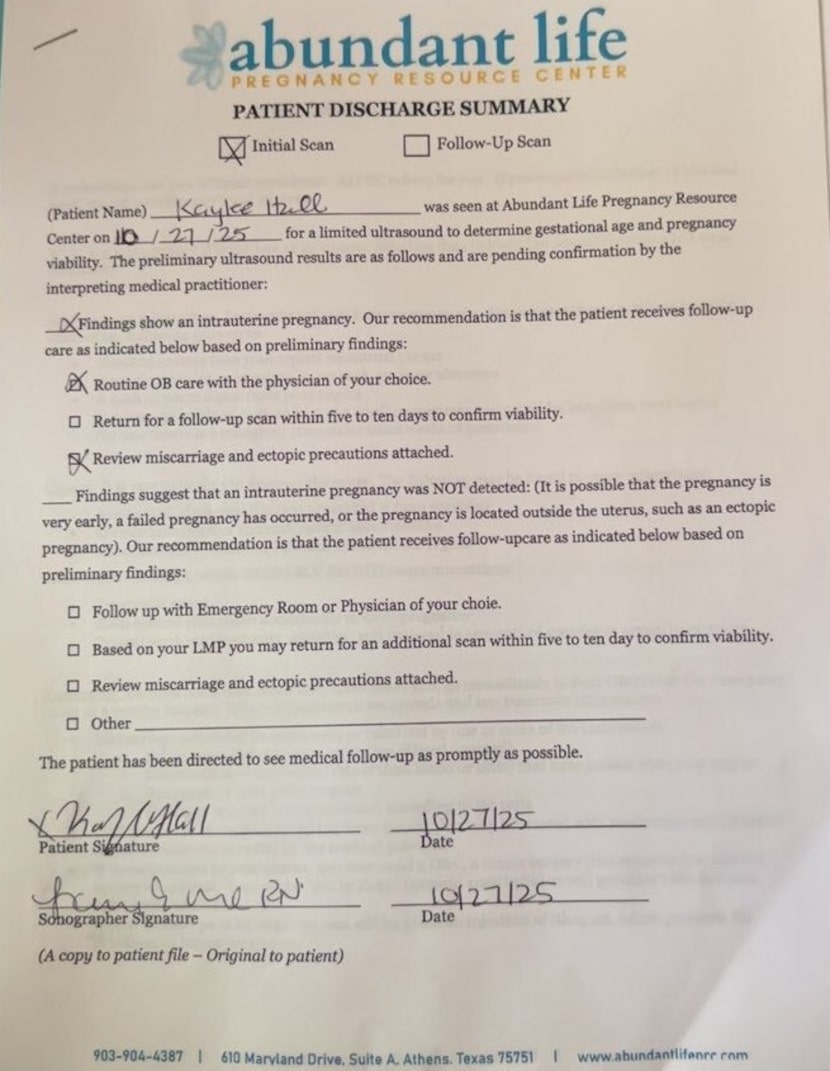
Kaylee Hall went to a pregnancy center in Athens for confirmation of pregnancy. After her ultrasound, the center gave her a piece of paper indicating that her pregnancy was intrauterine. She later learned the pregnancy was actually ectopic.
Courtesy of Kaylee Hall
“She had every opportunity to say, ‘Maybe there’s something wrong,’” Hall said. “But she didn’t.”
Hall felt uneasy about the call and asked her doctor to fit her in as soon as possible. Dr. Alicia Cleaver, in Athens, made room on the schedule for the next morning, a Wednesday.
’Front lines’ of a movement
Pregnancy centers are a central pillar of the anti-abortion movement.
Individual centers can differ widely from each other and may provide a range of services such as pregnancy tests, parenting classes, diapers, maternity clothes and more, typically at no cost. Some centers also provide ultrasounds or STI testing.
The Thriving Texas Families program sends millions of dollars in state funding to pregnancy centers each year, for non-medical supplies and services.
While the exact services may vary from one center to the next, they share a common goal: preventing abortion. Pregnancy centers don’t offer abortion services or referrals, and they typically do not provide birth control.
Seago, at Texas Right to Life, described them as the “front lines” of the pro-life movement.
“The pro-life movement really would be just politics, or just a policy thinktank,” he said, “without this critical piece of serving women every single day across the state of Texas.”
O’Donnell, at Texas Alliance for Life, similarly described the centers as the “boots on the ground” for pregnancy support.
“Pregnancy centers are strategically located in rural and urban communities to meet the needs of pregnant women, especially women facing unplanned pregnancies,” she said, “to help them with the support they need to give life to their baby and raise their baby.”
Pregnancy centers are often affiliated with a church or other Christian organization.
Abundant Life’s website does not contain any language that would indicate the center is religious or anti-abortion, or that it’s associated with any larger organizations. However, Abundant Life is listed as an affiliate on the websites of both Heartbeat International and Care Net, two massive networks of crisis pregnancy centers.
Both of those networks are explicitly Christian and explicitly anti-abortion.
Heartbeat International’s website says the network’s vision “is a world where every new life is welcomed and children are nurtured within strong families, according to God’s Plan, so that abortion is unthinkable.”
Care Net has a similar mission statement.
“Our Pro Abundant Life vision means that our goal is not just to save babies from abortion,” Care Net’s website says, “but to ensure that they and their parents have the abundant life that can only be found in Christ.”
Some centers — including Abundant Life — also work with licensed medical professionals.
Because a medical professional’s license is attached to them, and not the building where they’re working, they are legally allowed to provide medical care at crisis pregnancy centers — as long as it’s in line with the limitations of their license.
However, because pregnancy centers themselves are not medical facilities, there’s no clear agency in charge of regulating them.
Both Seago and O’Donnell described pregnancy centers as filling a gap in care for women who live in rural or otherwise underserved areas.
To Blake Rocap, an attorney who works specifically on reproductive rights and justice, that’s a concern. He worries that an increasing number of Texans may seek pregnancy care at these centers because they don’t have access to more traditional or full-spectrum prenatal care. Hall’s case, Rocap said, illustrates that point.
“What she really needed was a doctor’s appointment, and she knew that, but she couldn’t get one,” Rocap said. “What she really needed was to get health care and instead what she got was whatever this was at the CPC.”
The follow-up appointment
Hall’s follow-up appointment was at 10:15 a.m. at Dr. Alicia Cleaver’s office in Athens, one day after her ultrasound at Abundant Life.
When Cleaver ran a sonogram on Hall, she found something much different than the crisis pregnancy center had reported. Hall’s uterus was empty.
The pregnancy was ectopic, a medical term for a pregnancy located outside of the uterus. In Hall’s case, the embryo had attached in her right fallopian tube.
Cleaver said it can be hard to see the actual ectopic pregnancy on an ultrasound at that early stage. But the ultrasound very clearly showed, Cleaver said, that Hall’s uterus was empty.
“Definitely, definitely nothing inside,” the doctor said in a phone interview.
That, at least, should’ve been caught at the pregnancy center, Cleaver said. The missed signs, she said, made her angry.
Ectopic pregnancies account for 1 to 2% of all pregnancies in the U.S. The vast majority of the time, an ectopic pregnancy takes place in a fallopian tube, which is a part of the reproductive system that is not able to stretch in the way the uterus can.
Because of this, an ectopic pregnancy can rupture, which can damage or destroy internal organs and can lead to the loss of a fallopian tube. A rupture can also cause internal bleeding which, in severe cases, can be fatal.
Cleaver sent her patient home while she set up follow-up care at a larger hospital in Tyler. At that hospital, Cleaver said, Hall would be able to take medication to treat the ectopic pregnancy.
But Hall didn’t make it to the Tyler hospital.
The day after her appointment with Cleaver, and three days after Abundant Life told her the pregnancy was intrauterine, Hall started feeling “a weird pain.” She drove to the closest emergency room, in Athens.
Did Abundant Life break any rules?
Reproductive rights advocates worry about pregnancy centers advertising their ultrasounds as “non-diagnostic,” which would imply they aren’t subject to the rules that govern medical care.
The first question, then, is whether an ultrasound to confirm pregnancy is legally considered medical care in Texas.
Representatives of the Texas Medical Board, through spokesperson Spencer Miller-Payne, declined an interview request for this article. Miller-Payne instead emailed written answers to The News’ questions.
The purpose of an ultrasound matters when determining if it’s medical care, the board wrote, pointing to instances where ultrasounds could be used for animals or, in the case of pregnancy, simply to hear a baby’s heartbeat.
“Thus, the purpose of the ultrasound is significant,” the board wrote. “When conducted in a healthcare setting to confirm pregnancy, it always constitutes medical care.”
In those cases, then, pregnancy ultrasounds are required to be performed by medical professionals.
Hall’s ultrasound record includes the name of the sonographer. In social media posts, the center describes that person as a nurse, and state records show an active nursing license under the same name.
Calls and texts to a phone number associated with the worker’s name, as well as Facebook messages to her profile, went unanswered.
However, a registered nurse still needs to have ultrasound results read and interpreted by an advanced practitioner, such as a physician.
When performing an ultrasound, a registered nurse “cannot look at it in real time with the patient or interpret the exam itself,” Miller-Payne wrote in an email. “That must be done by someone with a scope of practice that allows them to diagnose or treat patients.”
Hall’s medical records include an ultrasound report, signed by the center’s sonographer, recording the pregnancy as intrauterine. The center also gave Hall a “patient discharge summary” on the day of the ultrasound, which again recorded the pregnancy as intrauterine. Hall also said that the sonographer repeatedly told her, during the ultrasound, that the pregnancy was healthy.
Sutliff, the OB-GYN who works with Abundant Life, reviewed Hall’s ultrasound after the fact. By the time he signed and timestamped his review, three days after the ultrasound and one day after Cleaver called to notify the center of the incorrect reading, Hall was already feeling the “weird pain” that would send her to the emergency room.
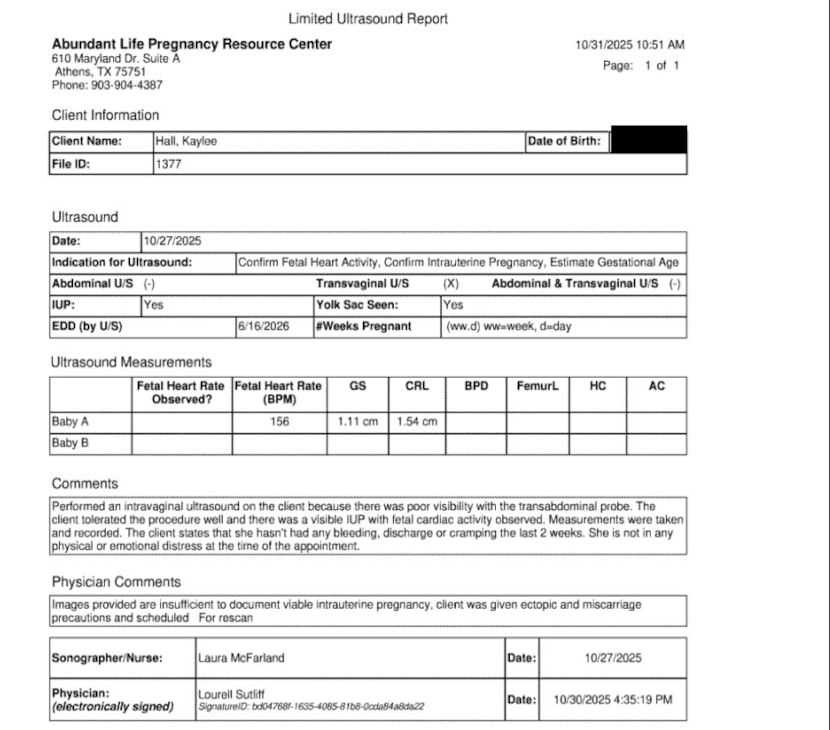
This screenshot, from Kaylee Hall’s medical records, shows the ultrasound report from Abundant Life Pregnancy Resource Center. The report shows the initial sonographer notes, plus physician notes added later.
Screenshot of records from Lakel
Sutliff declined multiple interview requests, but he did respond a few times over text.
“Regardless of the sonographers opinion, all clients are given precautions regarding ectopic pregnancy and miscarriage,” he wrote.
Hall provided photos of documents that the center gave her on the day of the ultrasound, which do include general precautions about miscarriage and ectopic pregnancy.
With another piece of paper indicating her pregnancy was not ectopic, though, Hall had left the clinic thinking that concern didn’t apply to her.
The emergency surgery
At the hospital, UT Health Athens, Hall’s pain was getting worse.
She remembers being doubled over, in too much agony to look at her phone or do anything else. In her medical records, a hospital provider notes that Hall appeared “uncomfortable, writhing around in the exam chair.”
At the hospital, Hall got another ultrasound, which again showed the embryo was in her fallopian tube.
Hall remembers the medical providers telling her they were worried the ectopic pregnancy could rupture her fallopian tube at any time. They worried, Hall said, that it might rupture before she could be transferred to Tyler, to the larger hospital.
Hall underwent laparoscopic surgery in Athens that night, her medical records show, at 10:56 p.m.
She was, relatively speaking, lucky: She survived and she didn’t lose a fallopian tube or suffer any other organ damage.
But Hall is keenly aware of how close she was to catastrophe, how close her young daughter was to losing a parent.
It was Thursday night when Hall underwent emergency surgery, still several days before the Monday when Abundant Life intended to redo her ultrasound.
“I quite literally don’t think I would’ve made it to Monday alive,” Hall said. “My daughter could’ve not had a mom.”
Where could change come from?
Andrea Trudden is a spokesperson for the pregnancy center network Heartbeat International, which lists Abundant Life as an affiliate.
She said she feels sad for Hall’s situation and understands Hall’s worries.
Trudden said she wishes there weren’t errors at pregnancy centers or at doctor’s offices or hospitals. When these cases do arise, she said, it’s a time for providers to reflect on their work.
“It’s an opportunity,” Trudden said, “for everybody to look at their policies, procedures, walk through them again and make sure that they’re doing everything that they can.”
Abundant Life’s executive director did not answer The News’ questions, including a question about whether the center is making any changes to its ultrasound process. The OB-GYN who works with Abundant Life, Sutliff, said in a text that there is “nothing to fix.”
Hall said she appreciates the free, non-medical services that Abundant Life provides to the community in Athens. But she wants to see change when it comes to ultrasounds.
Hall and her doctor, Cleaver, want to see Abundant Life and other pregnancy centers stop offering ultrasounds that may be low quality.
“I do not think pregnancy centers should be doing sonograms at all,” Cleaver said, “because they are not a medical clinic and a sonogram is a medical diagnostic procedure that requires trained personnel to read and interpret a study.”
That’s a stance echoed more broadly by Dr. Rachel Jensen, an OB-GYN who’s currently a fellow with the American College of Obstetricians and Gynecologists and who is unconnected with Hall’s case. Because of the risks of inaccurate or incomplete information, Jensen believes crisis pregnancy centers should either stop offering ultrasounds or become subject to stricter regulations.
“It would be wonderful if people could access free prenatal care,” Jensen said. “But we can’t allow that to be substandard, inaccurate care that could potentially lead to more dangerous outcomes for patients.”
Seago, at Texas Right to Life, said changes to pregnancy centers as a whole would be the “wrong approach.” If there are concerns about care provided at an individual pregnancy center, Seago said that’s an issue that should be taken up according to the existing enforcement avenues.
It isn’t clear if there’s any state agency responsible for regulating pregnancy centers themselves.
A spokesperson for Texas Health and Human Services wrote in an email that the agency “does not license crisis pregnancy centers or pregnancy resource centers.”
Rocap, the reproductive justice lawyer, suggested the Texas attorney general may have authority to investigate crisis pregnancy centers. The News requested comment from Attorney General Ken Paxton’s office, but the office did not respond.
When Paxton’s office has taken public action regarding crisis pregnancy centers, it’s largely been to defend centers — such as with a 2023 lawsuit against Yelp for adding disclaimers on the centers’ listings.
However, when it comes to individual medical providers, there’s a clearer oversight path.
Medical licensure boards such as the Texas Medical Board and the Texas Board of Nursing are responsible for upholding medical professional standards no matter where an individual provides care.
Both Hall and Cleaver have filed complaints with the Texas Medical Board, accusing Abundant Life of practicing medicine without a license.
The News filed a public records request for these complaints and any related documents, but the board declined to release anything. The News obtained copies of the complaints from the patient and her doctor.
It’s not clear how much traction Hall’s and Cleaver’s complaints may get with the Texas Medical Board or, if referred, with the Texas Board of Nursing.
Elizabeth Sepper, a professor at The University of Texas at Austin’s School of Law, said that crisis pregnancy centers operate in a “shadowy gray area” of the law. As a whole, she said, the centers also “have enormous amounts of political and economic power, especially in a state like Texas.”
Because of that, going up against a center — or its workers — would be no small feat.
“A political actor like a prosecutor, like the Texas Medical Board, would need to gird its loins for a fight,” Sepper said, “because that’s what they would get.”
Seago said that any concerns about whether a medical licensure board will enforce its own rules should be taken up with the board itself, not with pregnancy centers or any other type of centers.
“We need to make sure that those oversight boards are efficient,” he said, “that they are doing their job, that they are holding accountable and getting to the truth no matter what kind of center it is.”
‘We could have avoided this’
Hall struggled in the days and weeks after the emergency surgery.
There was, of course, the grief of losing a pregnancy. But for Hall, the convoluted process of finding out about the ectopic pregnancy, and then undergoing emergency surgery, added layers to her pain.
“The fact that it was ectopic was clearly not their fault, that just happened. But I could have had it dealt with, not having to involve surgery,” Hall said. “We could have avoided this just altogether.”
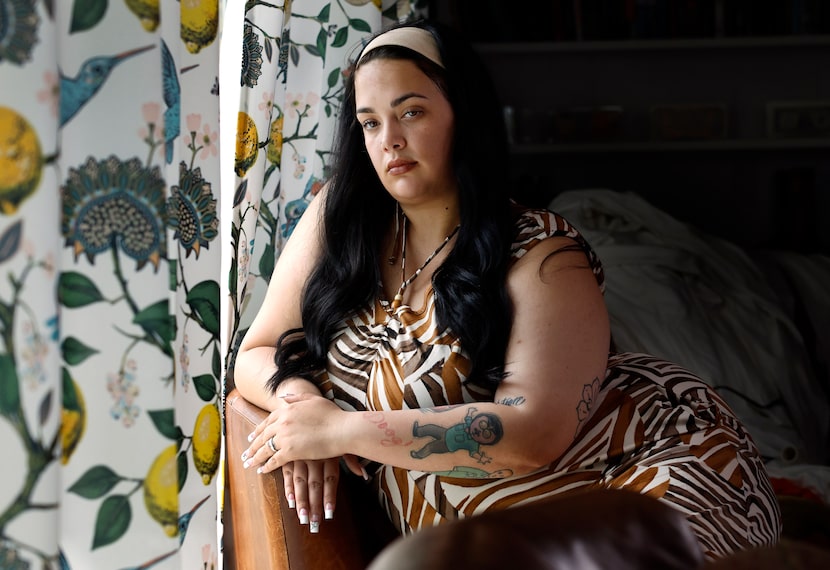
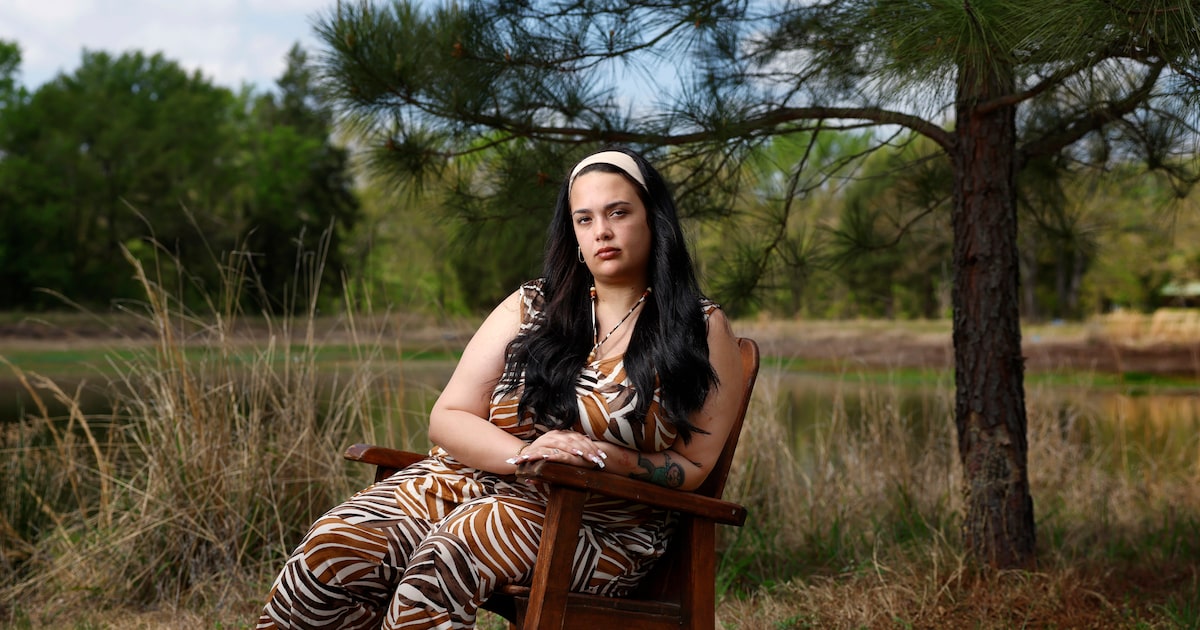
Kaylee Hall of Athens, Texas is photographed at her parents home in Malakoff, March 26, 2026. A Texas pregnancy center told Hall that her pregnancy was viable. It wasn’t. Three days after she visited the center, Hall had emergency surgery for an ectopic pregnancy.
Tom Fox / Staff Photographer
Her anguish shows up in her medical records. At a follow-up appointment in Cleaver’s office, the medical staff wrote that Hall was “having trouble coping after the ectopic pregnancy.”
Rocap worries about other pregnant Texans, too, especially as the state’s maternal care system continues to fall short. Statewide, as The News reported in 2025, hospitals are closing labor and delivery units, particularly in rural areas, leaving more pregnant Texans without access to perinatal medical care.
“We have this big gap in what’s needed and, rather than filling that gap,” Rocap said, “we’re spending resources to prop up these politically aligned charities that don’t fill the gap and in fact have the potential to cause harm because they’re not real health care.”
Hall worries about the other patients she saw at Abundant Life on the day of her inaccurate ultrasound.
“I saw three other people in the lobby,” Hall said. “Did you have the same ultrasound tech telling all of them their babies are fine?”
Hall hopes something will change. She hopes something will change before a pregnancy center incorrectly informs another woman that her pregnancy is healthy. She hopes something will change before another woman isn’t as lucky as she was.