
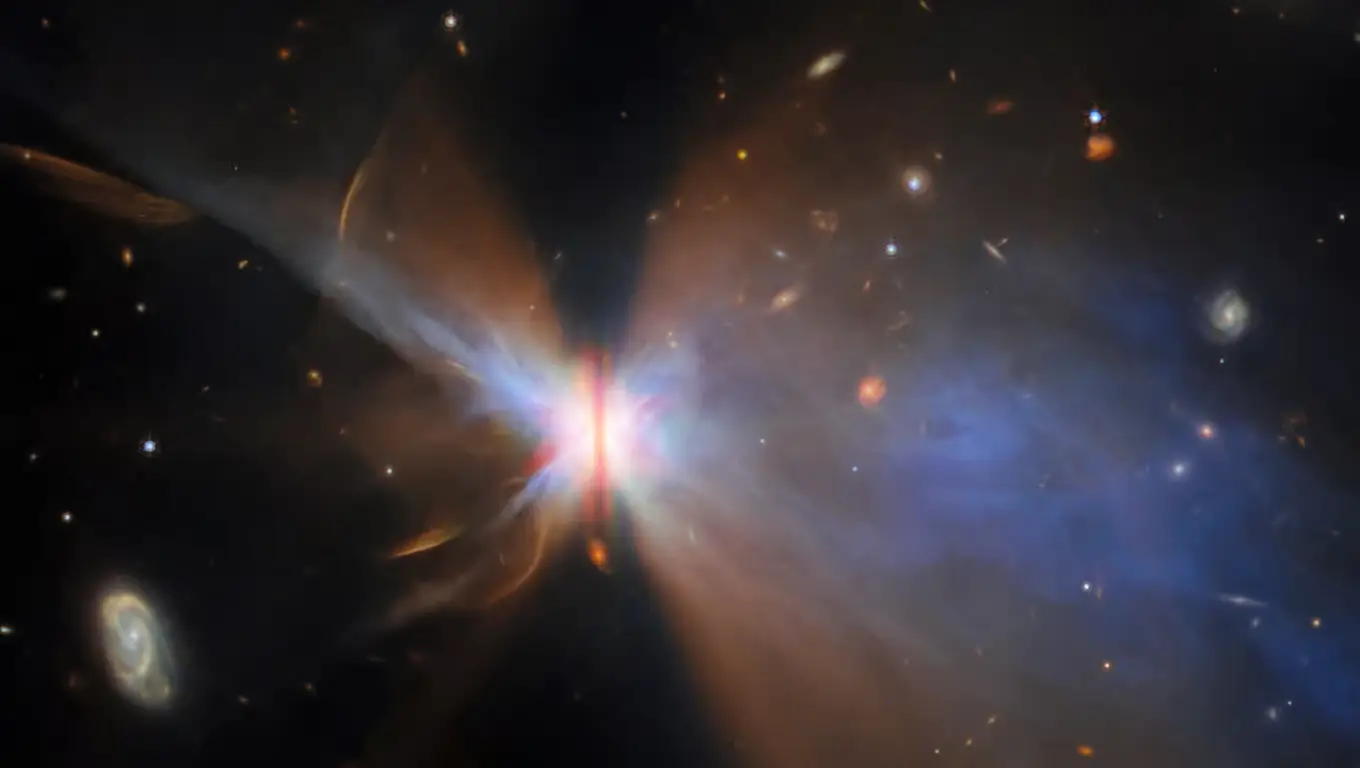
Astronomers have taken a major step forward in understanding how planets form. Using the powerful James Webb Space Telescope, researchers have captured what appears to be a young planet in the process of forming, located roughly 525 light-years from Earth.
The observation offers a rare glimpse into one of the most complex and elusive processes in astronomy: the birth of a planet.
A direct look at planetary formation
Planet formation typically occurs inside vast disks of gas and dust that surround young stars. These regions are difficult to observe because they are often obscured by dense material.
Thanks to its advanced infrared capabilities, the James Webb Space Telescope can peer through these dusty environments and reveal structures that were previously hidden.
In this case, scientists identified a distinct bright region within a protoplanetary disk, believed to be a forming planet gathering material from its surroundings.
An astronomer involved in the research explains:
“We are essentially witnessing a planet assembling itself in real time.”
What makes this discovery unique
While astronomers have previously detected signs of planet formation, direct observations like this remain extremely rare. The level of detail captured in this image allows researchers to study:
how material accumulates around a forming planet
how gaps form within the surrounding disk
how young planets interact with their environment
These insights are crucial for refining current models of planetary evolution.
A system not so far away
At a distance of around 525 light-years, the system is relatively close in astronomical terms. This proximity makes it an ideal candidate for further observation and long-term study.
Scientists expect that continued monitoring could reveal how the planet evolves over time.
Opening a new era of discovery
The James Webb Space Telescope has already transformed our understanding of the universe, from distant galaxies to nearby stellar systems. This latest observation highlights its ability to explore the earliest stages of planetary life cycles.
A window into our own origins
Studying how planets form in other systems also helps scientists better understand the history of our own solar system. The processes observed today may resemble those that shaped Earth billions of years ago.
A rare cosmic moment captured
Although the universe is filled with forming planets, catching one in the act is exceptionally difficult. This observation provides a unique snapshot of a process that usually unfolds over millions of years.
And for researchers, it represents something extraordinary: a direct look at the birth of a new world.