
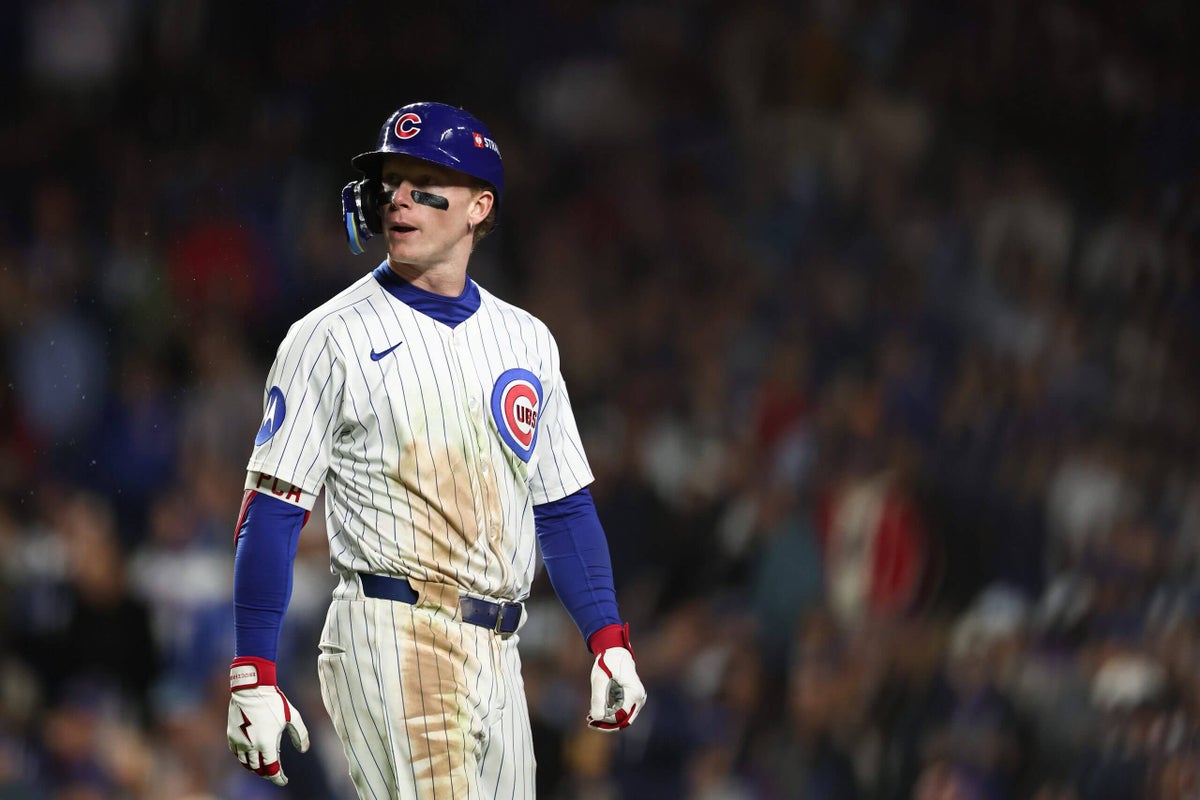
CHICAGO — Pete Crow-Armstrong enjoys performing in front of 40,000 fans and absorbing all that energy from the crowd. At 24, he’s essentially spent half of his life as a sporting commodity, going back to his selection for USA Baseball’s 12-and-under national team. He felt something different, though, while looking around the conference room at all the familiar faces.
All these memories came rushing back Friday afternoon as he sat on the second floor of the Wrigley Field office building, where the Chicago Cubs trumpeted a six-year, $115 million contract extension for the new face of their franchise.
“My hands are a little sweaty,” Crow-Armstrong said near the end of the news conference. “This is more nerve-racking than going out and standing in center field.”
For Crow-Armstrong, this was both a pragmatic move and an emotional decision. His opening statement recognized the sacrifices made by his parents, Matt and Ashley, who raised their only child in Southern California while acting, teaching and chasing his baseball dream.
“It’s time to get you to Chicago for good,” Crow-Armstrong said. “I’m proud to have both of your names on my back.”
Sitting next to his parents in the front row were his agents, Ryan Hamill and Ollie Linton of Creative Artists Agency. Linton had once called Hamill after watching Crow-Armstrong play varsity baseball as a freshman at Harvard-Westlake, a prestigious high school in Los Angeles: You got to see this kid.
CAA’s connections to the Harvard-Westlake program include Max Fried and Lucas Giolito, first-round picks in the 2012 draft. The agents watched Crow-Armstrong punctuate a double with a headfirst slide.
“His helmet pops off and he’s got long red curls down to his chin,” Hamill recalled with a laugh. “I go, ‘Who is this kid?’ He’s playing like his hair’s on fire. And his hair is on fire.”
The “PCA” experience had already begun, as he pounded his chest and tried to pump up his teammates: Let’s go!
“Same way he is now,” Linton said with a smile.
Leading to the 2020 draft, Matt Armstrong mused about how cool it would be if Pete got drafted by the Cubs. Matt had grown up in Naperville, Ill., and still followed the team closely. Imagine, someday, getting a place in Wrigleyville and walking over to watch your son play center field at the Friendly Confines.
Crow-Armstrong’s senior season was shut down during the pandemic, which likely lowered his draft stock. After the Cubs passed at No. 16, the New York Mets selected him with the 19th pick and bought out his college commitment to Vanderbilt with a $3.359 million signing bonus.
And then on his first day in professional baseball, Crow-Armstrong overslept.
As the Mets reviewed a round of COVID-19 intake testing at their Florida training complex, one name had not been checked off yet. Someone had to go wake up Crow-Armstrong in his hotel room. New York’s farm director at that time, future Cubs executive Jared Banner, treated it as a learning experience.
Before moving to Chicago, Banner saw Crow-Armstrong’s unique athletic traits up close and got a better feel for his personality. Banner’s perspective helped convince Cubs president of baseball operations Jed Hoyer to acquire Crow-Armstrong in the Javier Báez deal at the 2021 trade deadline.
At that point, Crow-Armstrong was still recovering from shoulder surgery, with only six A-ball games on his professional resume, a gap Crow-Armstrong acknowledged while giving Banner a shout-out during his opening remarks: “I don’t know if I would be in a Cubs uniform if it wasn’t for you.
“I appreciate the tough love the very first day that I showed up late to Mets camp,” Crow-Armstrong said. “You didn’t care that I was a first-round pick and this guy that’s walking in with his hair all bleached and an earring.”
Image isn’t everything. Cubs officials quickly understood how much Crow-Armstrong cared. Two hitting instructors who had worked with him in the minors, Dustin Kelly and John Mallee, joined Chicago’s major-league coaching staff, continuing to refine his daily routine, swing mechanics and mental approach.
Their presence at the news conference — along with that of Cubs manager Craig Counsell, staff assistant AJ Lewis and first baseman Michael Busch — spoke to the group efforts that helped Crow-Armstrong blossom into an All-Star.
“He never stops trying to get better,” Banner said. “He’s a cheerleader for his teammates. He represents the organization with class off the field. He’s an inspiration to all the young players in our system. There’s a reason you see his jersey on so many kids walking around Chicago.”
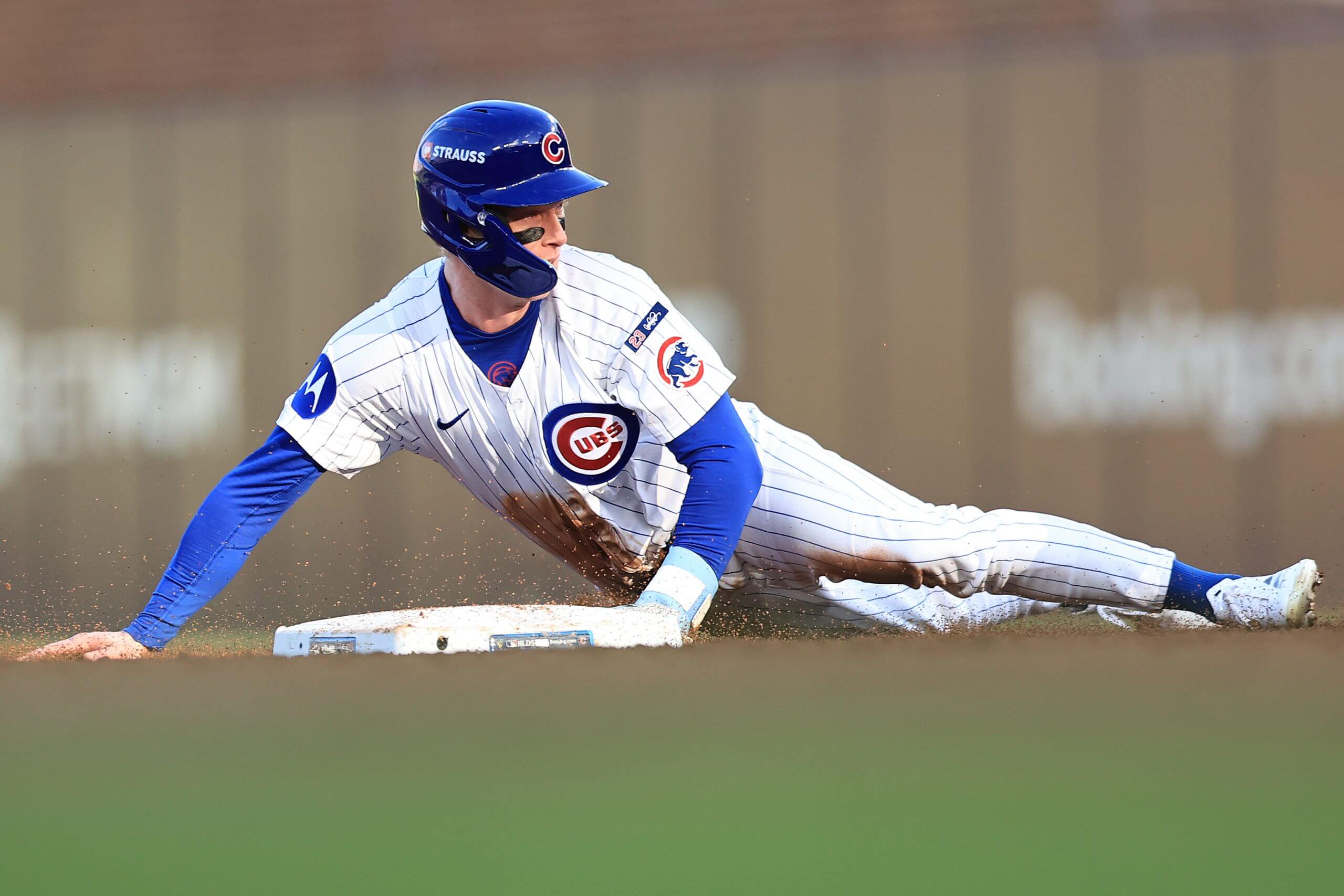
Pete Crow-Armstrong had a hit, two RBIs and a stolen base in the Cubs’ 4-3 Game 3 win at Wrigley Field in the 2025 National League Division Series against the Milwaukee Brewers. (Geoff Stellfox / Getty Images)
In the end, Crow-Armstrong couldn’t picture himself playing anywhere else. With Marquee Sports Network broadcasting the press event, Crow-Armstrong praised Counsell, the manager who showed patience during his offensive struggles: “He really gives a s— about us as people.”
This will always be personal for Crow-Armstrong, who understands that small gestures and brief interactions can create lifetime memories for fans. In engaging CAA in on-and-off negotiations for over a year, Hoyer recognized how well Crow-Armstrong handles fame, and how valuable his persona is to the team’s brand.
Cubs chairman Tom Ricketts, president of business operations Crane Kenney and chief commercial officer Colin Faulkner all popped into the conference room inside the team’s administrative building to watch Crow-Armstrong, whose marketing portfolio now includes deals with Gatorade, New Balance, Corona and Southwest Airlines.
As an organization, the Cubs seem to have learned from the breakup of the 2016 World Series team, and how that transition may have gone smoother with the right contract extensions.
“It wasn’t through lack of trying before,” Hoyer said. “We definitely had these discussions, but this is one where it was pretty clear from the outset that there was mutual interest. That, sometimes, is the most important thing. There are times when the player is not interested, which I totally understand. That’s their right.
“In this case, they made it clear that getting a deal done and staying here for a long time was a priority, so that made the conversation real easy. There was never a question of desire on either side.”
Baseball is so unpredictable and the industry is too volatile to know how this will end in 2032. But for the Cubs and Crow-Armstrong, this moment was all about what it took to get here.
“This city means everything to me,” Crow-Armstrong said. “It really welcomed me. They’ve been patient with me and my performance. That’s definitely inspiring stuff when I wake up and I think about what I want to achieve.”