
Jonathan Canites sounded distracted when I called at our previously arranged time on an unseasonably hot March afternoon. After a minute of exchanging niceties, I sensed something was off and asked if we should connect at a later time. Canites jumped at the idea — he was in the middle of fixing a washing machine, he said. He’d call me back soon.

Less than two years ago, Canites and his business partner Brian Lagman got in on a viral passive income trend, and purchased a laundromat at the edge of San Francisco’s Outer Mission.
For the uninitiated, the internet is swimming in videos showing the life-changing effects of laundromat ownership. On TikTok, these montages are usually set to peppy songs and reveal the glory in a series of neatly edited clips that usually go something like this: Someone is pushing a laundry cart, they’re unlocking metal cases, they’re dumping out hundreds upon hundreds of quarters into buckets like they just hit the mega jackpot at Dave & Buster’s.
Article continues below this ad
On-screen captions provide other crucial info: These people barely work, yet they are rich.
The sign for the Laundry Hub SF, a laundromat in San Francisco, on March 20, 2026.
Douglas Zimmerman/SFGATE
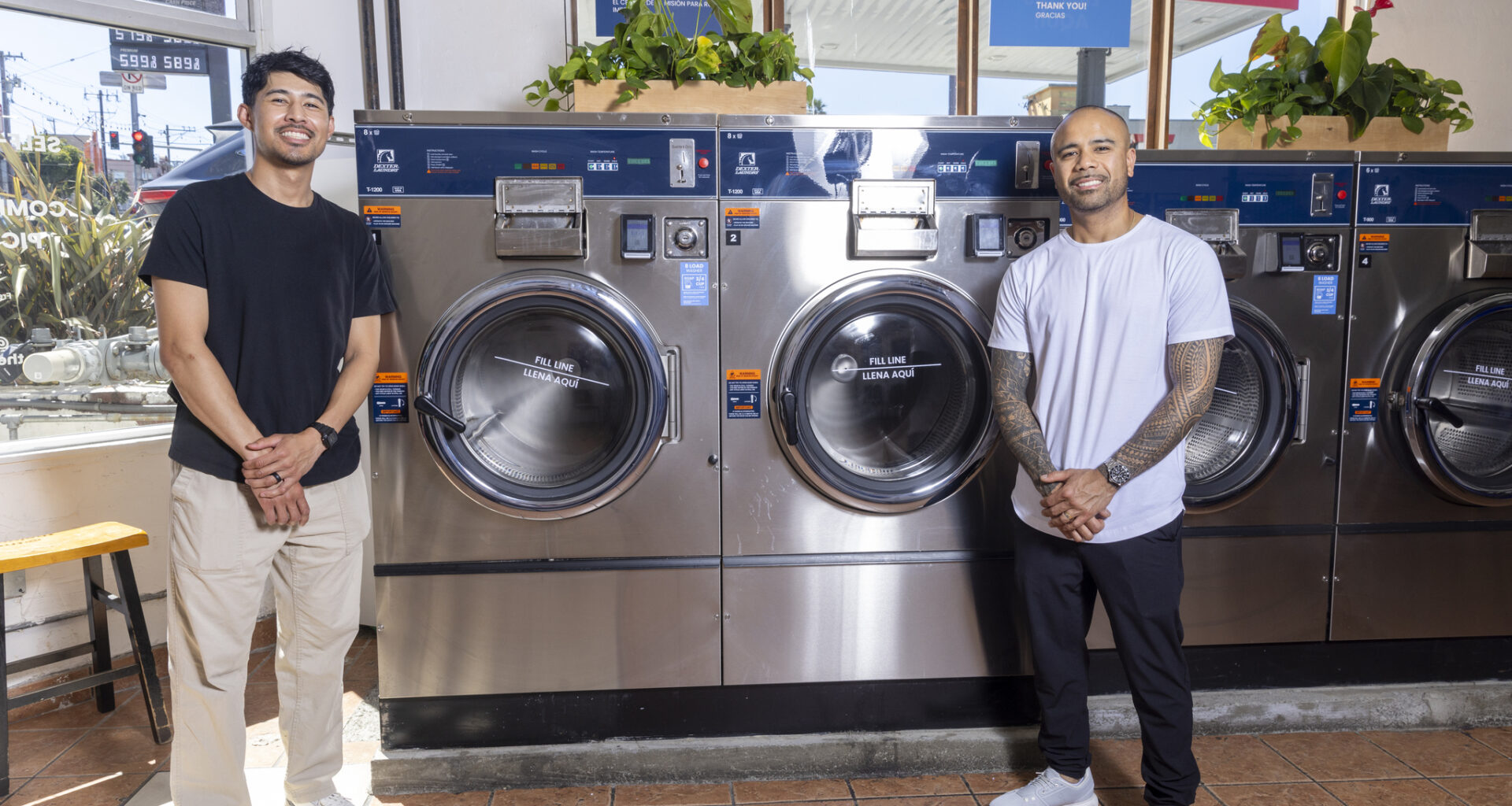
Owners Brian Lagman, left, and Jonathan Canites stand in front of dryers at the Laundry Hub, a laundromat in San Francisco, on March 20, 2026.
Douglas Zimmerman/SFGATE
Laundry carts available for customers at the Laundry Hub, a laundromat in San Francisco, on March 20, 2026.
Douglas Zimmerman/SFGATE
It’s an alluring prospect, especially at a time when most everyone has played out scenarios of artificial intelligence ripping away their livelihood. Maybe instead of spending months futilely job searching on LinkedIn, they can end up like one of the most famous faces in the laundry universe, Cami Wengert.
Article continues below this ad
Make SFGATE a preferred source so your search results prioritize writing by actual people, not AI.
Add Preferred Source
Better known as Laundromat Girl, Wengert bought a laundromat in 2020 and quit her nursing job to dedicate herself to this new life path full-time in 2023. She frequently posts about how despite only working 10 to 15 hours a week, her laundry business brings in three times more than nursing did.
“I wanted something that was turnkey,” Lagman admitted during a phone call. He was seeking something, “quote, unquote, passive, with less people, not a lot of headaches.”
While owning the Laundry Hub — located at 5090 Mission Street near the intersection of Geneva Avenue — has turned out to be rewarding in unexpected ways, the venture has also proven to be anything but hands-off.
Article continues below this ad
Buying a laundromat
Canites and Lagman, both 36, met several years ago in Las Vegas at WealthCon, a conference for investors looking to scale their business. Canites runs a handyman business and Lagman is an engineer. On top of their day jobs, they were both already involved in real estate and looking for a different side hustle.
Their Bay Area roots acted as a bridge, and eventually the duo began exploring the world of laundromats for the first time ever. They cold-called businesses.
Owners Brian Lagman, left, and Jonathan Canites stand next to some newly installed washing machines at the Laundry Hub, a laundromat in San Francisco, on March 20, 2026.
Douglas Zimmerman/SFGATE
“I would say about 70, 60% of the people that we spoke with, they were older folks getting ready to retire,” Lagman said. They found what is now the Laundry Hub on OfferUp, an online marketplace that’s essentially a sleeker Craigslist, typically used for finding things like West Elm coffee tables and gaming devices. Due to the cash nature of the business, loans are tough to secure for laundromats, so Canites and Lagman used their real estate chops to work out a seller financing arrangement.
Article continues below this ad
They officially closed on the now-bright, plant-filled space in November 2024.
A $100,000 bet
Pretty quickly, they realized the profit and loss figures presented by the owner did not match reality. The first few months, they were deeply in the negative, and pulling money from their own pockets to keep the business afloat.
“It was very difficult, because we’re juggling our full-time jobs,” said Lagman during a phone call. “We had a lot of broken machines. We had a lot of customers complaining constantly, so they were calling our numbers every time.”
Article continues below this ad
Lagman and Canites both have their contact info posted on the wall inside the laundromat so customers can reach out with issues. They also have cameras rigged inside, with live feeds they can see on their phones.
A customer uses a large washing machine at the Laundry Hub, a laundromat in San Francisco, on March 20, 2026.
Douglas Zimmerman/SFGATE
After viewing the footage, Lagman noticed a pattern: customers bringing huge garbage bags of laundry, seeing that machines were down, and leaving.
The gut punch ended up serving as a light bulb moment.
Article continues below this ad
Canites and Lagman decided to double down, and went in on new machines. “It was a risk,” Lagman said. Large, heavy-duty machines cost $18,000 per unit, and the total cost for the upgrade was over $100,000. They financed the investment.
Soon, they started to see more customer traffic, and developed more plans to modernize operations, including installing card readers on the machines.
The reality of owning a laundromat
While the improvements helped, Canites and Lagman weren’t in the black yet. A parade of problems ensued. A blockage, stemming from a shoe insole, rags and coins clogging a pipe, flooded the entire laundromat.
Article continues below this ad
“I remember this because it was my daughter’s birthday that day,” said Lagman, recalling the precise date. The buildup was so intense that it couldn’t be snaked out, and a whole section of tile floor had to be cut out for the water to drain to the main line. To this day, you can see a cluster of different colored flooring in the front.
Signs for customers on a wall at the Laundry Hub, a laundromat in San Francisco, on March 20, 2026.
Douglas Zimmerman/SFGATE
Large clothes washing machines at the Laundry Hub, a laundromat in San Francisco, on March 20, 2026.
Douglas Zimmerman/SFGATE
Fortunately, the previous owner went half-and-half on the $6,000 job that Canites couldn’t resolve. Typically, he handles most of the repairs.
Article continues below this ad
There was also a permitting snafu, and Canites and Lagman slogged through the process for over five months, only to learn the permit wasn’t actually needed.
“Luckily, it wasn’t, like, a big, hefty amount,” said Lagman of the permit fee, which was never refunded.
Then there were the issues with unhoused people sleeping inside the business, which automatically opens its doors at 5 a.m., and individuals rummaging for coins under machines. Canites and Lagman both agree that this worked itself out once business picked up.
A lot of these challenges are documented in the Laundry Hub’s Instagram posts, alongside general laundry advice.
Article continues below this ad
Becoming part of the neighborhood
Both Canites and Lagman grew up going to laundromats and saw them as an extension of someone’s home. They hired an attendant to keep the space clean, and Lagman’s brother installed a vending machine, stocked with laundry supplies as well as popular drinks and snacks. On some busy days, they’ll bring in coffee and doughnuts. During the holidays, they put up a Christmas tree and held a toy drive for the kids.
A customer takes laundry out of a dryer at the Laundry Hub, a laundromat in San Francisco, on March 20, 2026.
Douglas Zimmerman/SFGATE
Customers took notice of the improvements and care. One man who has lived in the neighborhood for decades shared that this was the first time he’d seen a Christmas tree in the window, and thanked the duo.
Article continues below this ad
Canites and Lagman now know many customers on a first-name basis, and are improving on their Spanish skills.
“I feel like, you invest in the people, then they’ll actually show the return,” Canites said.
The growing success of their business has also had a spillover effect. The Laundry Hub is surrounded by a number of restaurants that have noticed more business due to the laundromat’s increased traffic.
“Customers will just do the laundry, they’ll go stop by somewhere close around, and they’ll come back. It helps out all around,” Canites said.
Article continues below this ad
Not passive, but working
Currently, the Laundry Hub is moving in the right direction. It’s still in the red, but getting closer to turning a profit. The duo have established a pickup and delivery business that’s growing, and though they’re still monitoring problems, the problems don’t feel as overwhelming as they did in the beginning.
The exterior of the San Francisco business before Brian Lagman and Jonathan Canites took over.
Courtesy of Brian Lagman
A lid shows what detergents and fabric softeners are placed in a washing machine at the Laundry Hub, a laundromat in San Francisco, on March 20, 2026.
Douglas Zimmerman/SFGATE
Large clothes washing machines at the Laundry Hub SF, a laundromat in San Francisco, on March 20, 2026.
Douglas Zimmerman/SFGATE
They take turns stepping in when the other partner is slammed, and genuinely sound resentment-free in conversation. They can also finally take vacation time.
Article continues below this ad
Canites and Lagman credit the strength of their partnership for this newfound stability. Both are married with kids, and Lagman shared that he only has two favorite contacts in his phone: his wife and Canites.
“A business partnership is a relationship,” Canites said. “And the business is our baby.”