
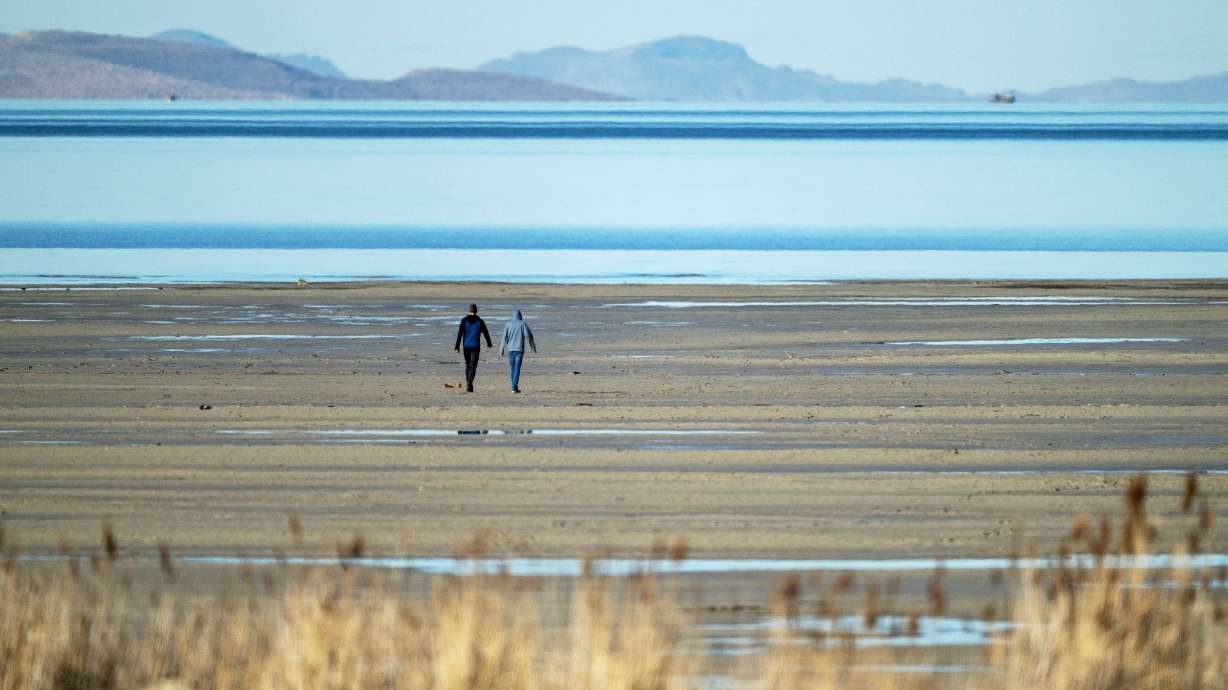
SALT LAKE CITY — The declining water levels of the Great Salt Lake have exposed 800 square miles of lake playa, becoming a major cause of concern and source of dust pollution blowing into Utah’s population centers.
But in a first-of-its-kind breakthrough that could have major implications for mitigating that pollution, geophysicists at the University of Utah used electromagnetic data from airborne surveys to locate a deep, freshwater reservoir under Farmington Bay.
The study demonstrated the ability of airborne electromagnetic survey methods to detect freshwater beneath the thin layer of conductive salt water at the surface of the Great Salt Lake, lead author Michael Zhdanov explained.
“We were able to answer the question of how deep this potential reservoir is, and what its spatial extent is beneath the eastern lake margin. If you know how deep, you know how wide, you know the porous space, you can calculate the potential freshwater volume,” said Zhdanov, a distinguished professor of geology and geophysics at the U. and director of the Consortium for Electromagnetic Modeling and Inversion.
An analysis of the data recorded through the survey method — which involved dangling electromagnetic equipment from a helicopter and flying in 10 east-west survey lines over Farmington Bay and the northern part of Antelope Island — showed fresh water saturates the sediments beneath the lake’s hypersaline surface to depths of about 10,000 to 13,000 feet.
A helicopter lifts off from Antelope Island carrying electromagnetic survey equipment for a geophysical data-gathering mission over Farmington Bay in February 2025. (Photo: Brian Maffly, University of Utah)
The results of the study in February were published in the Nature-affiliated journal Scientific Reports, building on a larger research project led by the Unversity of Utah Department of Geology and Geophysics and funded by the Utah Department of Natural Resources to understand the groundwater beneath Great Salt Lake.
Zhdanov said the appearance of circular phragmites mounds on the dried-out bed of Farmington Bay, each 50 to 100 meters in diameter and covered with 15-foot-tall thickets of reeds, catalyzed these studies.
“These very strange plants — they use a lot of fresh water. So, where does this water come from? It looks like this water comes from underground,” Zhdanov said.
Of course, this discovery could have tremendous implications for mitigating toxic metal-laden dust pollution from the lake’s dried areas.
Zhadanov explained that this “reservoir” isn’t an underground mass of pure water like one would imagine, but a cluster of rocks with porous spaces filled with fresh water.
“In principle, you may drill this and you can pump this water on the surface and use it to mitigate dust pollution blowing from the lake surface and, possibly, in irrigation,” Zhdanov said.
U. hydrologist Bill Johnson, a co-author on all the Great Salt Lake groundwater papers, said more studies should be done to determine whether the artesian groundwater could be safely tapped to mitigate the dust.
“There are beneficial effects of this groundwater that we need to understand before we go extracting more of it. A first-order objective is to understand whether we could use this fresh water to wet dust hotspots and douse them in a meaningful way without perturbing the freshwater system too much,” Johnson said in a statement. “To me, that’s a primary objective because it’s very practical and it’s unlikely we’ll be able to fill Farmington Bay and other parts of the playa enough to avoid some dust spots appearing at the higher elevations. This would be a great way to get at that.”
Zhdanov said he thinks it’s important for the study and others like it to continue, not only over the Great Salt Lake, but throughout the state.
“We have a desert here. This desert could hide fresh water. … We know this happens in (the) Sahara, we know this happens in Africa and this may happen here,” Zhdanov said. “We really don’t know very well the subsurface groundwater distributions in Utah.”
Map of the airborne electromagnetic survey area overlaid on the ESRI World Imagery basemap. Flight-line locations are shown in red across Farmington Bay. (Photo: University of Utah)
To do that, though, more funding is required — something Johnson and Zhdanov are both pushing for to expand the groundwater studies to cover a much larger portion of the lake, and beyond.
Zhdanov said there have been preliminary discussions about further studies with the Utah Legislature and the Utah Department of Natural Resources.
While the initial study covered only a small segment of the lake, Zhdanov believes his team can fly airborne electromagnetic survey lines across the lake’s entire 1,500-square-mile footprint. A survey of that scale, he said, could help guide regional water-resource planning and inform similar searches for freshwater beneath terminal lakes worldwide.
“It becomes a very, very important question, really for all of the economy and for the well-being of our population here, because we need water,” Zhdanov said.
The Key Takeaways for this article were generated with the assistance of large language models and reviewed by our editorial team. The article, itself, is solely human-written.