
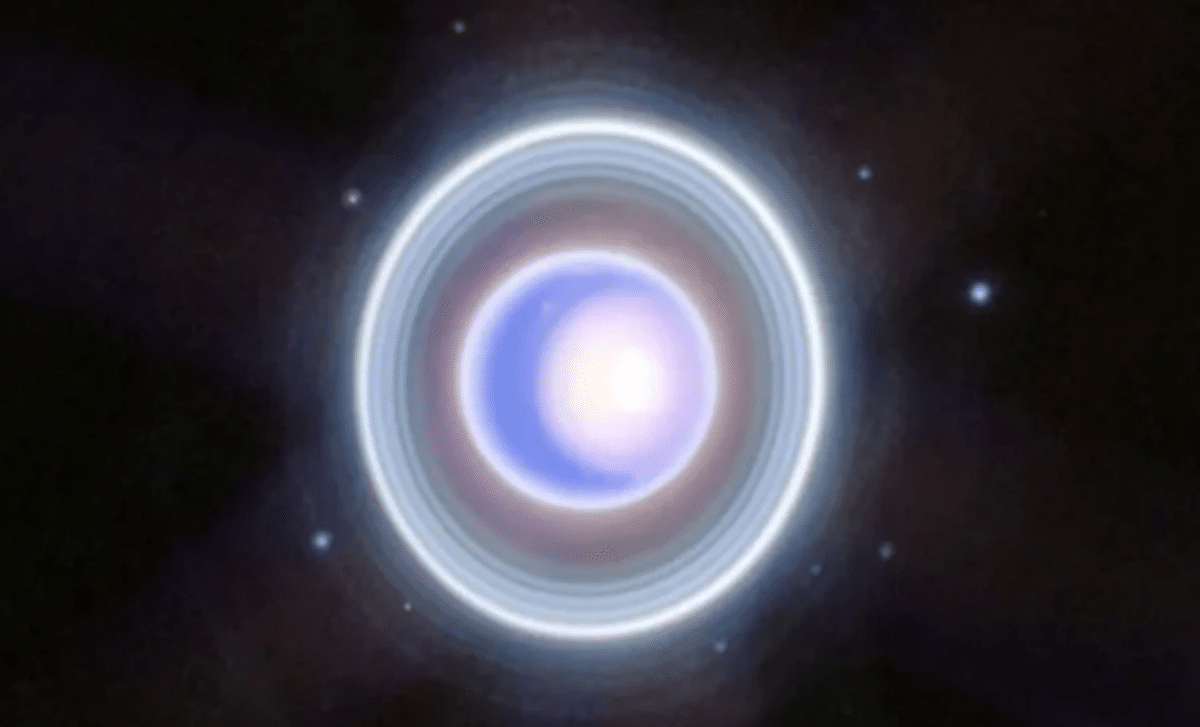
A new mission concept, recently presented at the 57th Lunar and Planetary Science Conference, promises to take humanity one step closer to unraveling the icy mysteries of Uranus. The CASMIUS (Coupled AtmosphereS and Magnetosphere Interactions of the Uranus System) mission concept could reveal vital details about this enigmatic planet, which has remained largely unexplored since Voyager 2’s historic flyby in 1986. As scientists push the boundaries of space exploration, CASMIUS emerges as a potential flagship mission that could redefine our understanding of Uranus and the larger solar system.
CASMIUS Mission: Paving the Way for Unprecedented Discovery
The CASMIUS mission concept, proposed by Dr. Hadi Madanian, a Research Scientist and founder of Earth and Planetary Exploration Sciences LLC (Epex Scientific), brings fresh excitement to the scientific community. Uranus, often overlooked due to its remote location and extreme distance from the Sun, holds a treasure trove of scientific mysteries. Its sideways rotation, magnetic field, intricate rings, and unique moons make it one of the most captivating yet underexplored planets in our solar system.
Dr. Madanian’s study, presented at the 57th Lunar and Planetary Science Conference, lays out a plan for a pair of spacecraft designed to work in tandem, collecting complementary data from the planet’s atmosphere, magnetic field, rings, and moons. Unlike previous missions, the study emphasizes that CASMIUS could finally offer an in-depth exploration of Uranus’ complex system, filling in crucial gaps left by Voyager 2. While the exact nature of the mission, whether it will be an orbiter or a flyby, remains unclear, the research suggests a promising approach for the future of planetary exploration.
Uranus: The Ice Giant We’ve Only Begun to Understand
Despite being one of the largest planets in the solar system, Uranus has been shrouded in mystery due to its extreme distance from Earth. Voyager 2’s flyby, which occurred in 1986, remains the only time humanity has directly observed the planet up close. As reported by Universe Today, the spacecraft revealed startling discoveries, including 10 previously unknown moons, two new rings, and the planet’s unusual sideways magnetic field. However, despite these revelations, the data collected during this brief encounter left many questions unanswered.
Uranus’ rings and moons continue to intrigue scientists, particularly because of their unusual properties. The planet’s tilted axis of rotation, which causes its moons to orbit at extreme angles, challenges our understanding of planetary dynamics and could provide important insights into the evolution of ice giants like Uranus. The CASMIUS mission, with its dual spacecraft approach, promises to address these mysteries by investigating the planet’s magnetic field and its connection to the system’s moons and rings.
The Potential of CASMIUS: Unlocking Uranus’ Magnetic Secrets
One of the most compelling aspects of the CASMIUS mission is its potential to unlock the mysteries surrounding Uranus’ magnetic field. Unlike the magnetic fields of most other planets, Uranus’ field is tilted and off-center, suggesting a unique and poorly understood structure. The study highlights the importance of understanding such a complex system, as Uranus’ magnetic environment could hold clues to the processes that govern planetary dynamos.
“The study notes, ‘Understanding the complexities of the Uranus system opens a new window to understanding the solar system formation, planetary dynamo, and exoplanet research,’” said Dr. Madanian.
By exploring Uranus’ magnetic interactions, scientists could gain insights not only into the planet itself but also into the fundamental processes that shape other planets in our solar system and beyond. This knowledge could even offer new perspectives on geomagnetism here on Earth, a crucial field of study for understanding the planet’s core and how it affects everything from our atmosphere to our climate.