

Adam RittenbergMar 31, 2026, 08:21 PM ET
CloseCollege football reporter; joined ESPN in 2008. Graduate of Northwestern University.
Multiple Authors
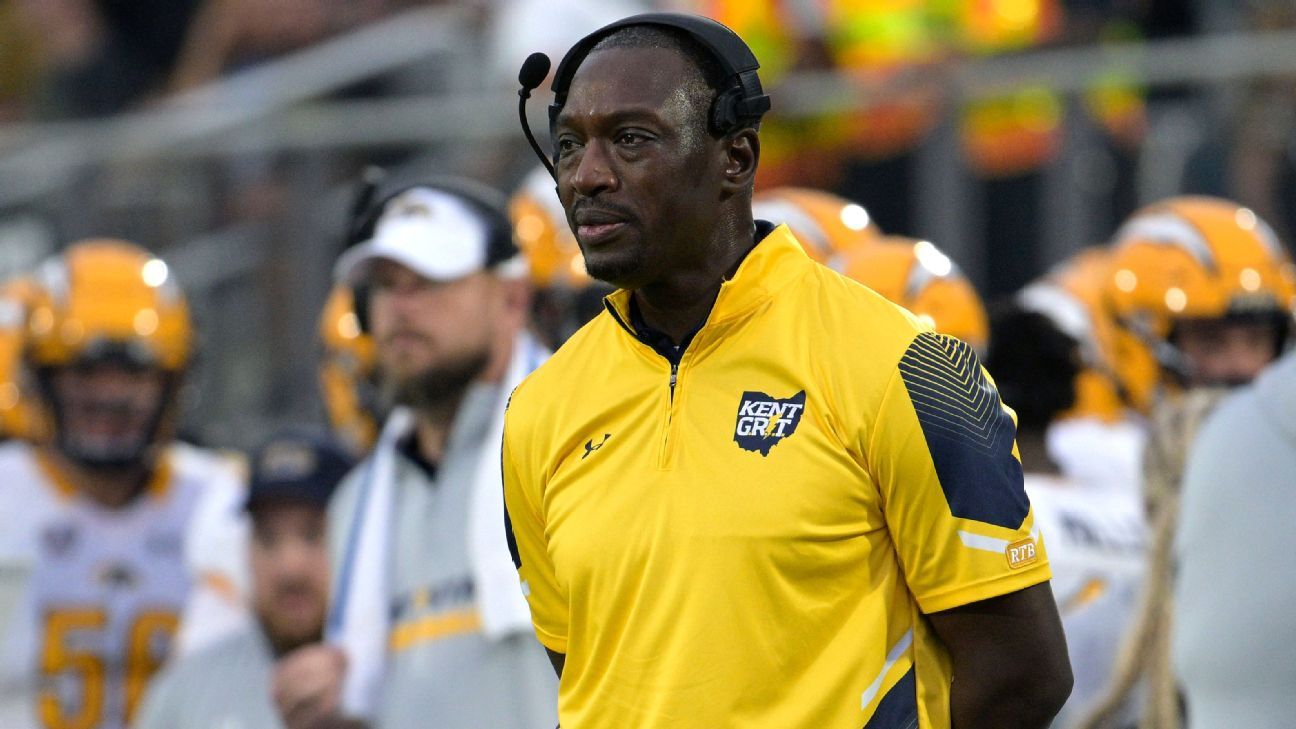
Former Kent State football coach Kenni Burns has sued the university and several top officials for wrongful termination, breach of contract and defamation, alleging that his April 2025 firing was the last step in the school’s “conspiracy” to save money.
Kent State fired Burns weeks after placing him on administrative leave, noting that he had significant and repetitive violations of the purchasing card (P-card) he received from the university and that he violated Kent State’s conflict of interest and code of conduct policies. Burns’ lawsuit filed Monday states that he never went through proper training for P-card use and that he provided receipts for several expenses that appeared on an audit report, which followed an October 2024 suspension of his P-card.
Burns went 1-23 in two seasons as Golden Flashes coach. Kent State named Mark Carney interim coach for the 2025 season and gave Carney the permanent role Oct. 30.
Editor’s Picks
1 Related
According to the lawsuit, Burns sent Kent State a check for more than $7,000 to cover a portion of the disputed P-card expenses, which the school cashed several weeks later. Burns’ complaint noted that he had some financial challenges while at Kent State, which stemmed in part from him having to temporarily relocate after some flooding in his home, but also because the school allegedly wasn’t paying him his full salary.
Kent State’s investigative report on Burns cited a sizable loan he received from Mike Awad, a prominent booster and vendor of the university, to assist with costs from the flood damage, which violated the school’s conflict of interest policy. The report noted that Burns repaid Awad $109,000 in a series of checks during a 14-month span in 2023 and 2024.
The lawsuit states that Burns accepted several monthly loans from Awad that he repaid with interest, and that he disclosed “money exchanging with … Awad” to executive deputy athletic director Greg Glaus. According to the complaint, Glaus told Burns that there would be no problem and that other Kent State employees had engaged in similar business arrangements with Awad.
Kent State’s investigative report stated there was “conflicting evidence” about whether Burns disclosed his agreement with Awad to the athletic department or other university leaders. As Burns’ complaint notes, Kent State’s report found no evidence of a quid pro quo relationship between Burns and Awad.
A Kent State spokeswoman told ESPN that the university does not comment on pending litigation.
The lawsuit states that a “malicious scheme” to oust Burns began in early 2024, when the two sides were finalizing a one-year contract extension that would be announced that February. The extension contained an amendment that changed Burns’ payout if fired without cause — from a percentage of his remaining base salary over the length of the new deal through 2028 (approximately $2 million) to a percentage of his current base salary for that year (approximately $371,000).
According to the complaint, Burns’ agent never discussed the termination amendment with Glaus and Burns signed the agreement on the understanding that no changes to termination language from his original contact had been made. When Burns and his attorney asked athletic director Randale Richmond about the amendment, Richmond said it would be changed to reflect the original contract language, the lawsuit states. But when Burns’ agent asked for the adjustment, Richmond told him the school would not alter the terms.
“Upon information and belief, the ‘error’ in the First Amendment allowed Kent State’s plan to wrongfully terminate Kenni Burns’ to move forward, saving the University money by not having to comply with the buy-out terms of Kenni Burns’ original contract,” Burns’ lawsuit reads.
The lawsuit also states that during Burns’ leave and while the investigation into his conduct was ongoing, David Ochmann, Kent State’s deputy general counsel, called Burns’ attorney and asked if Burns would accept money to “quietly walk away.” According to the claim, Ochmann later offered Burns $371,000, the same amount as the coach’s amended contract stated if he was fired without cause. Burns was given a day to respond and then Ochmann, in an email to Burns’ attorney that is included with the lawsuit, wrote that Kent State would proceed with potential for-cause termination.
In addition to Kent State, Burns’ lawsuit names Ochmann, university president Todd Diacon, senior vice president for finance and administration Mark Polatajko and the school’s board of trustees as defendants.