
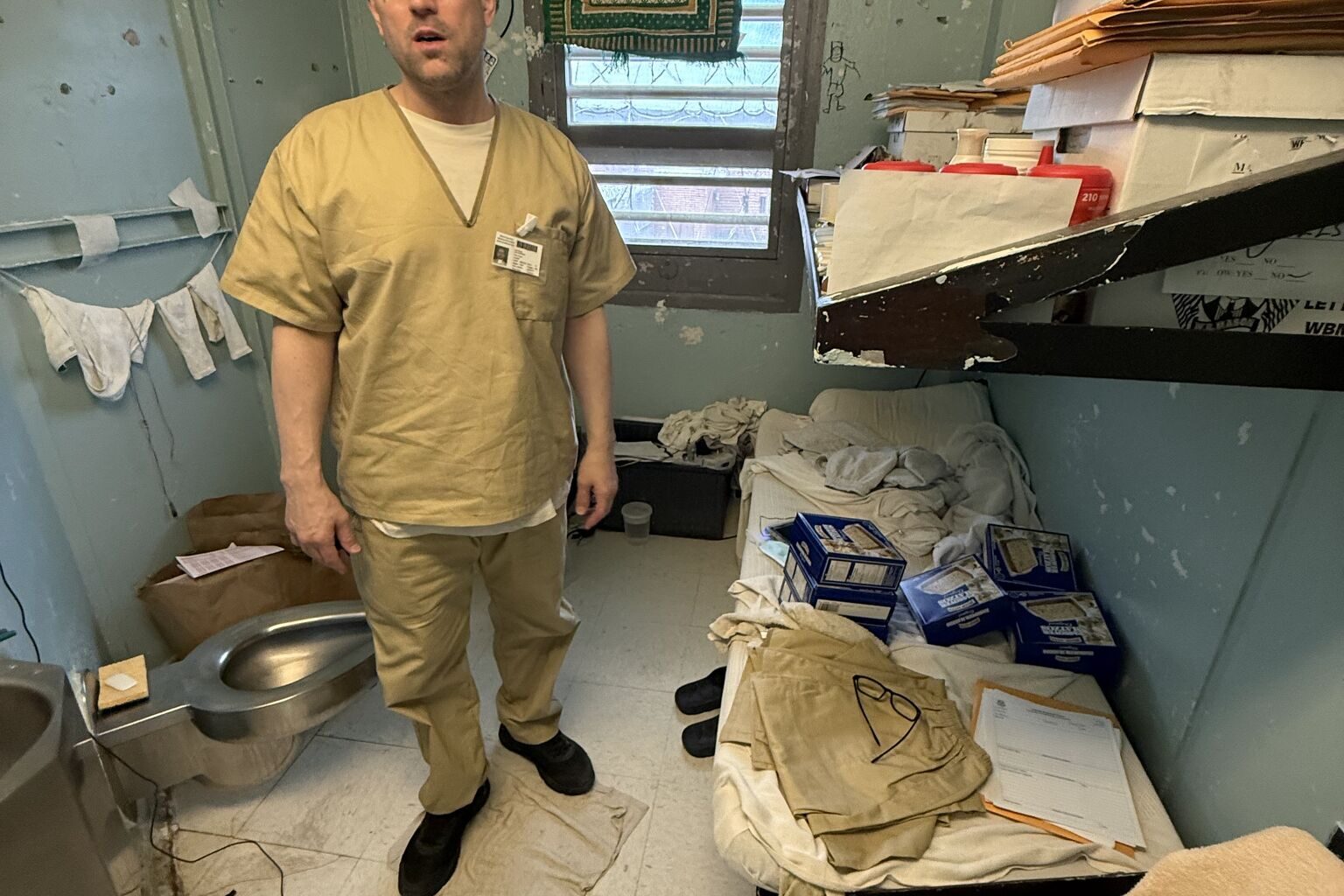
A room in the prison infirmary at MacDougall-Walker Correctional Institution in Suffield in March 2026
Photo courtesy of Prison Ombudsman DeVaughn Ward
The prison infirmary at MacDougall-Walker Correctional Institution in Suffield in March 2026
Photo courtesy of Prison Ombudsman DeVaughn Ward
The view of the entrance to the prison infirmary from the waiting room at MacDougall-Walker Correctional Institution in March 2026.
Photo courtesy of Prison Ombudsman DeVaughn Ward
A prison infirmary at XXXX in March 2026.
Photo courtesy of Prison Ombudsman DeVaughn Ward
Thirty-four months. That’s how long records show a Connecticut prisoner diagnosed with colon cancer has been waiting for a colonoscopy ordered by his doctor.

Twenty-nine months. That’s how long another prisoner has waited for a surgery to extract his tooth.
Article continues below this ad
Six months. That’s how long a prisoner whose mammogram showed dense breast tissue and needed an ultrasound to rule out breast cancer, has waited.
These are not isolated delays.
They are part of a wide breakdown in Connecticut’s prison health care system, where incarcerated people are left waiting extended periods of time for specialist care already deemed medically necessary.
On Jan. 20, the state Department of Correction had over 2,600 speciality care appointments yet to be scheduled, according to records obtained by CT Insider. The backlog includes referrals for radiologists, oral surgeons, gastroenterologists and orthopedists. Of those, 44 had been waiting for scheduling for over two years, 190 more than a year, and 397 over six months.
Article continues below this ad
Make CT Insider a preferred source on Google to see more of our journalism when you search.
Add Preferred Source
The list includes patients with cancer, rectal bleeding, cracked teeth and nerve disorders.
The delays come after a doctor has already determined the care is necessary, and DOC’s medical administrators have signed off to provide the specialty care, records show.
Article continues below this ad
Officials at the DOC in recent weeks declined CT Insider’s requests to being interviewed about these waitlists or prison health care. The governor’s office is now working to set up an interview with prison officials.
In February, CT Insider obtained the waitlist nearly one year after requesting it, and on the eve of a hearing before the state’s Freedom of Information Commission, which has the authority to compel the DOC to release it. CT Insider is still waiting for other records requested nearly one year ago related to prison health care and those who have died while incarcerated.
Each appointment on the waitlist is assigned a priority level for how soon the patient must be seen — ranging from immediate to 13 months — based on what the DOC says aligns with community standards of care for best practice. But a CT Insider investigation found hundreds of cases exceeding those timelines.
Article continues below this ad
“It’s concerning — 34 months — I continue to be shocked,” said Amy Zipf, the state’s assistant correction ombudsman and a nurse with a PhD in health systems. “To wait over a year for any appointment seems unreasonable at best. If I’ve waited for over a year, is someone even paying attention?”
The DOC has long been warned before about the backlog.
A private contractor hired to help manage specialty care — paid roughly $100,000 a month last year to do so — told officials the system was failing. Internal communications obtained through an open records request show the company repeatedly pushed for access to fix it.
The department declined to engage.
Article continues below this ad
“The DOC still isn’t letting us help them. Numbers are trending in the wrong direction,” Trent Turek, a vice president at NaphCare, wrote the state’s prison ombudsman last June as the waitlist approached 5,900 appointments. “We were contracted to do a job and help, but they do not want to let us do it.”
It’s unclear if things are getting better or worse. In response to CT Insider’s request for all the waitlist data, the assistant director of legal affairs said there is no way to pull the historical data, despite state law requiring computer-stored public records to be retrievable.
DeVaughn Ward, the state’s prison ombudsman, said there is confusion among many incarcerated people around their health care. Many believe they are on waitlists, and when he checks they are not.
“Inhumane,” is how he describes the situation.
Article continues below this ad
CT Prison Ombudsman DeVaughn Ward stands outside his team’s Hartford office in March 2026
Jacqueline Rabe Thomas / Hearst Connecticut Media
Ward’s office has received two waitlists from the DOC, pulled on Feb. 27 and March 13. In-between when those two wait lists were pulled, several prisoners were added and some removed. For those removed, it’s unclear what happened — if they have been scheduled and seen or any died while waiting.
“We haven’t found anyone — yet — that has died as a result of waiting for the care, but we have identified individuals whose condition have significantly worsened as a result of waiting for care,” Ward said.
Hours after that interview, one of the people on the waitlist was dead.
Article continues below this ad
Jeffrey Yeaw, 59, had been referred for a cardiology appointment on Jan. 5. Six day later, before any appointment was scheduled, he was rushed to the hospital during a cardiac emergency.
His name was still on the waitlist, the ombudsman reported in an investigation released Tuesday.
The DOC reported Yeaw’s death appeared to be from natural causes. Yeaw was incarcerated at MacDougall-Walker Correctional Institution in Suffield while serving a lengthy sentence for a 2012 gunfight with police.
Article continues below this ad
Ward said Yeaw’s delayed access to medical care is not an isolated situation, and “reflects broader system issues.”
CT Insider communicated through the prison’s messaging system with eight incarcerated people still waiting for care. Their cases show how delays move from a single line item on a 144-page waitlist to pain.
Michelle Troconis waits for specialty care
Michelle Troconis, perhaps the state’s highest-profile female inmate, has been waiting months for specialty care to address a medical issue that is leading to pain, bleeding and possibly could cause an infection.
Article continues below this ad
Her intrauterine device should have been replaced years ago, she and her father Carlos Troconis said through the prison’s messaging system and through his text messages.
She also needs eyewear that corrects her vision to eliminate headaches while she’s working transcribing books into Braille for children, a job she holds at York Correctional Institution, the state’s only prison for women.
Troconis was sentenced to 14½ years on charges of conspiracy to commit murder, tampering with evidence and hindering prosecution in the 2019 death of Jennifer Dulos after an eight-week trial. She maintains her innocence and has a pending appeal and habeas motion seeking to have her conviction overturned on the grounds her first attorney was ineffective.
Her IUD should have been replaced in June 2024, but she was incarcerated by that point and hasn’t been scheduled to see a gynecologist despite repeated requests, she and her father said.
Article continues below this ad
The result has been cramping and bleeding and the risk of a potential infection caused by a device that was meant to be replaced after five years in use, they both said.
It took a year for Troconis to be seen by a dentist and she’s still waiting for an eye appointment, she said.
She’s filed several requests for both treatments, but there have been no appointments made to deal with her medical concerns, Troconis said.
York CI inmates are required to fill out a form to request health care services. The forms are then placed by the women in a medical box in each housing unit, Troconis said. According to DOC directives, the agency has 15 days to deal with the request.
Article continues below this ad
But that’s rarely what happens, she added. Often, female inmates are sending several requests for the same health concern because there is no acknowledgement of the form and no action on being seen for specialty care, she said.
“This is a huge problem because we never know if they in fact are reading our forms and sometimes if there is an emergency, our life is in jeopardy,” Troconis said. “I am stuck in the DOC system with no solution to my problem.”
Ward said many incarcerated people aren’t sure if they have been put on a waitlist. With Troconis’ permission, Ward looked to see if she actually was on a wait list, and found she is not.
Delayed care leaves Shanta Perry in agony
It started in May 2025, a sharp knot on the left side of his stomach that dropped Shanta Perry into a fetal position on his prison bed. He was 22 and living in Middletown when he killed someone over a woman, an act the judge called “actions of a hot-headed young man.” Now, 25 years into a 30-year sentence, he remains imprisoned at Osborne Correctional Institution in Somers, struggling to get medical care.
Article continues below this ad
“The pain was so severe,” he wrote a reporter through the DOC’s messaging system.
Shanta Perry at Osborn Correctional Institution in March 2026
Photo courtesy of Prison Ombudsman DeVaughn Ward
A correctional officer called medical, he says, and a nurse told him to submit a request to see a doctor. He did and was placed on a waiting list.
Article continues below this ad
June became July before someone examined him.
August brought new pain — a knot near his belly button that he said “pops like a spring” when pressed. Nurses referred him to a doctor, who ordered in September an abdominal ultrasound to view the hernia and prioritized it as Level 3, meaning it should happen within three weeks, Ward confirmed.
But no scan — or appointment — happened.
Article continues below this ad
By December, the pain was worse. Maybe it’s not a hernia, he says the doctor tells him now — maybe it’s his liver. Another ultrasound was ordered to view his liver and prioritized to happen within three weeks, the ombudsman confirmed.
By mid-March, the pain had spread — ribs, stomach, sharp and frequent.
“It feels as if a sharp needle is going through (my ribs),” he said.
Ten months have passed since the pain began.
Article continues below this ad
“My mind (has) been all over the place not knowing what is wrong with (me). … I’m mentally drained,” he says. “D.O.C. medical needs to be exposed.”
For Rayshaun Bugg, 8 months waiting for surgery
Rayshaun Bugg’s knee often locks into a sideways “V,” frozen after months without treatment.
Bugg is just over halfway through a 25-year sentence for serving as the getaway driver at age 20 in a robbery that left a teenager dead.
Article continues below this ad
Behind the prison walls at Osborne Correctional Institution, a summer pickup basketball game set off the injury.
“I felt a pop in my knee and yelled immediately as I fell down in pain,” Bugg wrote through the DOC’s messaging system.
Rayshawn Bugg at Osborn Correctional Institution in March 2026
Photo courtesy of Prison Ombudsman DeVaughn Ward
Unable to stand, he was taken to get medical care in a wheelchair, where he said his injury was quickly dismissed and was sent back to his unit with ibuprofen.
Article continues below this ad
The pain worsened. Nights became a cycle of fractured sleep.
“It was hard for me to sleep at night…only being able to have 3 hours of sleep because my leg was hurting,” he says.
He filed repeated requests for care as his knee stiffened and eventually locked, records show. Weeks passed before he was given a crutch, he says. Months passed before he saw a specialist.
When Ward got involved, he discovered Bugg would require intensive physical therapy prior to surgical intervention due to deterioration caused by delayed treatment.
Article continues below this ad
But Bugg was not added to the physical therapy wait list until March 9 — eight months after the initial injury, Ward confirmed.
Uncertainty lingers alongside the pain.
“I’m still in pain as we speak, I have a noticeable limp to my walk,” he wrote. “I’ve been in excruciating pain, limping around, complaining, and I just want to be able to finally walk and run around again.”
Terry Johnson says he nearly died before cancer diagnosis
Terry Johnson knew something was wrong in 2023 when he began losing weight and his appetite while experiencing such intense pain on the left side of his ribs and lower back that he at times couldn’t sleep.
Article continues below this ad
But health care staff at Cheshire Correctional Institution didn’t seem to take his symptoms seriously, he said.
“I continued to put in for sick call and kept getting told that there was ‘nothing wrong’ with me, and that it was all ‘in your (my) head,” Johnson said through the prison’s messaging system. “This went on for several weeks, as my symptoms continued to get worse. Then one night, I sneezed and it felt like I had been hit in the chest with a pickaxe, and it dropped me to my knees. I went to medial again, and they told me I ‘pulled a muscle’ and was given a tube of athlete’s foot cream.”
Terry Johnson at MacDougall-Walker Correctional Institution in March 2026
Photo courtesy of Prison Ombudsman DeVaughn Ward
It wasn’t until three months after he initially complained when he showed medical staff his blood-soaked undergarments that they agreed to send him to the hospital, the 56-year-old said.
Article continues below this ad
Medical testing at the University of Connecticut Health Center, he says, revealed that he was near death from multiple myeloma — a rare blood cancer that killed his sister Greta in 2021. The ombudsman reports confirms he was diagnosed with cancer and broken ribs.
“Her passing weighed heavily on me, because she and I were always close, and kept in touch with each other on a regular basis,” he said. “She would also come visit me as often as she could. It was really hard for her emotionally to come and see me in here. Her passing has given me strength to never miss my appointments, and to continue the battle, for as long as I possibly can. As hard as it has been to do all this on my own, I’ll never give up.”
Johnson and his brother Duane are serving life sentences in the 1991 murder of Connecticut State Police Trooper Russell Bagsaw.
Johnson said he repeatedly pointed out that something was wrong three years ago, but his concerns were written off as constipation or other mild health issues.
Article continues below this ad
After his cancer diagnosis, he was placed in the infirmary at MacDougall-Walker Correctional Institution in Suffield for a year, he said. He has undergone a stem cell transplant and continues to receive chemotherapy at UConn to keep the cancer at bay.
“Due to the lack of medical attention and proper medical treatment while housed at Cheshire Correctional, it almost cost me my life,” he said. “If I had received proper medical treatment when I informed the medical staff at Cheshire Correctional, a lot of what I had to go through, wouldn’t have had to happen.”
For Mathew Pugh, struggling for air while waiting for care
Matthew Pugh has struggled to breathe for the last 17 months. Nasal polyps, he says, leave him gasping, coughing up phlegm, and doing pushups just to open his airways. When he sneezes, Pugh says no air can pass through his nose. Once, after trying to blow his nose, he says he fainted in his cell at Cheshire.
Article continues below this ad
Mathew Pugh at Cheshire Correctional Institution in March 2026
Photo courtesy of Prison Ombudsman DeVaughn Ward
He has been seen by prison medical staff, but Pugh says the appointments take months to happen and have done little to improve his condition.
“This is like neglect! I’ve had this problem since October 2004 and still haven’t had anything done to relieve it,” he wrote through the prison messaging system.
According to the prison ombudsman, Pugh has been awaiting a pulmonary function test and consultation since Jan. 22. Both were designated Priority 4, meaning he should be seen within two months. As of March 13, he had already been waiting seven weeks without an appointment scheduled.
Article continues below this ad
Pugh, originally from Hamden, has spent the last 16 years in prison for killing his former girlfriend in her Milford home in 2006. His sentence all but guarantees he will die behind bars. But at 53, he didn’t expect his life would be in jeopardy as he struggles for air while waiting for care.
Jimmy Davenport
At one point, James “Jimmy” Davenport said he had to wait three weeks for someone to remove a catheter from his groin, even though it was never clearly explained to him why he needed the device in the first place.
There was some push and pull as to who was supposed to remove the catheter — a urologist at a hospital where the device was put in or the health care staff at Cheshire Correctional Institution where he is housed.
Article continues below this ad
James Davenport in his cell at Cheshire Correctional Institution in March 2026.
Photo courtesy of Prison Ombudsman DeVaughn Ward
He was in pain and an infection was setting in because the device wasn’t properly cleaned or removed in a timely fashion, his fiancé Tamera McElhinny said.
“This isn’t a temporary stay for him,” she said. “This is his entire existence. When the facility tells him to ‘just floss’ a loose tooth that’s causing him gum pain, or tells him to “just do stretches” for a hand injury he actually won a lawsuit over at Cheshire, they are telling a man that the rest of his life will be defined by untreated pain.”
Davenport is a transfer from Oregon through an interstate inmate exchange. He’s been in Connecticut since 2012. He’s 3,000 miles away from his family, while he serves a life sentence for two murders committed out west.
Article continues below this ad
Although he’s 48 years old, Davenport has health care needs that McElhinny said are not being addressed. His referral to see a cardiologist for fainting spells has been in the pipeline for months. He was turned down physical therapy for a hand injury and has issues getting his medication regulated for depression, which the prison threatened to withhold, she said.
He suffers from a traumatic brain injury, his fiancé said, and was deemed to have an intellectual disability, which spared him the death penalty, according to the Associated Press.
McElhinny has been tirelessly battling for better health care for Davenport for months, including providing emails to CT Insider detailing every step the couple has taken to get his health on track.
Kenyon Joseph awaits treatment for ailing knee
Kenyon Joseph measures time not in months or years, but in what still hasn’t happened.
Article continues below this ad
He lives with constant abdominal pain, eats little, and describes relentless diarrhea that leaves him dehydrated and weak, fearful the condition will worsen before anyone intervenes.
Kenyon Joseph at MacDougall-Walker Correctional Institutionin March 2026
Photo courtesy of Prison Ombudsman DeVaughn Ward
His left knee tells a similar story. The knee still swells, buckles, and limits even short movements, forcing him to navigate daily life on an unstable joint that has never been properly treated, he says.
In his spine, there is sharp pain in his lower back. The pain can confine him to bed, he says, without adequate medical accommodations — not even proper bedding — to manage it.
Article continues below this ad
Kenyon is incarcerated for his involvement at age 26 in a shooting that left a Meriden man dead in 2001.
Joseph has been awaiting both an echocardiogram and a sleep study since last December, the ombudsman confirmed. Both were assigned a Priority 4 designation, meaning he should have been seen within two months. But as of March 13, 2026, more than 11 weeks had passed without either appointment being scheduled.
What remains is not a history of injury, but a present defined by delay — a body still waiting for decisions already made.
Article continues below this ad