
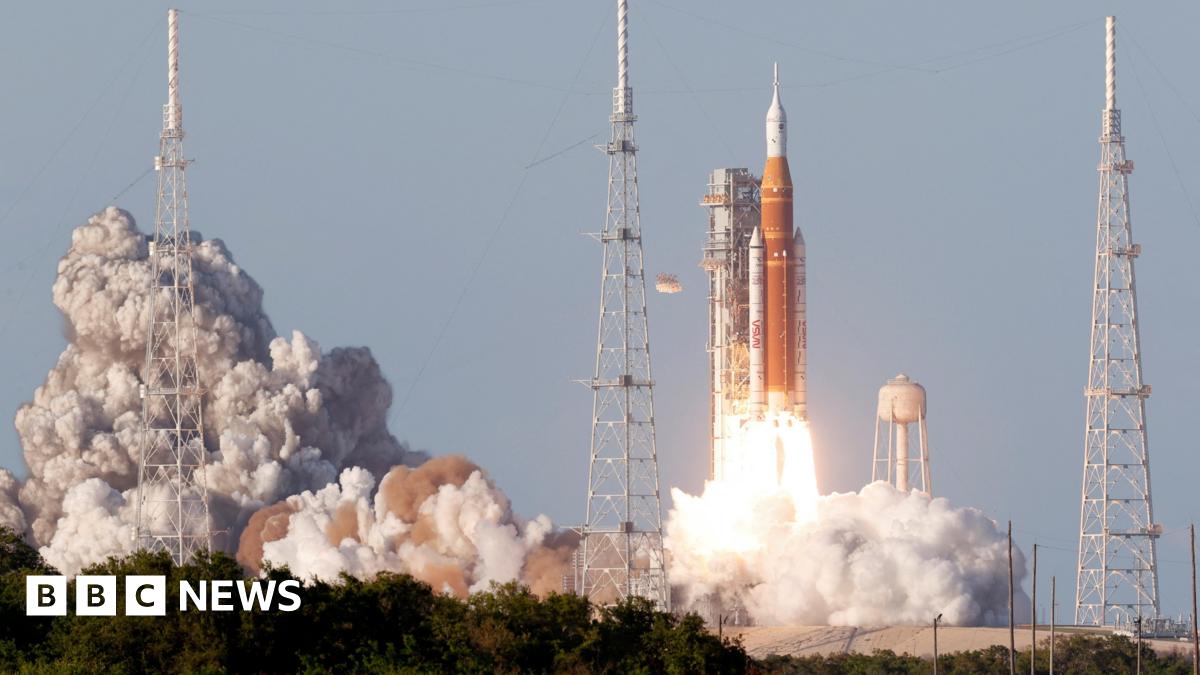
Key moments to look out forpublished at 23:46 BST
23:46 BST
 Pallab Ghosh
Science correspondent, reporting from the launch
It’s now been ten minutes since launch – here’s some of the key moments to look out for for the rest of the flight:
After about eight minutes the core runs dry and drops back towards Earth, while the upper stage of the rocket – the interim cryogenic propulsion stage (ICPS) – takes over, lighting its engine to nudge the crew the rest of the way into orbit.
With two engine burns, the ICPS places Orion into a high, stretched out orbit around Earth.
At its furthest, the spacecraft will be about 46,000 miles away; at its nearest, roughly 115 miles up.
That loop takes about a day. During this first day, Orion separates from the ICPS and carries out a docking practice manoeuvre, flying towards and around the spent stage as if it were a future Moon lander or small space station.
All of this is rehearsal for what comes much later in Nasa’s grand plans for a long term presence on the lunar surface, when Orion will have to hook up in space with lunar landers and an orbiting outpost near the Moon.
Artemis II is the crew’s chance to see how the capsule’s autopilot and thrusters behave when they really lean on them.