
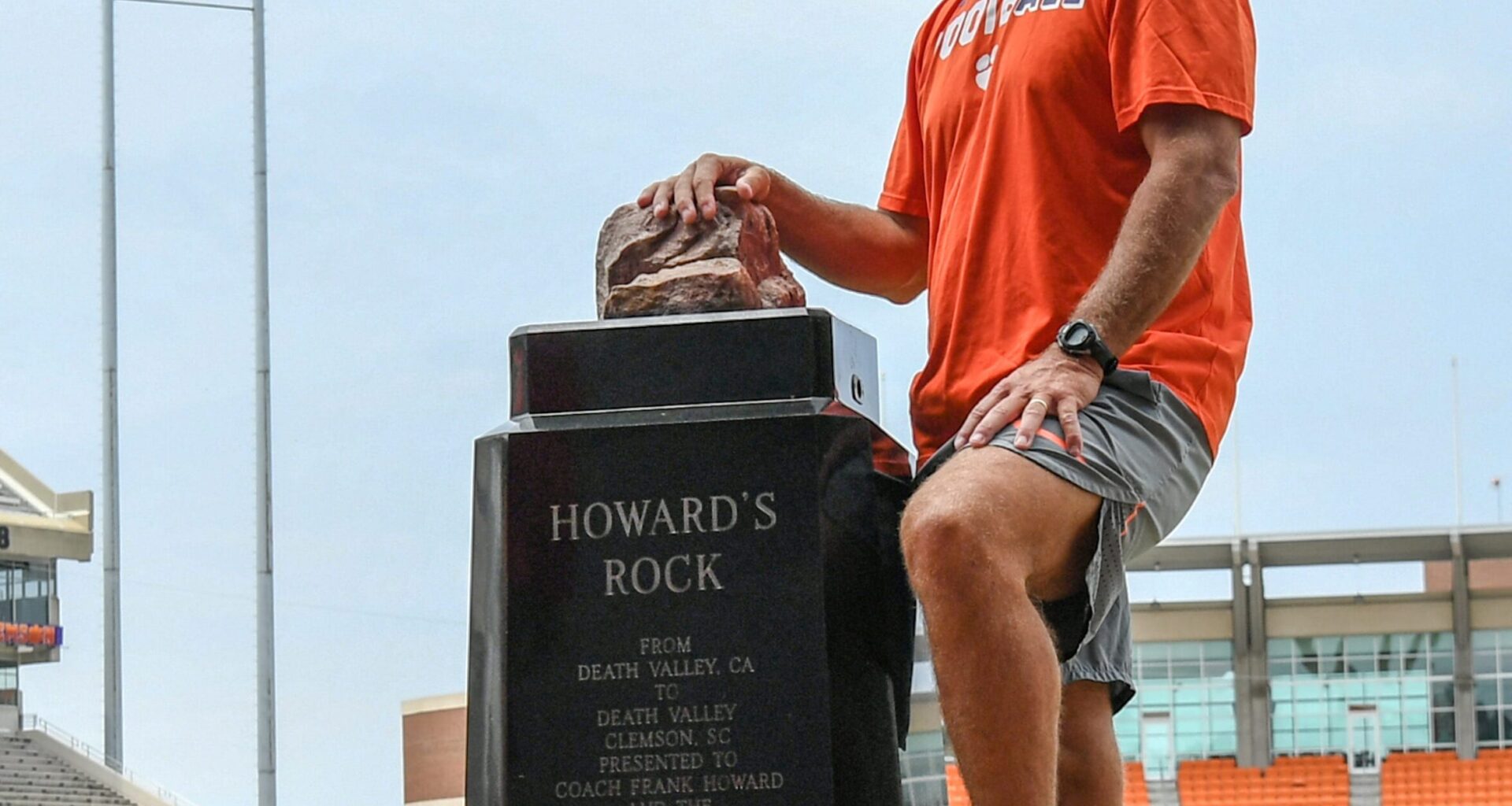
What can other programs learn from this cautionary tale?
As with my Virginia Tech piece, which garnered a viral life with Hokie fans, perhaps a lot.
Clemson was one of the elite programs in college football between 2015-2020, with two national titles and four total title game appearances, never finishing outside of the AP Top 4 over that six year period.
During that window, they were college football’s premier program.
After a five year decline culminating in a 7-6 2025 season, that claim feels distant.
How much of their decline was a failure to adapt to a shifting environment, the cycles of empire, or the eventual complacency that victory seemingly always guarantees?
What can Texas learn from it?
THE CLEMSON MODEL
Clemson featured elite defensive and skill position talent, innovative coaching, unremarkable offensive line play, and a homegrown developmental strategy that placed a massive emphasis on culture, “our kind of guy”, and a mutual promise between player and staff that both would stay the course.
They were the counterpoint to Nick Saban’s ruthless mega classes and unceasing effort to turn over his roster and staff to guard against complacency.
Clemson signed small boutique classes, bragged about their staff tenure and security, and let athletes blossom on their own timelines.
Clemson’s NFL Draft eligible players tended to stay longer than expected and the handful of young starters thrust into action were typically the freshman phenom Trevor Lawrence variety who started because they were unicorns, not because they had to.
Did playing in the ACC help their cause?
Of course, but Clemson was also scalable to big boy play.
The league also hurt their cause, in ways you may not anticipate, which I’ll cover later.
A program that went 79-7 over a six year span between 2015-2020 and played for four national titles morphed into a team that’s 47-20 over their last five years with one opening round playoff loss.
THE RECRUITING & DEVELOPMENT DECLINE
YearRecruiting Class RankPortal Class Rank Season Record 202621317-62025234410-4202414669-42023115411-32022145110-320215n/a10-320203n/a10-220199n/a14-120186n/a15-0201711n/a12-2201610n/a14-120158n/a14-1
There’s a persistent perception that Best Clemson didn’t recruit at an elite level.
In their heyday, they were comfortably a Top 10 recruiting program despite never taking large classes or surplus blue chips that they knew would wash out simply to juice their rankings.
These were “true classes”, not fan marketing exercises.
Texas A&M leaps to mind as the false class counterpoint, but much of the college landscape was guilty. Including Texas. The Horns had some well-constructed class fictions.
On a per player basis, Clemson was clearly a Top 5 program. They emphasized landing blue chips at certain positions and were happy to take 3 stars in units they didn’t deem vital or were developmental by their nature.
Clemson’s five stars also had an unbelievable hit rate: Trevor Lawrence, Deshaun Watson, Sammy Watkins, Dexter Lawrence, Tee Higgins, Christian Wilkins – just to name a few.
Interestingly, that blue chip hit rate streak ended around 2020 as a number of their highly touted recruits started to bust.
In fact, Clemson’s best ranked recruiting classes were the core element of their eventual decline – they never recruited better by the numbers than between 2018-2021.
At the same time, another key recruiting tool gained prominence: the portal.
Dabo treated the portal with contempt, Clemson’s pockets are respectable but not elite, and their failure to enforce a vitality curve showed up on the field.
Increasingly, Clemson featured a few starters and a number of 2nd teamers that were not really playable at an elite program.
You may recall my Clemson playoff preview from a couple of years ago where I struggled to square the NFL top line talent level of the defense (very high) with their questionable effort, bad schemes, and lack of depth.
Texas crucified them for 292 rushing yards exploiting edges and linebackers who had no clue how to set the edge against outside zone.
I thought that malaise could be addressed with a new staff and better teaching, but the issues are much deeper. A skilled coach can cut infection out of a program, but what happens when the program is the contamination?
A portal embrace could have addressed many of those issues, but an insistence on their way has hampered them and the institutional desire to threaten Dabo – the man who created relevant modern Clemson football – is almost zero.
COMPLACENCY KILLS
Once upon a time, Clemson narrowcasted for a certain type of athlete and then developed the hell out of them.
Somehow, they’re now selecting for and appealing to a different type – one that superficially resembles the Clemson athletes that drove the program a decade ago, but lacking some inner drive to maximize. Or those athletes now exist in a program that’s gone too country club or church social.
Best Clemson was “Family, but with an edge.”
The ACC has also been a hindrance. Not just the small TV checks, but the lack of reality checks.
Counterintuitively, when things are going well, a weak league is just insurance for your playoff run. Rest that starter another week. Who cares? You’re playing Stanford.
But when things are going poorly at a Clemson level program, weak leagues fail to provide brutal reality checks.
A challenging schedule is a corrective. A hard public slap.
If you’ve read my takes on conference alignment, the monetary and “it’s just more fun” reasons are self-evident, but perhaps my biggest reason Texas had to leave the Big 12 is that Texas bureaucracy and fans only respond to humiliation as a corrective.
We must be challenged externally as the default setting is complacency.
It appears we’re not alone in that.
Clemson’s decline took five years to be fully revealed, disguised by fake ten win seasons built on Wake Forest, Georgia Southern, Wofford, and Boston College.
Playing in the SEC or Big 10 would have revealed the infection earlier. In fact, it did. 2024 Clemson was 0-3 against the SEC while the Tigers were 9-1 against all other comers.
Clemson has re-hauled its entire staff over the last two years, but many of those additions are unimiginative retreads (Tom Allen, DC) and Clemson family (OC Chad Morris, QB coach Tajh Boyd) who may not be au courant.
This phase of cycling out coordinators and promising new blood (and getting old blood) isn’t new. At this point, it’s a coaching cliche. But the pattern must be honored.
As for Swinney and how he’s viewed, this 2025 ESPN preseason head coach power ranking had Dabo at #3 in the nation. Clearly predicated on an older body of work, not analyzing the trend line.
What will that power ranking look like in May 2026? What’s the value prop of Clemson Football absent a head coach perceived to be absolutely elite?
Meanwhile, the broader lessons from Clemson are instructive.
Unlike Dabo Swinney, Sark doesn’t have the titles to tell his critics or his own inner monologue to be quiet after a 10-3 season. Throw in arguably the country’s hardest 2026 schedule and there is no place to hide.
A final #12 2025 Longhorn ranking was treated like an offseason wake up call – not a successful year. The SEC move and Sark’s playoff runs reset Texas fan psychology.
Part of enforcing a vitality curve isn’t just internal attitudes, it’s imposed by external reality.
For too long, Clemson has been denying its own.