
I bumped into my father early on the morning of my wedding. He was sauntering down the main street of Port Jefferson with the overstuffed Sunday edition of the New York Times under his oxter. Already clean shaven, the most unlikely flaneur with a definite spring in his step.
“What are you up to?” I asked suspiciously.
“Just nipped out to buy the local paper,” he answered. “Jeez, you’d need a small man to carry it.”
A million miles from his native Blarney Street, a stranger in a strange land, glint in his eye. He wore the chipper look of a man readying himself for a long day’s march into the night. But there was more to it than that. Even his beloved tweed walking cap was perched at an especially optimistic tilt. Soon, he confessed the reason for his jauntiness, leaning in conspiratorially as if worried somebody on the otherwise deserted sidewalk might eavesdrop this crucial intelligence.
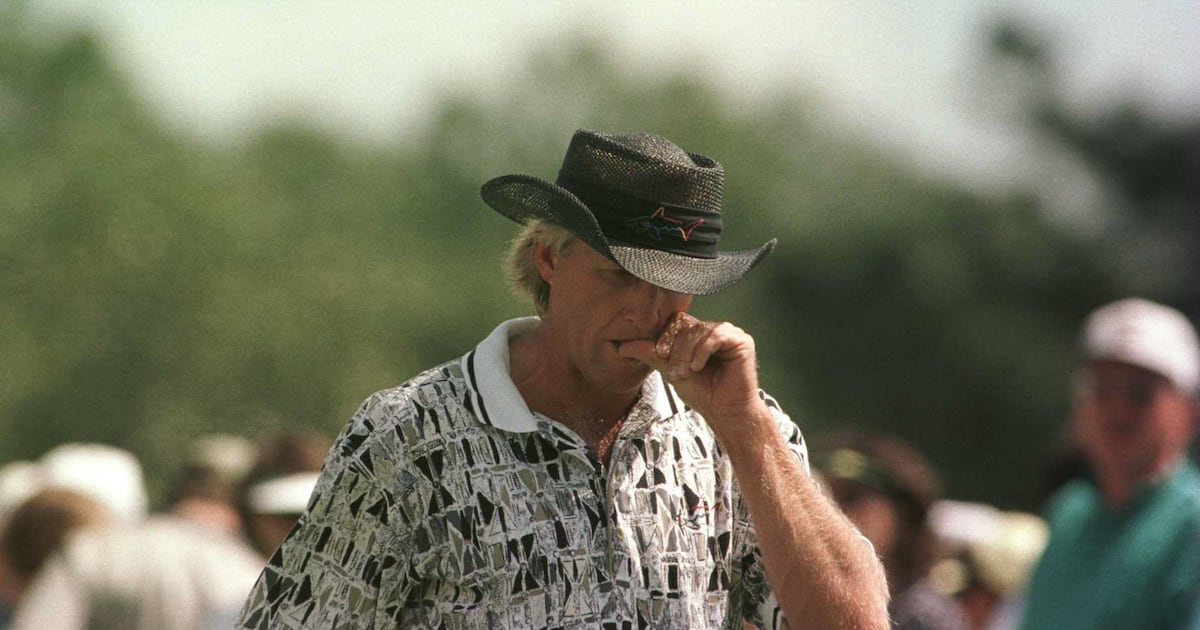
“I’ve a few bob on Greg Norman to win the Masters,” he whispered, and but for the small forest of newsprint in his precarious possession, he might well have rubbed his hands with glee. “He’s six shots clear of Faldo, you know.”
I didn’t know. I’d spent the previous afternoon racing around a succession of bemused Long Island jewellers trying to find a last-minute man’s wedding ring for a groom who’d forgotten to arrange one because he didn’t think it was mandatory. Small detail summing up how much the same fella knew about getting married at the ripe old age of 25.
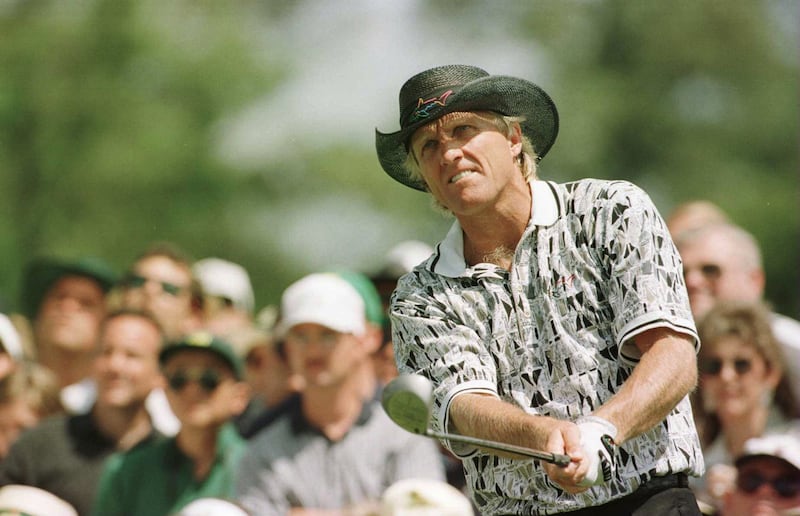 Greg Norman of Australia tees off on his final round at the 1996 Masters in Augusta, Georgia. Photograph: David Cannon/Allsport
I hadn’t seen a shot from Augusta all week. Very quickly, though, he brought me up to speed on how he’d walked into John O’Mahoney’s bookmakers on Edward Walsh Road the previous Monday and had a splurge. The soon-to-be winning docket was safely tucked under the clock on the mantelpiece back in Cork and now Norman had the green jacket all but in his grasp. For a man who never swung a driver in his life, whose experience of the game extended no further than putting competitions with his sons around the postage stamp of our back garden in Togher, my Dad somehow, some way, spoke fluent golf.
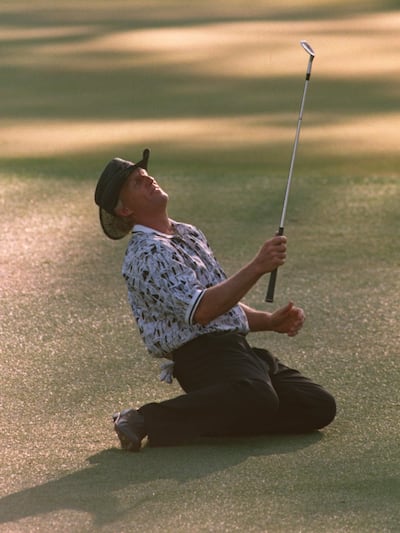 Greg Norman falls to the ground after narrowly missing his chip shot on the 15th green. Photograph: Stephen Munday/Allsport
When Norman and Nick Faldo teed off for the final round that afternoon, however, he was stuck to a pew in St James Catholic Church watching his youngest child get married. The wedding was a typically American production, every guest ferried immediately from ceremony to reception. No stops en route for cheeky pints and impromptu cabaret at a local pub. No chance for my father to nip into some tavern to glimpse the blushing azaleas and to check on the Great White Shark’s inevitable, triumphal progress around Amen Corner.
He didn’t seem unduly bothered by any of this until he arrived at the Old Field Country Club and discovered the establishment was genuinely old school. Not a television screen in the joint.
“How are we supposed to keep an eye on the golf?” he asked as the official photographer marshalled us around the veranda for pictures.
“Eh, there’s a free bar,” I countered, opting for distraction tactics.
“Free free?”
“Free free.”
“All day?”
“All day.”
In a time before ubiquitous mobile phones, the poor man found himself stranded in an actual dead zone on Masters’ Sunday. Complete radio silence observed. More than once during the festivities, he tapped me on the shoulder and asked if there was any update. As if in between the first dance, the speeches and cutting the cake, I’d happened upon some previously unknown news source revealing fresh details of the undulating leader board at Augusta National.
[ Greg Norman: ‘I’d win’ LIV-PGA debate with Rory McIlroy and Tiger WoodsOpens in new window ]
He had no way of knowing then that Norman bogeyed the first and fourth and ninth and it was all about to go so horribly wrong. His ignorance was bliss. The last time we spoke that night, he loosened his tie and declared, “I don’t know what I’m worried about. He couldn’t lose from six shots clear.” That confidence might have been the free drink talking.
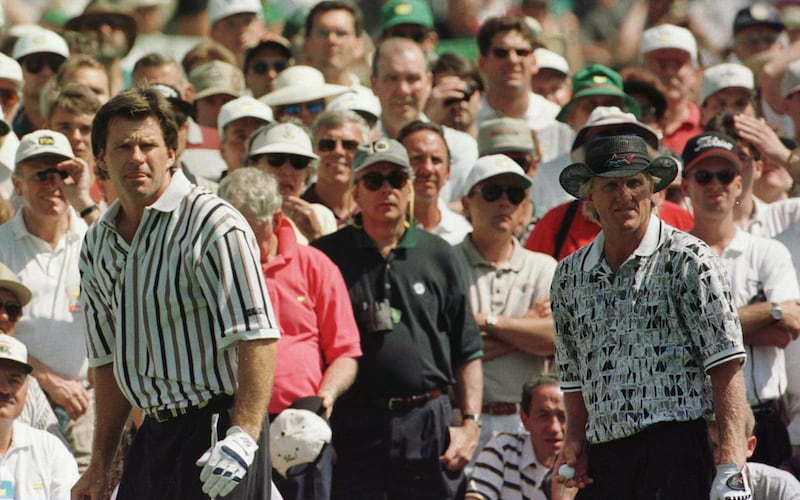 Nick Faldo of England and Greg Norman of Australia during the final round of the 1996 Masters at Augusta National Golf Club. Photograph: David Cannon/Allsport
The morning after the wedding my bride, Cathy, and I caught a dawn flight from JFK. In the departure lounge I picked up the New York Daily News, and read all about Faldo’s remarkable performance and the third-round leader’s historic disintegration. I felt bad for the Aussie. I felt far worse for my Dad. A few days later, from a payphone in the Bahamas, I called my parents. My mother only wanted to revisit the minutiae of our big day in all its glory; my father, well, he had more important things to get off his chest.
“Can you believe Norman?” he asked. “Bastard let me down.”
Three decades have passed since that Sunday. A fact brought home in recent weeks by so many media references to the looming anniversary of Norman’s worst nightmare. Eighteen Masters have come and gone since my father’s death but the treachery of Alzheimer’s thieved that tournament of any significance some years before that. Yet, whenever spring comes to Long Island, and I find myself down the main street of Port Jefferson, I can still see him standing there, telling me his ship was about to come in.
The tweed walking cap he wore that April morning so long ago now hangs in the hallway of my house that he never got to see. A memory of the Masters. A relic of the man.