
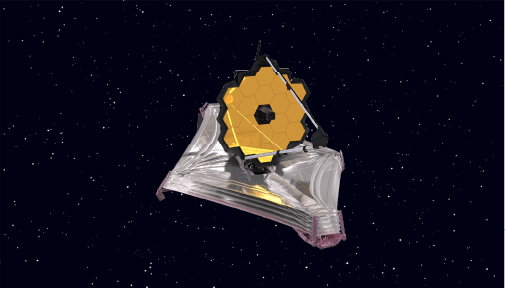
James Webb Space Telescope (JWST) observations have revealed unexpectedly overmassive black holes at the hearts of a pair of dwarf galaxies, far in excess of the expected ratio of black hole to galaxy mass.
While supermassive black holes are often described as “anchors” to their host galaxies, in reality, data show them to account for a mere 0.1 to 0.5% of a galaxy’s mass. Previous deep infrared JWST observations later demonstrated that supermassive black holes could grow far beyond this size in the early universe, yet this is the first time such a phenomenon has been identified in more recent galaxies at intermediate redshifts.
In short, the discovery of these black holes at such sizes, and at such early periods in the universe, represents a discovery that challenges our current understanding of black hole formation with relation to galaxies.
Conflicting James Webb Space Telescope Observations
The research, led by Institute of Science and Technology Austria PhD fellow Eduardo Iani, is currently available as a preprint on arXiv, pending potential publication by Astronomy & Astrophysics. The galaxies in question, Pelias and Neleus, display unusual spectral energy distributions. When images with JWST’s NIRISS and NIRSpec instruments are taken, the galaxies appear to be quite blue, indicating low amounts of dust and young, ionizing stars.
However, JWST’s MIRI instrument is telling an entirely different story. Instead of the deep blue of the other observations, it shows a large amount of mid-infrared emissions, well beyond what their stellar masses should produce. The author suggests that a type of black hole—an active galactic nucleus—is likely behind the readings.
Explaining the James Webb Space Telescope Observations
The researchers say that hot dust associated with an active galactic nucleus fits the JWST data far better than alternative explanations, such as the local star population or dust heated by star formation. According to their estimates, these black holes could account for up to 60% of their host galaxies’ mass. Potentially, this indicates that the black holes formed first, with the stellar masses accumulating later on to form the galaxies.
Additionally, the authors note that Pelias and Neleus have spectral energy distributions similar to those of the mysterious “little red dots,” which have puzzled astronomers since JWST began detecting them. Potentially, this pair of galaxies may represent lower-redshift objects similar to the little red dots, as dust blocks the emitted light while these galaxies are still under construction.
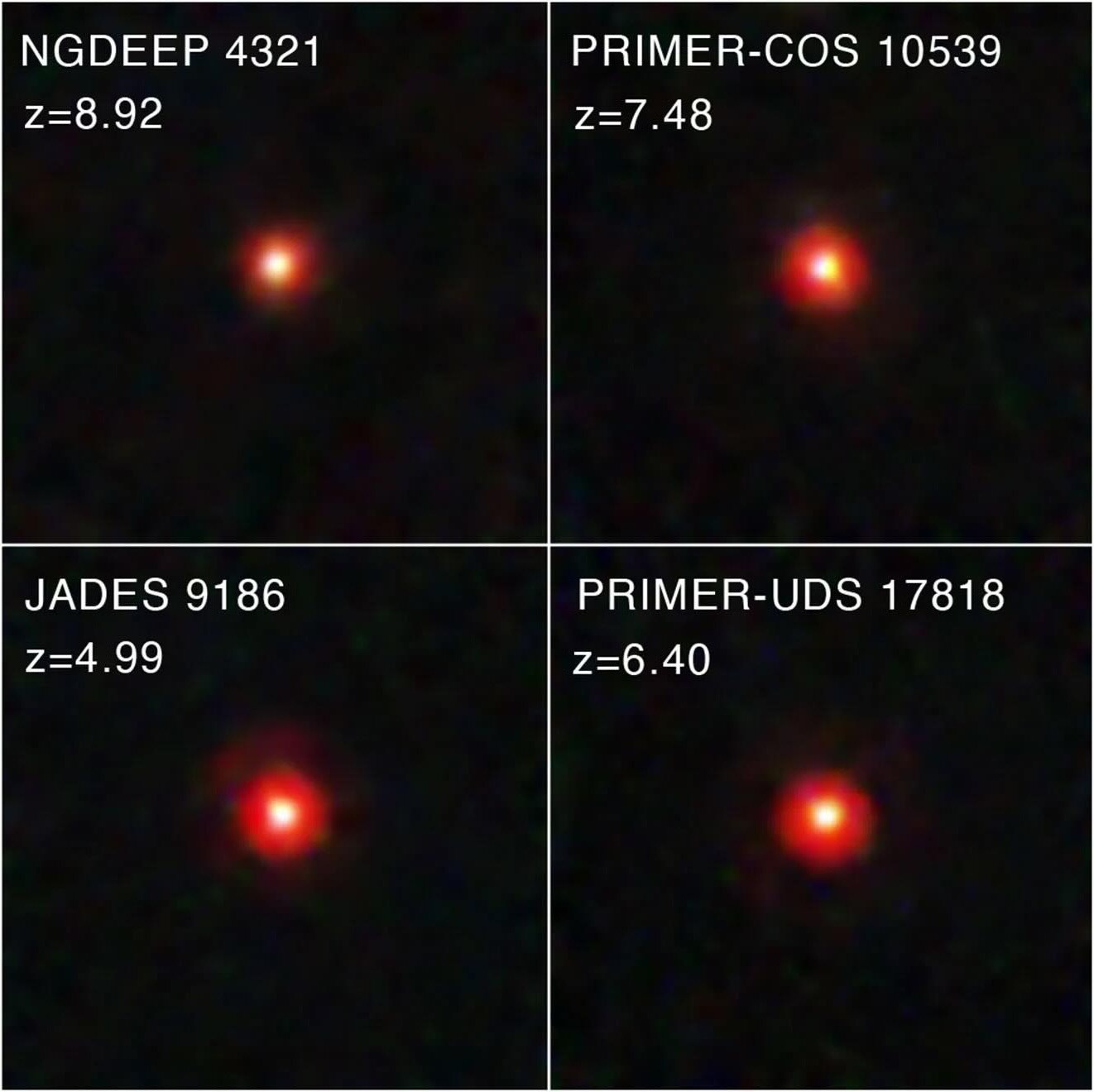 Above: Examples of “Little Red Dot” galaxies (Image: NASA, ESA, CSA, STScI, Dale Kocevski (Colby College)).
Tiny Galaxies, Big Black Holes
Even more strangely, the active galactic nuclei are not emitting X-rays, which they normally should. The researchers offer two possible reasons this may be: either the accretion is X-ray-weak or just heavily obscured from JWST’s point of view. Possibly, the accretion is breaking the Eddington limit, the maximum rate at which black holes are supposed to be able to intake matter, which has been shown to be more and more flexible as JWST spies farther into the universe. Many of these Super-Eddington accretions have been identified in low-mass galaxies, similar to Pelias and Neleus.

In fact, Pelias and Neleus are among the smallest galaxies ever observed to contain active galactic nuclei. This fits the black hole-to-galaxy mass ratio, as Super-Eddington phases are associated with rapid early growth in black holes, primarily in low-mass galaxies. However, the researchers caution that uncertainties in estimating black hole mass may give a false impression of a Super-Eddington phase when none is occurring.
The team will continue to monitor JWST and other platforms for additional examples of dwarf galaxies displaying similar behavior. X-ray telescopes such as NASA’s Chandra X-ray Observatory and the upcoming ESA Athena mission will be essential to the data-collection effort. Only continued attention and analysis will reveal whether these twin dwarf galaxies are true outliers or represent an as-yet-unknown class of active galactic nuclei.
The paper, “JWST Reveals Two Overmassive Black Hole Candidates in Dwarf Galaxies at z≈ 0.7: Pushing Black Hole Searches into the Dwarf-Galaxy Regime,” is available in preprint form on arXiv.
Ryan Whalen covers science and technology for The Debrief. He holds an MA in History and a Master of Library and Information Science with a certificate in Data Science. He can be contacted at ryan@thedebrief.org, and follow him on Twitter @mdntwvlf.