
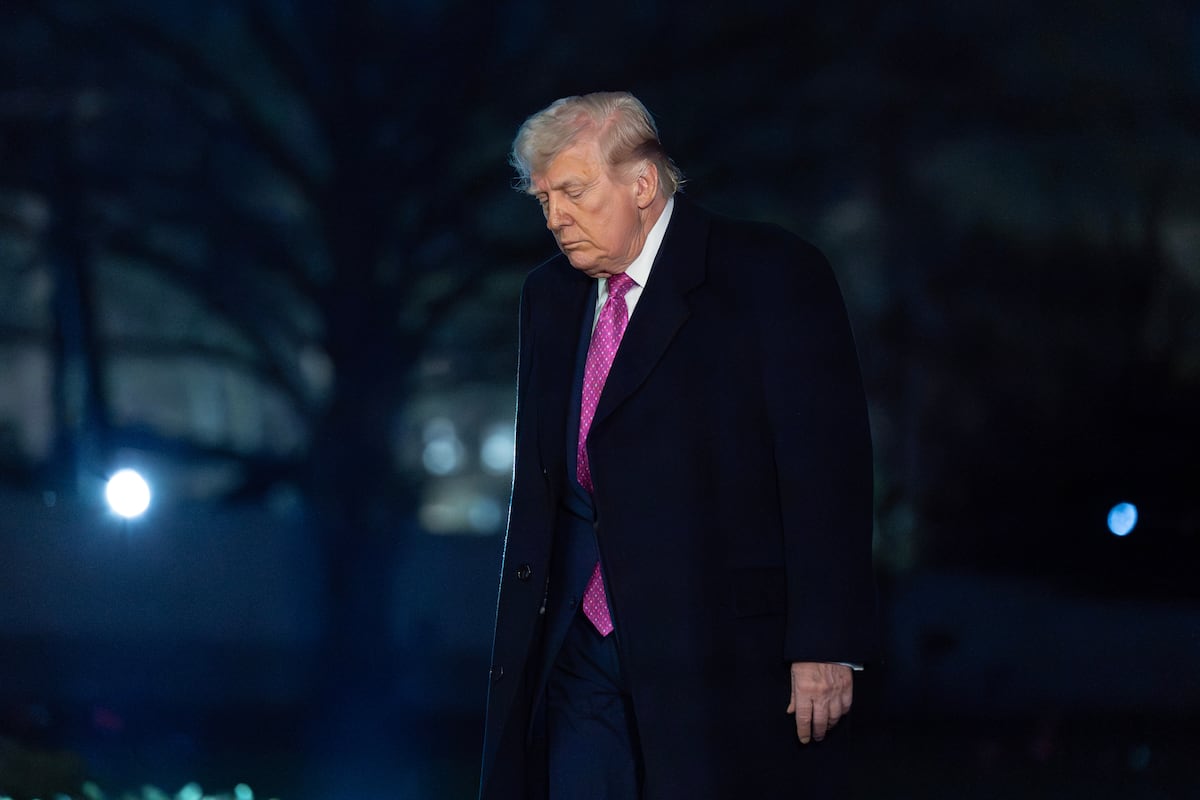
A failed trade war with China; annexation threats towards Greenland that reaped only indignation and ended in backtracking; pressure on Canada that led to Mark Carney’s victory and brought Ottawa closer to Beijing; Congress’s decision to limit the White House’s ability to withdraw troops from Europe and the Supreme Court ruling that overturned the tariff war. While we wait to see if the Iran conflict will be added to the list of Donald Trump’s setbacks and defeats, the tally from his second term is already extensive and multifaceted. Several of these items are of profound significance, revealing the limits of the United States and its government, as well as mechanisms of effective opposition to the current White House’s offensive campaigns. Markets often prove to be the circuits transmitting the electrical messages that restrain Trump, but the underlying factor is always a combination of will and resilience. Seen as a whole, there is a dynamic here that sheds light on the future of the world, and deserves to be analyzed consistently and carefully.
Iran
The world’s attention is quite logically fixed right now on the attack that the United States — and Israel — have launched against Iran. That conflict is in a state of flux, and it would be unwise and premature to make any definitive judgments at this point. However, the situation is already causing serious problems for Washington, and threatens to result in a major setback for the U.S. administration.
Iran has suffered serious blows over the last four weeks, but its regime remains firm and continues to block the Strait of Hormuz. The consequences of the blockade have been serious with respect to the hydrocarbon and fertilizer industries, but also to those of other essential products, like helium, for example, which is essential to microchips manufacturing. In addition, its impact on the Arab Gulf states threatens to cause serious repercussions in global financial markets, as the deep pockets of those countries have been a key factor in investment projects around the world.
On a political level, the Iranian regime not only continues to hold power, but is increasingly falling under the control of the hardline Revolutionary Guard. Meanwhile in the United States, the offensive has led to tension in the MAGA movement, where many adherents abhor the elective war.
But perhaps the most relevant factor pertaining to the conflict is a critical vulnerability that Operation Epic Fury has made evident: the limits of military technological superiority in the new martial panorama, in which large numbers of cheap weapons can offset qualitative disadvantage.
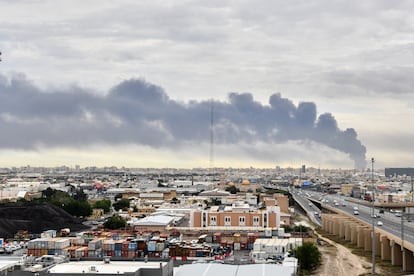 A column of smoke after a drone attack in Kuwait.AP
Macdonald Amoah, Morgan D. Bazilian, and Jahara Matisek have done a good job of describing this pattern in a commentary published by the Royal United Services Institute. In the first 16 days of combat, the United States and its allies fired off some 11,000 munitions — among them, nearly 1,700 missiles from the Patriot surface-to-air missile system, 300 from the Terminal High Altitude Area Defense (THAAD) system and around 500 Tomahawks, at a cost of some $26 billion. Past this financial sum, the problem is that some of these weapons — especially the long-range interceptors and precision strike arms — are difficult to produce, and have limited stockpiles. The rate at which they are depleted is rapid, while their rate of replenishment is slow.
According to estimates published by the authors (countries do not disclose data on their stockpiles), Israel is believed to have used 80% of its Arrow 2 and 3 interceptors, while Arab State countries have used 60% of their THAAD system arms. The United States has used 40% of its THAAD system weapons.
Of course, the industry will replace this technology, but many of the systems involved are highly complex. For example, the authors estimate that it will take five years to recover the 500 Tomahawk missiles that were fired in the first 16 days of the war. Other experts suggest that replenishment can be carried somewhat more quickly, though it remains a very cumbersome process. Meanwhile, the war continues. Sources cited by The Washington Post put the number of Tomahawk cruise missiles fired in the first four weeks at more than 850. The modern version of the missile costs about $3.5 million per unit.
There’s no doubt that the offensive has demonstrated the United States’s astonishing strike capabilities and inflicted significant military damage on Iran. At the same time, however, it is causing severe economic turmoil, depleting arsenals and exposing a troubling vulnerability hidden behind U.S. technological superiority. It only takes a large number of drones worth $34,000 per unit like the Iranian Shaheds to quickly deplete a stock of missiles worth over $4 million each, like those of the Patriot system.
This asymmetry challenges long-held assumptions about the balance of power. We saw the same dynamic unfold during the war in Ukraine, but it is striking to witness its impact on the world’s greatest military power. There will be global repercussions as well, affecting those that depend on arms deliveries from the U.S. industrial complex, which will now need to focus on replenishing stocks for the Pentagon — and, because Washington’s adversaries are taking note of a critical moment of limited weaponry availability. China continues to be delighted by U.S. attrition due to unnecessary war.
China
Beijing itself is the protagonist of another immensely significant setback that Trump has suffered, related to the failure of the trade war offensive that Washington launched against China last year. In contrast to other nations that took a knee, Beijing refused to fold under pressure through signing an unfavorable trade agreement with the United States. The country resisted, activating a kind of nuclear trade option: restrictions on exports of strategic raw materials, an asset that has been carefully built up over several decades through controls on both extraction and refining. Beijing’s move to restrict sales of rare earths generated panic in the global industrial market, which depends on its raw materials for virtually all modern manufacturing.
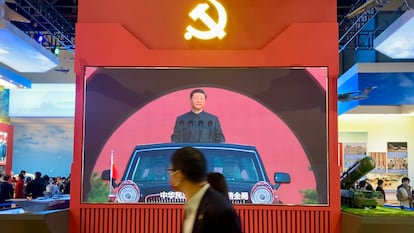 A poster of Xi Jinping at a defense conference in China.G. A.
“Trump thought he was going to bring China to its knees, but he has learned that China was better prepared than he assumed. He overestimated his own strength and capabilities and underestimated his rival,” says Miguel Otero, a senior researcher at Spain’s Elcano Royal Institute, who specializes in international political economy and the power triangle of the United States, China, and the European Union.
“With its move on rare earth exports, China dared to bring out the big guns,” Otero continues. “And that is very significant, because it wasn’t just a bluff. Backed by economic, political and military clout, as well as strategic resolve — and without much fanfare — China demonstrated its structural power, and I believe that is a major development.”
“My reading is that there is an element of U.S. desperation in relation to the rise of China. Trump is a reflection of that,” Otero continues. “They haven’t managed to halt that rise with multilateral action, with alliances. Now they think that they’ll be able to get everyone in line with force.”
But at the moment, all they’ve managed to do is make China’s strengths more evident. The whole world was watching, and took note of how Trump halted his trade offensive. Notes have also been taken on how he has had to delay his anticipated official state visit to Beijing, an appearance that has become unviable amid the vulnerability represented by an out-of-control war with Iran.
Canada
China also plays a major role in another great lesson of Trump’s second-term setbacks: his failed strategy to put pressure on Canada. From the very beginning of this term, the U.S. president expressed his desire to turn the neighboring country into the 51st state, hitting it with a barrage of tariffs and meddling in its domestic politics. The result was a strong outpouring of Canadian national pride, the collapse of the party whose ideology most closely resembled that of Trump during his election campaign, and the victory of Mark Carney, who would go on to become a political and intellectual leader of the global resistance to Trumpism and the driving force behind a reconfiguration of his country’s relationship with China.
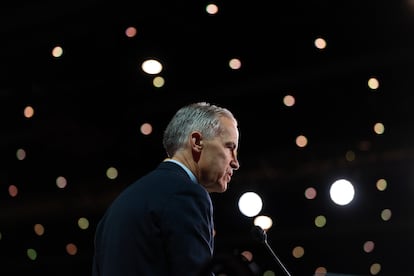 Canadian Prime Minister Mark Carney in Halifax on Friday.Darren Calabrese (AP)
“Independently of one’s opinion on Donald Trump and his foreign policy approach, there is something that can now be said with a certain degree of confidence: he is a historic accelerator, forcing both allies and adversaries to reevaluate their economic and security policies in real time, and with tangible effects,” says Philippe Rehault, director of the University of Alberta’s China Institute, in a written response to interview questions.
“By doing so,” Rehault continues, “he is also forcing even long-standing allies and partners to reevaluate their relationship with Beijing. The real setback for Trump is not simply that countries like Canada are pushing back. It is that his stance may be undermining the hierarchy of trust upon which U.S. power among its allies has long been based.”
Canada, due to its particular exposure to the United States because of its geographic location, can be seen as a prime testing ground. “The impact has been profound. Trump’s comments about the 51st state and his aggressive trade stance toward Canada are shaking up the country, rousing it from its usual complacency and pushing it to accelerate its efforts toward trade diversification, greater resilience, and a broader reassessment of its foreign policy options,” Rehault continues. The country’s shift toward China comes after years of highly problematic relations with its neighbor to the south.
“What has changed is not really that Canada has developed a deep or renewed affinity for China. But there is a growing acceptance — especially in business and strategic circles — that China should once again be considered, at least in a selective manner, as part of a wider buffering strategy against the volatility, belligerence, and unpredictability of the United States,” says Rehault.
The Canadian situation is an example of a dynamic that, while not yet an established pattern, does send significant signals: Trumpist excesses have negative effects on forces aligned with Trumpism. Carney’s victory is not the only example. The Danish elections were positive for the leaders of the resistance to the United States. Where Trump attacks, he does a favor to those who resist him. And even where there are no direct attacks, in some cases, his excesses take a toll on his allies. There is no doubt that her closeness with Trump didn’t help Italian Prime Minister Giorgia Meloni in her failed judicial reform referendum, and last year in the Australian elections, the Labor Party won by a landslide, in part due to anti-Trump sentiment.
Greenland
Another problematic episode for the White House that is replete with lessons for the rest of the world is the campaign Trump launched to annex Greenland. His declarations ran into consistent resistance from Denmark and its Arctic territory — which, according to recently released information, even began to prepare military resistance to a possible invasion. European countries closed ranks with them. The result was political tension, market turbulence, and a retreat that Trump announced at the Davos Forum.
“We can call it a complete defeat — the failure of someone who thinks he’s all-powerful, but isn’t,” says Diego López Garrido, the current director of Fundación Alternativas. The former Spanish Secretary of State for Foreign Affairs believes that this reaction “worked because there was absolute solidarity around Denmark in the face of Trump’s threat. In other words, proof that when the European Union displays an attitude of ‘unity in diversity’, as goes its motto, it works. When the European Union takes a fearful attitude, it loses, it always loses.”
The whole world watched in astonishment as the prospect of a U.S. military attack on a European ally loomed, as that ally and others prepared and rallied in the face of that prospect, and then as Washington backed down in the blink of an eye — even though its leader had vigorously maintained that control of the Arctic region was necessary for the nation’s national security.
The whole world also took note of how, one month after December’s about-face in Davos, the U.S. Congress approved a defense budget that included measures to significantly limit the president’s authority to reduce troop deployments in Europe. Although clearly in decline, as recent studies by V-Dem and Freedom House conclude, U.S. democracy is still putting up resistance to Trump’s excesses, as evidenced by the Supreme Court’s ruling against the way the White House unleashed the tariff war. That resistance is another important lesson to be drawn from Trump’s setbacks.
Sign up for our weekly newsletter to get more English-language news coverage from EL PAÍS USA Edition