
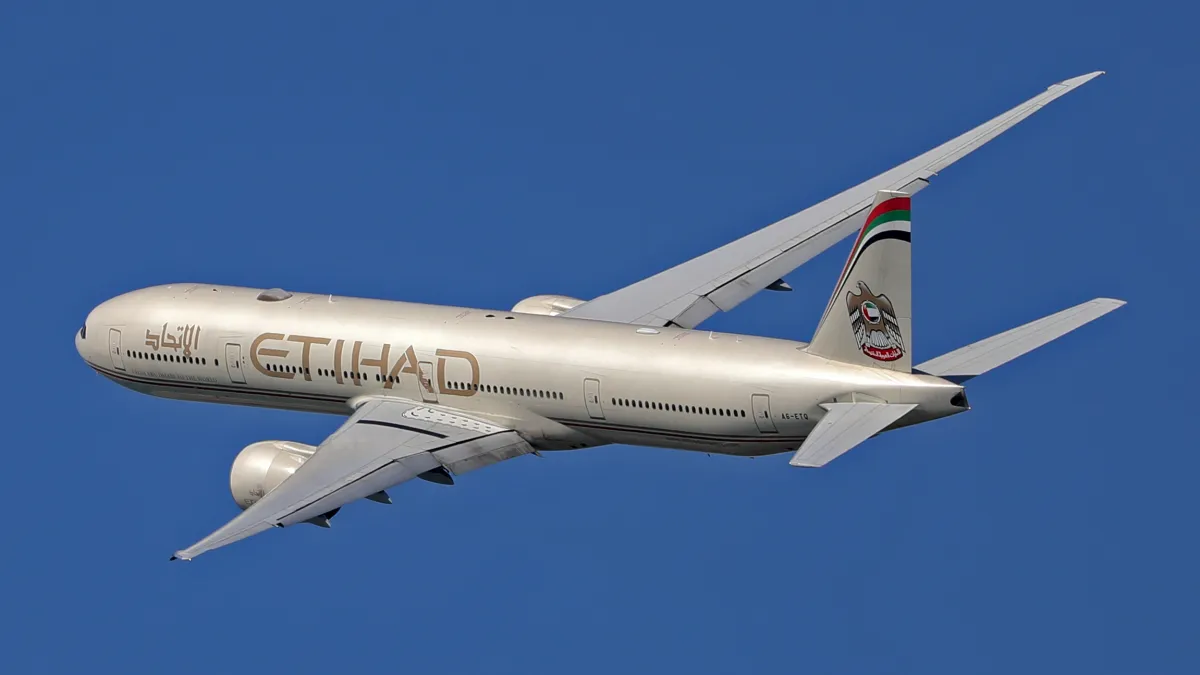
Etihad Airways, the official airline of the United Arab Emirates, has started a price fight among the big three Gulf carriers. It is slashing fares by 50 per cent in response to the war in the Middle East, which has sent demand for air travel in the region tumbling.
The Abu Dhabi-based airline now offers some of the lowest-ever fares from the UK to popular destinations including Sydney, Singapore, Hong Kong, the Maldives, Bangkok and Tokyo. Some fares are just one sixth of those on British Airways.
Economy-class return flights from London to Sydney, via Abu Dhabi, leaving in May and returning in June, are as low as £688. A business-class return is £2,465. The fares include all taxes.
By contrast, the cheapest tickets on British Airways to Sydney, via Singapore, on the same dates, are £1,850 in economy and £10,435 in business class. An Etihad business-class return from London to Singapore is just £1,521, compared with £8,485 on BA.
Some of the UAE carrier’s fares are even lower than during the pandemic.
State-owned Etihad is gambling that the deep discounts will tempt passengers to book now to fill planes from next month until the end of June, in the hope that the conflict between the US and Israel and Iran will have eased by then. Prices rise again in July, Etihad’s website shows.
One Etihad executive — speaking privately because, during hostilities, all communication on state entities is limited to official government spokesmen — said: “As soon as travel picks up, we want to be back to flying planes 100 per cent full in all cabins, as we were before the conflict. These prices will help.”
Etihad hopes to tempt first-time passengers who will become regulars. On its website, it reminds customers of the perks that it offers. For example, they can book two nights in a hotel in Abu Dhabi free of charge to make their stopover a mini-break — although executives acknowledge that few will take up this offer while Iran is attacking the UAE.
The Foreign Office currently advises against all but essential travel to the UAE.
The airline also hopes travellers will be impressed by Etihad’s new hub airport, Zayed International, which many frequent flyers consider the best designed, easiest and quickest to navigate, and luxurious in the world.
Fares are even lower for Etihad passengers leaving from cities in continental Europe — about 10 per cent cheaper — because Heathrow, from where the airline mainly operates in the south of England, has the highest airline charges in Europe, which airlines pass on to customers.
There is no sign that either Emirates, the Dubai-based carrier that is the biggest international airline in the world by passenger miles flown, or Qatar Airways, its nearest rival, will follow Etihad’s lead on price. Both are larger than Etihad and, therefore, better able to ride out the disruption caused by the war. However, both are offering greater booking flexibility, including one free date change.
Privately, one executive at a rival Gulf carrier described Etihad’s discounts as “a crazy move that looks weak and cheapens its brand”. He said: “Sure, people in the UK and Europe might buy a ticket once while it’s cheap, but when prices rise again, they’ll go back to the airlines they used to choose before — whether it’s a European carrier, Emirates, Qatar Airways or Turkish.”
A leading global aviation analyst, Henry Harteveldt of the US-based Atmosphere Research, said Etihad’s move was “not unusual … After 9/11, US airlines offered deep discounts to tempt passengers back. I call it ‘the price of courage’.”
Harteveldt added: “Despite what they may say now, I expect Etihad’s competitors will respond. Because not only do they have plenty of empty seats, the last thing they want to do is risk losing a passenger to Etihad.”
Additional research by Reet Mulchandani