

The future of robotics took a distinctly biological turn in Shanghai this week, where researchers unveiled Moya, a humanoid robot that replaces traditional mechanical joints with artificial muscles and a spine-like skeletal structure. Unlike conventional machines that rely on motors and rigid metal frames, this new platform is designed to mimic the way actual human tissue moves and flexes.
Developed by the Shanghai Engineering Research Center of Humanoid Robots and featured in a recent report from the South China Morning Post, Moya is being billed as the world’s first fully biomimetic embodied intelligent robot. The prototype represents a sharp departure from the hydraulic or electric servo systems that power famous machines like Boston Dynamics’ Atlas, aiming instead for a softer, more adaptable form of movement.
A Body Built to Bend, Not Just Bolt
Instead of stacking metal gears and pistons, engineers gave Moya a flexible spine and limbs powered by pneumatic artificial muscles. These muscles contract and expand when air is pumped through them, creating a pushing-and-pulling motion that looks far more organic than the jerky movements of traditional bots.
According to the research team, this design allows Moya to achieve motions that are nearly impossible for rigid robots. The spine can twist and bend, distributing force across the structure rather than concentrating it at single pivot points. In a demonstration video shared by the center, the robot’s torso rotates smoothly while its shoulders adjust in real time, mimicking the natural compensation patterns of a human reaching for an object.
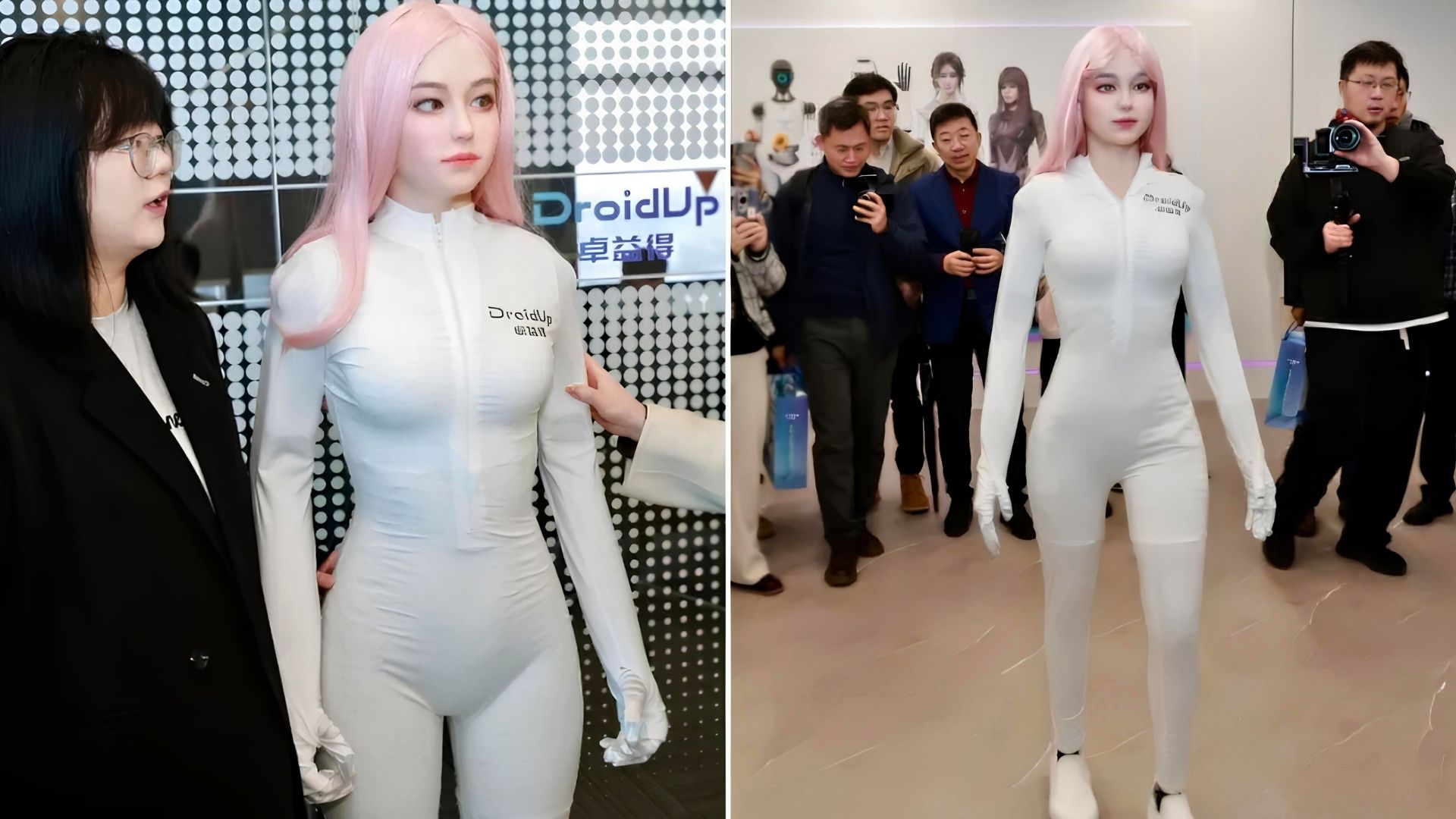 China’s Moya humanoid robot is designed to assist, interact, and accompany. Credit: DroidUp
The robot’s skeletal frame is also built differently. Researchers used lightweight composite materials shaped to resemble human bone geometry, creating attachment points for the artificial muscles that mirror the human musculoskeletal system. That anatomical attention to detail is what separates Moya from other humanoids currently in development.
Why Soft Robotics Matters for Real-World Work
Most industrial robots excel in predictable environments like factory assembly lines. Give them a bolt to turn or a weld to make, and they outperform any human. But put that same machine in a disaster zone, a cluttered home, or a construction site with uneven footing, and its rigid joints become a liability.
That is exactly the problem Moya is trying to solve. A flexible spine and muscle-like actuators allow the robot to absorb shocks, adapt to irregular surfaces, and manipulate fragile objects without crushing them. For example, a traditional robot gripping a glass of water must calculate precise force limits in advance; a biomimetic system with variable tension can feel its way into the right grip pressure through passive compliance.
The Shanghai team is not alone in pursuing this approach, but they appear to have integrated more biological principles into a single platform than most competitors. Other labs have built artificial muscles or flexible spines in isolation. Moya reportedly combines both with a control system designed to manage their interaction in real time.
The Intelligence Inside the Muscle
A robot with bendy parts is useless without a brain that can predict how those parts will behave. Muscle-driven systems are inherently harder to control than motor-driven ones because pneumatic muscles stretch, contract unevenly, and respond differently under varying loads.
To solve that, Moya runs an embodied intelligence framework, meaning its software is tightly coupled with the physical properties of its own body. The control algorithm does not just issue movement commands; it continuously models how the muscles will deform under current conditions. That allows the robot to adjust its posture and force output faster than a system relying on external sensors alone.
In the Interesting Engineering coverage of the unveiling, the robot demonstrates this by reaching toward an object while its torso and shoulders shift in a fluid sequence. No joint locks into position. No sudden mechanical stops occur. The entire motion looks like a slow, deliberate human stretch rather than a programmed machine movement.
The One Big Trade Off Engineers Still Need to Solve
The research team has not announced a commercial release date or specific industrial partnerships. As of the unveiling in Shanghai, Moya remains a prototype designed to prove that a fully biomimetic body can function as a cohesive unit rather than a collection of experimental parts.
Engineers are currently refining the robot’s response speed and load capacity. Pneumatic muscles have historically struggled to match the raw power of hydraulics or electric motors, so boosting strength without losing the flexibility advantage is the next engineering hurdle.
The center has indicated that future iterations may incorporate hybrid systems, using small motors for high-power tasks while retaining muscles for fine manipulation and spinal flexibility.