
This is the Trail Report, a weekly email newsletter from reporter Maura Fox about hikes and San Diego County’s outdoors. Sign up to get it in your inbox first, every Friday.
I was hunched over a Baja hillside last October looking for arachnids with a San Diego Natural History Museum entomologist when I heard a shout from scientists just a few yards up the canyon.
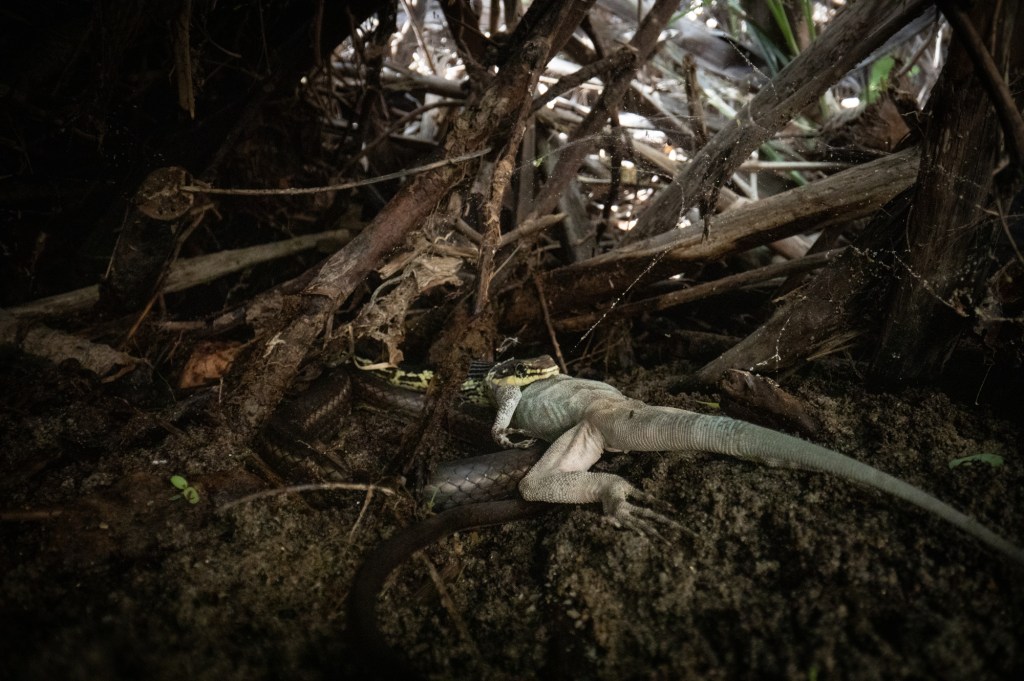
They had spotted a snake — a cape striped racer — and it was devouring a San Lucan rock lizard.
I raced over to watch the painfully slow-motion lunch taking place on the canyon floor. The energy among all of us — the scientists and me and the Union-Tribune’s photographer — seemed to be: What are the odds that we’d be here to see this?
It was one of many incredible moments on an expedition last fall with NAT scientists in the Sierra de las Cacachilas, a mountain range just outside of La Paz in Baja Sur. But this one was particularly special.
Very little is known about the diet of the cape striped racer, says Adam Clause, collections manager for the NAT’s herpetology department.
“Just about every field guide says something about what it eats,” he said. “But when we dug into that literature and tried to find the actual evidence behind what people were saying the snake ate, we kept coming up dry.”
Predations like the one we saw in Las Cacachilas are a big deal because they give scientists the real-life evidence they need to better understand these snakes.
And in fact, the one we saw is now part of a research paper published late last month by the NAT’s herpetology apprentice Sahamara Ruiz-Ornelas, along with Clause and other colleagues from the NAT and Baja.
It’s based on about a decade’s worth of research on the cape striped racer, Clause says — and it’s not a long paper, meaning there’s still a lot to learn about the snake. There have now been two confirmed predations: one in 2017 when the snake was seen eating a moth pupa, and the one I watched.
The cape striped racer is endemic to the Cape region of Baja Sur, but it’s not the only snake that Clause is eager to learn more about. The rat snake, which he also describes as an elusive species in California and throughout the U.S., is also on his list. So is the Sonoran lyresnake — common in Arizona but only seen once in California, back in 1938.
This spring, Clause will set out to a small town along the Colorado River to search for it. He says the mysteries behind his work never gets old.
“I like learning about these enigmatic animals that few people have ever seen,” he said. “I like trying to bring more awareness to the fact that there are these things out there in the world that we all live in that maybe nobody knows about.”
You can read the full research paper here.
In other news, the Sierra Nevada and mountain ranges across the western U.S. are seeing some of the lowest snowpack levels in decades, leaving experts worried about how this will affect the region’s water availability and wildfire risk. For those of us who spend a lot of time outdoors, I’m also thinking about all the ways it might affect what we do, and when. I’d love to speak with people who are concerned about it for an upcoming story, so send me an email if you’d like to chat.
Plus, the Trump administration wants more oil and gas drilling in the Gulf of Mexico, where the endangered Rice’s whale lives. Scientists say the noise could impact the whale’s foraging behavior, and the pollution could harm its health.
When you’re done reading this week’s news, take a hike in Sandrock Canyon in Serra Mesa, where I enjoyed a short, 2-mile skip while being serenaded by dozens of frogs.
That’s all for now. See you next week.
–Maura
Hike of the week: Sandrock Canyon Trail mixes terrain and scenery for a funky little hike
Outdoors: Watching hummingbirds is almost hypnotic
Record low Colorado mountain snow won’t bode well for water in the drought-stricken West
Things to know about Rice’s whale, a rare species at risk from Trump plans for more Gulf drilling
If the giant sequoia is dying out, why are there tens of thousands of seedlings and saplings?
Hike of the week: 9 canyon hikes in San Diego for spending time in nature
Nevada lithium mine clears major hurdle despite conservationists’ worries for rare wildflower