
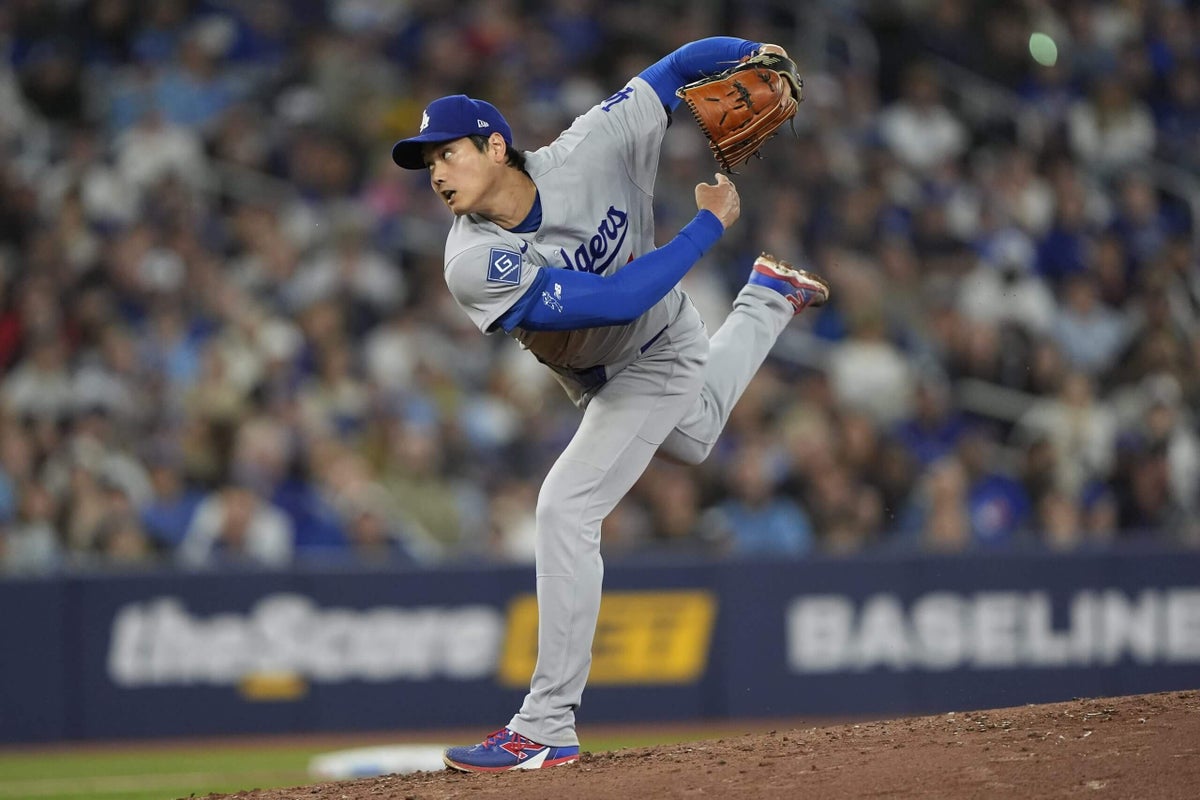
TORONTO — There is no blueprint for Shohei Ohtani, which means every time he takes the mound for the Los Angeles Dodgers will be a checkpoint on how to keep him healthy. Nothing matters more for the winner of the last two World Series.
No one else is capable of doing what Ohtani is doing, but his two-way talents cannot simply be bottled up and preserved for October. The Dodgers will need to strike the right balance to get the most out of him. It’s an impossible task, even if Ohtani has built a career out of making the impossible possible.
“There’s no exact science,” manager Dave Roberts said Wednesday. “You’re just going to watch.”
Ohtani didn’t have his sharpest performance in his second start of the season against the Toronto Blue Jays. He struggled with his command and threw too many pitches early. He went six innings but recorded just two strikeouts, something he had never done in his career. For the first time in 24 2/3 innings, he allowed a run. His final line score speaks to his otherworldly talent: he only allowed the one unearned run, exiting in line for the win before the bullpen blew a late lead in a 4-3 loss.
Then there’s this.
“I didn’t feel that great,” Ohtani said through interpreter Will Ireton. The Dodgers had rearranged their rotation on this six-game road trip to ensure there would be an off day after Ohtani’s start. He had seven days’ rest between outings as a result. Still, Ohtani mentioned the end of the road trip as an explanation for how he was feeling. Maybe his mechanics were a little off. Maybe he was fatigued.
“I’m not sure if that was the main cause,” Ohtani said, “but I want to make sure that I’m addressing, if any, some mechanical changes.”
Ohtani still threw 96 pitches, his most in a regular-season game since becoming a Dodger. His fastball velocity averaged 98.3 mph, up from his last start and perhaps a compensation for his lackluster command. He touched 100.1 mph on his fastball to strike out Kazuma Okamoto and get out of trouble in the first inning. Nothing about his arsenal appeared physically compromised. His ERA is still 0.00 through 12 innings.
“Pretty impressive, to be honest with you, given how he felt,” Roberts said.
Wednesday’s start was a reminder not only that Ohtani has the talent to win the Cy Young award he seeks, but also of how difficult that would be to accomplish. The Dodgers got a test run at what a two-way Ohtani looks like and how to best manage it last summer. That is not a one-to-one comparison; Ohtani didn’t throw his first pitch until June, and didn’t pitch into the sixth inning for the first time until his last start of the regular season.
Ohtani pitched Game 7 of the World Series in this very building, throwing on short rest for the second time ever in the major leagues. He was exhausted by the end.
The Dodgers still have to figure out how to manage this over the course of a full season. For as good as he is on the mound, he’s just as important at the plate. Ohtani slugged three home runs on this road trip after complaining about how his swing felt after the first six games of the season.
“I think it’s going in the right direction,” Ohtani said.
The Dodgers know what they can expect out of Ohtani at the plate. Getting the most out of their offense likely relies on the production of the hitters at the bottom of the order, who set the table for Ohtani, Kyle Tucker, Freddie Freeman and the rest of the stars in the middle. It’s a simple formula.
“If those guys are getting on base for the top, we’re going to score some runs,” Roberts said.
Those hitters did their job on this road trip. It’s a small sample, but they hit 25-for-69 (.362) with nine extra-base hits over the Dodgers’ six-game stretch. The offense as a whole combined to score 52 runs after logging 23 runs over the first six games of the season. It shouldn’t be a surprise they won five of six games with that kind of production against the lowly Washington Nationals and struggling Blue Jays.
The Dodgers are hoping this kind of production is a sign of things to come. Their 1.003 OPS out of the bottom three spots in the order entering Wednesday is likely an unsustainable figure, but it is the best in baseball so far.
Those three spots had just a .663 OPS a year ago (tied for 16th in the majors), struggling in particular down the stretch run. The Dodgers’ offense as a whole lagged as a result.
Mookie Betts’ injury throws a wrinkle into things, even if just for a little while. His absence has moved Andy Pages up in the order after Pages’ red-hot start fueled much of that early production. Alex Freeland is now locked into everyday at-bats; he’s had an up-and-down start, going quiet after his explosive first game of the season before putting up a three-hit day on Tuesday night. Not having Betts at shortstop means a platoon between Miguel Rojas and Hyeseong Kim at the position.
Kim has made a strong impression upon his return to the big leagues. The Dodgers need him to stabilize his swing and avoid spinning out when rotating his hips, something he’s shown in flashes through his first handful of games. It was noteworthy on Tuesday when Kim hung in on a fastball on his hands from Toronto’s Kevin Gausman, lining it 101.9 mph for a double.
“For me, it looks good,” Roberts said. “I think he’s into the ground much better. I think the swing decisions are better mechanically. It looks great.”
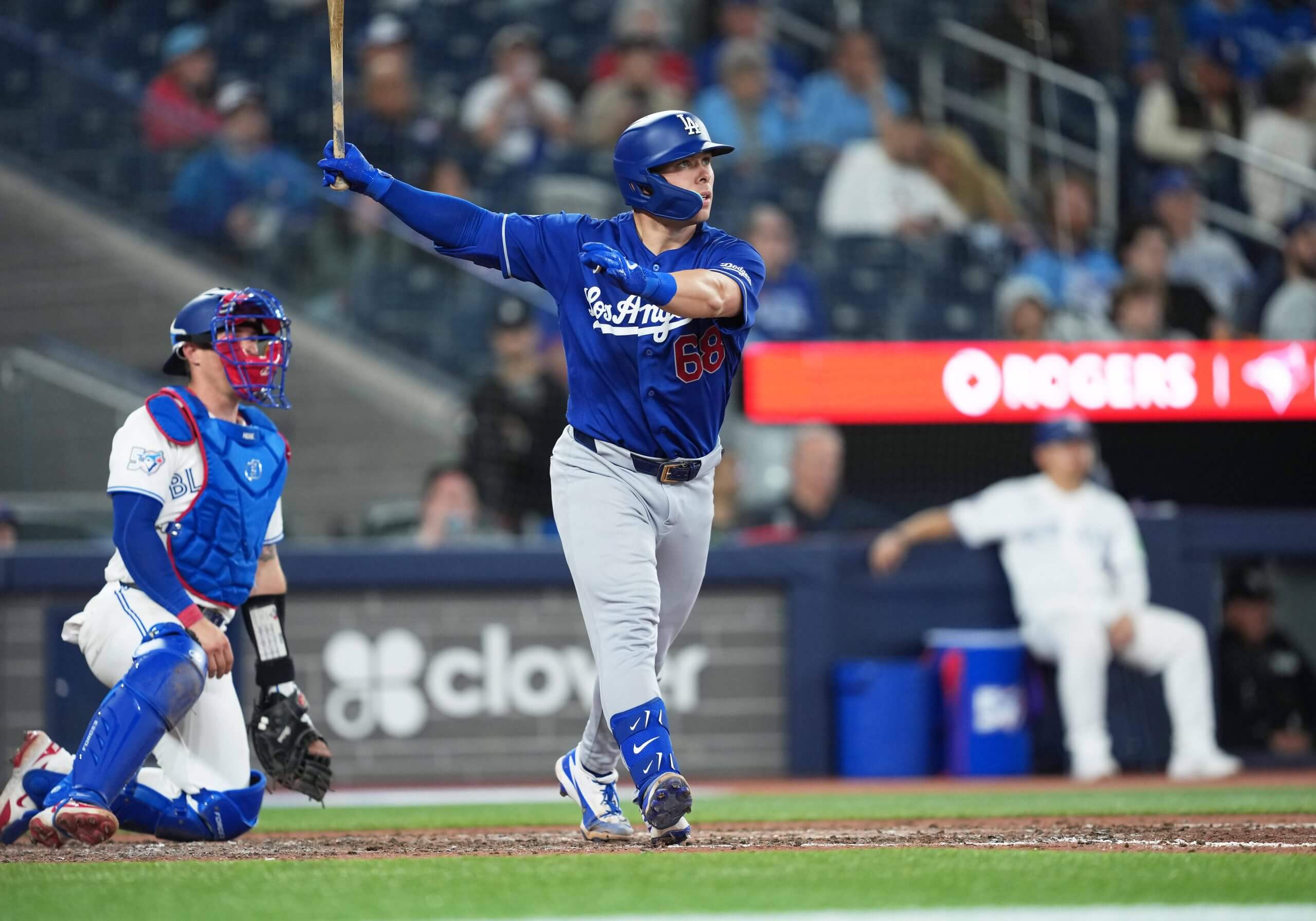
Dodgers catcher Dalton Rushing hits a home run against the Blue Jays on Monday in Toronto. (Nick Turchiaro / Imagn Images)
Dalton Rushing is keenly aware of the reality of his current situation, which made the joke he made after his career-best night on Monday feel all the more real.
“It’s only downhill from here,” Rushing said after he went 4-for-4 and hit a pair of home runs in a thumping of the Blue Jays. The Dodgers’ young backup catcher had already homered the day before in the series finale against the Nationals, and got the start for the second consecutive day because Roberts wanted Will Smith to catch Yoshinobu Yamamoto and Ohtani.
Rushing made the most of it. There just might be a ceiling for how high he can go right now.
The 25-year-old Rushing has done what he’s needed to do to start the season. His swing is in a better place than it was at any point in the big leagues last season. Rather than try too hard to maximize his limited opportunities, he’s taken on a more measured approach. He looks like the hitter who was one of the more polished catching prospects in the sport.
He’s also not supplanting Smith any time soon.
“I’m not worried about being a backup my whole career,” Rushing said. “I’m really not. But at the same time, I think I’m going to take advantage of this time and learn as much as I possibly can from it.”
The Dodgers are pleased with what they’ve gotten out of him. They have also made clear there is still growth they need to see from Rushing to gain more playing time; Roberts said this week that two starts a week is likely a good threshold with the team still trying to keep Smith fresh throughout the season.
It’s not entirely fair to compare Rushing’s situation to the one Smith entered when he debuted in 2019. Both were among the game’s best catching prospects when they arrived in the majors, and both were plucked from the same pipeline of catchers at the University of Louisville. The likenesses essentially stop there.
Smith got a chance to essentially intern at the big-league level in September 2018 before he even played in a game. He also didn’t have a guy with a massive contract extension sitting in front of him on the depth chart, as Rushing has with Smith.
Still, an interesting question was posed to Roberts this week: What did the Dodgers see in Smith to grab the reins in 2019 that Rushing still needs to develop?
“You can just see the calmness (in Will),” Roberts said. “I think that, for me, a catcher has so much more responsibility than anyone on the field that they’ve got to navigate their emotions and separate the hitting from the game calling … (Will) never panicked. I think for me, that just gave me the confidence to trust him to be an everyday guy, along with the offensive performance.”
Perhaps it just takes time.
“You can’t get too high, get too low,” Freeman said. “I think Dalton’s learning that. It comes. You get that with experience. You get that with playing multiple seasons. This is his second year up with us now. He’s more comfortable around here. Pitchers are throwing really well to him. Now obviously carrying it over to the plate, too.”