
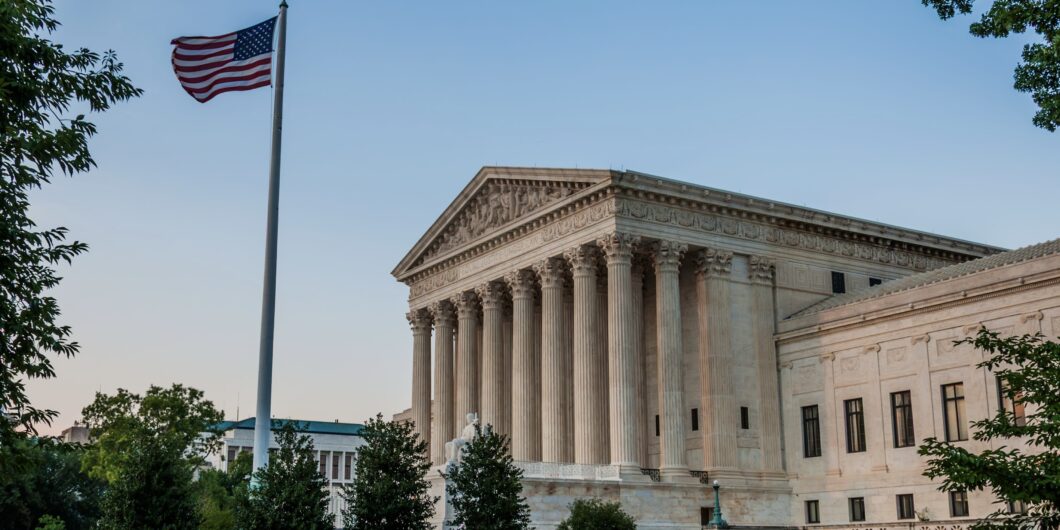
When the Supreme Court, on April 1, heard arguments about birthright citizenship in Trump v. Barbara, the justices focused on jurisdiction. The Fourteenth Amendment provides: “All persons born or naturalized in the United States, and subject to the jurisdiction thereof, are citizens of the United States and of the State wherein they reside.” The extent of birthright citizenship thus turns on conflicting ideas about jurisdiction—one view being based on territory, the other on exclusive allegiance.
The territorial approach guarantees citizenship for the children of almost anyone who gets across the border, including temporary and unlawful visitors. As put by the lawyer arguing against the government, “Virtually everyone born on U.S. soil is subject to its jurisdiction and is a citizen.”
But is that true? The Fourteenth Amendment’s guarantee of citizenship was, indisputably, designed to assure citizenship to Black Americans, mostly former slaves. So, it’s not unreasonable to ask about the breadth of that guarantee. Was it so expansive as to assure citizenship to the children of almost anyone who gets across the border?
Different Types of Jurisdiction
To answer that question, let’s consider some different concepts of jurisdiction. The justices’ questioning on April 1 revealed something very odd. At least several of them apparently think that if they discern the prevailing idea of jurisdiction in the 1860s, that will reveal the meaning of the Fourteenth Amendment’s word “jurisdiction”—as if a single idea of jurisdiction was dominant for all purposes. But then, as now, different ideas of jurisdiction could coexist, each being valuable for different purposes. Put simply, jurisdiction comes in layers, like Russian dolls.
The broadest jurisdiction of the United States is sometimes imposed on foreign criminals who have adversely affected the United States, but who have never set foot within this country or otherwise voluntarily agreed to its jurisdiction.
The nation’s territorial jurisdiction is not quite as expansive, but it’s remarkably broad, covering almost all persons within the United States, with exceptions only for ambassadors, etc. For purposes of criminal law and other legal proceedings, this territorial jurisdiction is very valuable; it means that almost anyone within the nation is subject to its laws. But for purposes of citizenship, it would constitutionalize the improbable and irresponsible message: “Get across the border, and your children will be citizens!”
Coexisting with the extra-territorial and territorial versions of jurisdiction is a more focused vision—one that centers on persons, mostly citizens, whose allegiance is exclusively to the United States, not other nations. This core vision of jurisdiction is precisely what one would expect of a constitutional amendment that aimed to protect citizenship in the aftermath of slavery.
Which layer of jurisdiction was that of the Fourteenth Amendment? Obviously, not the extra-territorial jurisdiction. That leaves a choice between the territorial and the exclusive-allegiance visions.
Of course, these two ideas of jurisdiction co-existed at the time the Fourteenth Amendment was adopted, and they weren’t inconsistent because they were used for different purposes. This point is crucial. It requires emphasis because, as already hinted, some of the justices don’t seem to understand it.
Some of the justices on April 1 quoted nineteenth-century generalizations about territorial jurisdiction—the idea that persons within the United States are subject to its laws—to suggest that this was the jurisdiction adopted by the Fourteenth Amendment. But such statements prove nothing of the sort. The nineteenth-century reliance on territorial jurisdiction to define legal accountability doesn’t mean there wasn’t reliance on exclusive-allegiance jurisdiction to define citizenship. On the contrary, one would expect these two types of jurisdiction to be embraced at the same time for these different purposes.
It’s therefore necessary to discern which was the sort of jurisdiction the Fourteenth Amendment adopted.
Drafting
The drafters of the Fourteenth Amendment repeatedly explained that they were referring to exclusive-allegiance jurisdiction, not territorial jurisdiction. A wide range of scholars, including Randy Barnett, Richard Epstein, Samuel Estreicher and Rudra Reddy, Kurt Lash, Tom Lee, and Ilan Wurman, have explored the evidence. Here, a few quotations from 1866 should suffice. Senator Trumbull said the Amendment’s jurisdictional clause meant “subject to the complete jurisdiction” of the United States or “not owing allegiance to anybody else.” Similarly, Senator Williams understood the clause “to mean fully and completely subject to the jurisdiction of the United States,” and Senator Howard said it concerned “a full and complete jurisdiction.” Along the same lines, Senator Johnson explained that it referred to persons “not subject to some foreign Power.” This was the jurisdiction of the United States over persons whose allegiance was exclusively to the nation, not other countries.
The amendment’s definition of citizenship was a response to the nation’s agonizing history of slavery and liberation. After the Dred Scott Case in 1857 denied that Black Americans could be citizens, the amendment recognized them as full and equal members of our society. The amendment assured them of citizenship and, for this purpose, the drafters relied on the core, exclusive-allegiance understanding of jurisdiction.
The drafters made the reasonable assumption that Black Americans were fully loyal to the United States, not any other nation, and thus were within the jurisdiction of the United States, defined in terms of exclusive allegiance. But what can be assumed about the children of temporary and unlawful visitors—children of parents who haven’t given primary allegiance to this country, including parents who have entered in violation of the law? It would be a perversion of the ideal of citizenship to stretch the Fourteenth Amendment’s conception of jurisdiction that far.
Text
How can we be confident that the Constitution rejected territorial jurisdiction and, instead, meant exclusive-allegiance jurisdiction? The answer is simple: the text.
Wait a minute, you may protest, the Fourteenth Amendment mentions “jurisdiction” without specifying either territorial or exclusive-allegiance jurisdiction. True enough. But that doesn’t mean the text is unrevealing.
The Fourteenth Amendment speaks of persons born in the United States and subject to its jurisdiction. In other words, its territorial limitation and its jurisdictional limitation are different.
English ideas about subjects translate to American ideas about who is bound by law, not to American ideas of citizenship.
The Thirteenth Amendment declares: “Neither slavery nor involuntary servitude, except as a punishment for crime whereof the party shall have been duly convicted, shall exist within the United States, or any place subject to their jurisdiction.” Slavery is thus barred within places, including jurisdiction defined by place. In contrast, the Fourteenth Amendment defines US citizenship in terms of persons “subject to the jurisdiction” of the United States, without any mention of “place.” This suggests that the jurisdiction relevant for US citizenship is one of exclusive allegiance, not location.
The different jurisdictions make sense when one considers the different purposes of the two amendments. The Thirteenth aimed to bar slavery and therefore had to exclude it territorially—from “the United States, or any place subject to their jurisdiction.” The Fourteenth assured citizenship to Black Americans and therefore relied more narrowly on the non-territorial jurisdiction—the jurisdiction over persons with unqualified allegiance to the United States.
Confirming this conclusion, the Fourteenth Amendment establishes state citizenship in terms of “the State wherein they reside.” Whereas US citizenship was not a matter of place or residence, state citizenship additionally required residence.
Not once, but repeatedly, the Constitution’s text reveals that the Fourteenth Amendment’s jurisdictional requirement for US citizenship isn’t territorial. Against the background evidence from the debates, the text makes clear that its jurisdictional requirement, and therefore citizenship, rests on the core, exclusive-allegiance jurisdiction, not territorial jurisdiction.
Common Law
On April 1, the justices of the Supreme Court repeatedly referred back to the largely territorial vision of English common law. Justice Elena Kagan, for example, declared:
The rationale of the case is really quite clear. It says there was this common law tradition. It came from England. We know what it was. Everybody got citizenship by birth except for a few discrete categories.
And that tradition carried over to the United States. And then what the Fourteenth Amendment did was accept that tradition and not attempt to place any limitations on it. If that were true—if the common law gave citizenship to nearly everyone born on English territory—then that would seem a telling argument.
But in England there was no such thing as a citizen. Instead, the common law rule determined who was a subject of the Crown—meaning someone who was subject to law. Of course, the children of most visiting foreigners were subject to the law—that’s the standard role of territorial jurisdiction. But who is subject to the law is a very different question from who is a citizen.
Justice Kagan said that the common law’s territorial rule was “very generous” in that it “extended citizenship to those born there who may not have been born of parent citizens.” Again, however, the common law rule was not about citizenship, and was not so much generous as merely sensible in saying that almost all persons in the king’s territory were his subjects and thus subject to his laws.
The common law’s territorial rule on who was a subject is, at best, a distraction from the question of who is a citizen. Indeed, to conflate these issues is a category error to conflate these issues. English ideas about subjects translate to American ideas about who is bound by law, not to American ideas of citizenship.
Allegiance
The territorial vision of jurisdiction defined who was bound by law and who enjoyed its protection, and this was often discussed in terms of allegiance. It was a commonplace that allegiance and protection were reciprocal. But there was more than one sort of allegiance.
Some of the justices on April 1 conflated the generic, territorially defined allegiance, which was a matter of obedience to the laws, with the exclusive or complete allegiance, meaning loyalty, that was the foundation for American citizenship. The two types of allegiance, however, were different.
How different? The territorially defined allegiance, being a question of obedience, included aliens in amity; it even included enemy aliens who were licensed to remain during wartime. It thus extended to many persons who owed their primary allegiance to foreign and even enemy nations.
That capacious sort of allegiance, based on territorial jurisdiction, was a good measure of who was bound by the laws. But it’s strange to think it was the foundation for citizenship.
Whereas territorial jurisdiction was the basis for a generic allegiance to the laws, only an exclusive allegiance, in the sense of loyalty, could be the measure of who was an American citizen. That’s why the drafters of the Fourteenth Amendment repeatedly emphasized that its phrase “subject to the jurisdiction of the United States” meant exclusive jurisdiction. In their words, it referred to “complete” jurisdiction and applied to persons “not subject to some foreign Power.”
At this point, we must return to the text—in particular, the Fourteenth Amendment’s distinction between being within a jurisdiction and subject to a jurisdiction. Not only were allegiance and protection said to be reciprocal, but it was also thought that the protection should be equal. This ideal of equal protection was assumed to reach across a state’s territorial jurisdiction. So, when the Fourteenth Amendment recites that no state shall deny the equal protection of the laws to any person “within its jurisdiction,” it is speaking of territorial jurisdiction. In contrast, when defining citizenship, the Amendment uses the phrase “subject to the jurisdiction” of the United States. That phrase is only slightly different, but it’s a reminder of what the drafters repeatedly said: that it referred only to persons owing exclusive or complete allegiance.
Precedent
What about precedent? In particular, what’s the weight of United States v. Wong Kim Ark (1898)?
The facts of the case fall squarely within the exclusive-allegiance vision of jurisdiction. That may seem difficult to believe, because the case has been heralded for its territorial vision of citizenship, but the facts repay close attention.
Remember, the Fourteenth Amendment assured citizenship to persons who had unqualified allegiance to the United States but were barred from citizenship. That was also the situation of Wong Kim Ark.
The stipulated facts presented the case on the basis of allegiance, not territory. At the time of Wong Kim Ark’s birth, “his mother and father were domiciled residents of the United States, and had established and enjoyed a permanent domicile and residence therein.” Since then, he had claimed to be a “citizen of the United States.” Although that didn’t mean he was a citizen, it showed the depth of his allegiance. Indeed, the agreed facts added that neither he nor his parents “ever renounced his allegiance to the United States” and that he has “never done or committed any act or thing to exclude him therefrom.” His allegiance was unquestioned.
It was a time when “double allegiance, in the sense of double nationality, has no place in our law.” Wong Kim Ark’s allegiance was thus entirely to the United States.
One consideration after another cuts against a territorial vision of birthright citizenship.
His difficulty was that the 1882 Chinese Exclusion Act declared that no court “shall admit Chinese to citizenship.” This put Wong Kim Ark in the same sort of position as free Black Americans in the aftermath of the Dred Scott Case. He had as much allegiance to the United States as was possible but for discrimination.
The facts of the case were thus squarely within the Fourteenth Amendment’s exclusive-allegiance vision of jurisdiction. To the extent the Supreme Court’s opinion drifted toward a theory of territorial jurisdiction, it went beyond the facts.
That’s not the only weakness of the precedent. Just as troubling, the Court in Wong Kim Ark apparently didn’t hear the arguments from the Constitution’s text—something that’s crucial. For at least two reasons, therefore, that precedent can’t be considered dispositive.
Policy
Policy considerations matter—not to displace principle, but to reveal the value of the Constitution’s textual rejection of territorial jurisdiction. One such consideration is that citizenship is different from equal protection under the laws. Citizenship is a matter of loyalty, not just obedience and protection, and no nation can survive long if it dilutes the commitments underlying citizenship.
Another consideration concerns immigration. The Fourteenth Amendment’s exclusive-allegiance jurisdiction protected Black Americans without intruding into the government’s management of immigration. In contrast, if the Supreme Court establishes US citizenship on the basis of territorial jurisdiction, it will severely burden government and immigrants. Some existing visitors will benefit, but the government will face an irrevocable impediment to its management of immigration, so it will probably institute severe restrictions to prevent abuses.
If that happens, the responsibility will rest on the Court, not the administration. The Court can’t depart from the Constitution’s text and imagine it won’t be considered the author of the resulting trouble—especially in a field, such as immigration, that the Court ordinarily says must be left to executive discretion.
Justice
The government’s opponents claim justice is on their side. Certainly, there’s much justice in statutory assurances of citizenship. Such statutes can be adapted to circumstances so as to protect both foreigners and Americans. But what is the justice, let alone the prudence, of giving an invariable, categorical guarantee of citizenship on the basis of territorial jurisdiction—that is, on the basis of merely having parents who got across the border?
Temporary foreign visitors have primary allegiances to other societies; foreigners who come here unlawfully begin their stay by disobeying our laws. Such persons and their children are within the nation’s jurisdiction, defined by place and residence, and therefore, both in justice and law, have rights within our legal system. But neither justice nor law requires that they be categorically assured citizenship. As recognized by the Fourteenth Amendment, citizenship should rest on the nation’s core jurisdiction over full members of society, whose allegiance is primarily to our society and our laws, not those of other nations.
Burden of Persuasion
Last, but not least, it’s important to remember that those arguing against the constitutionality of a government act have the burden of persuasion. That means the government’s opponents have the burden of showing that the Fourteenth Amendment’s jurisdiction is territorial and that it’s unconstitutional to deny citizenship to children born of temporary and unlawful visitors.
Conclusion
One consideration after another cuts against a territorial vision of birthright citizenship.
Debates. The debates over citizenship centered on exclusive-allegiance jurisdiction, not territorial jurisdiction.
Text. The Fourteenth Amendment protected US citizenship in terms of jurisdiction, without reference to place or residence. The Constitution’s very text thus indicates that the guarantee of US citizenship referred to the core jurisdiction founded on unqualified allegiance, not mere territorial jurisdiction.
Common Law. England had subjects, not citizens. The territorial English common law rule on who was a subject, and thus subject to English law, concerned who was bound by law, not who was a citizen.
Allegiance. The generic allegiance or obedience to the laws, which is, and should be, owed by all persons within territorial jurisdiction, shouldn’t be conflated with the exclusive allegiance or loyalty that was the foundation for citizenship.
Precedent. The facts in United States v. Wong Kim Ark—an alleged precedent for the territorial perspective—were actually within the exclusive-allegiance vision. And the Court didn’t hear the textual arguments against the territorial point of view. That precedent therefore isn’t dispositive.
Policy. A decision favoring birthright citizenship for the children of temporary and unlawful visitors will dilute the commitment foundational for citizenship and will produce immigration difficulties and severity.
Justice. Although foreigners within our borders have rights within our legal system, justice doesn’t require a categorical assurance of citizenship for foreigners who just happen to be born here.
Burden of Persuasion. Those arguing that the government is acting unconstitutionally have the burden of persuasion.
Unfortunately, it wasn’t evident from the April 1 hearing that the justices understood all of these considerations. It’s therefore important for them to pause to make sure they grasp what’s at stake. The nation needs justices who understand the law and adhere to it.