
Alas, this week’s column likely marks my last combo football-basketball questions until March 2027.
But man, I got a couple of good ones for the sendoff.
Do you know how sickening it is as an Indiana alum to always hear that former Bob Knight student manager Dusty May was calling IU wanting the head coach job, after Dusty cut down nets in Indianapolis of all places? How insane would it be if Indiana had both Curt Cignetti and Dusty May at the same time, and how would it stack up against other current or all-time great college coaching duos? — Graham B.
Definitely wild to think about, but you’ll have to excuse the rest of us for not holding a pity party because Indiana only has one national championship coach.
The first comparison that comes to mind is 2000s Florida, when Urban Meyer and Billy Donovan both won national championships in the same period. Of course, no one knew Meyer would “retire” a couple of years later. Otherwise, the Gators could have kept that combo going for nearly another decade. (Donovan left for the NBA in 2015.)
Here are two star-studded combos for you: Bob Stoops and Kelvin Sampson at Oklahoma from 1999-2006 and Nick Saban and Tom Izzo at Michigan State from 1995-99. The latter in particular is about as good as it gets, though both were early in their careers and reached greater heights in the 2000s.
Going way back, Ohio State had two national championship coaches, Woody Hayes and Fred Taylor, on campus together for 17 years (1959-76). Mind you, Taylor won in his second season and didn’t return to those heights again, but he, like Hayes, is in his sport’s Hall of Fame.
This is where I bring things back to the present and remind everyone that Cignetti and May have been in their current jobs for two years apiece. It will be a long time before we know if they’re truly the next Meyer-Donovan or Saban-Izzo.
Here’s a fun thought exercise: Say we could go back two years to the day Indiana hired Cignetti and Michigan hired May. We tell Michigan fans that May is going to win a national basketball title in the next two years, but your beloved football program is going to implode. And we tell Indiana fans, Cignetti is going to win a national title in football, but your beloved basketball team is going to stink for the foreseeable future.
Would they trade?
For years, Oregon has seemed like the safest bet to be the next program to win its first national title (until Indiana sniped that). They’ve made two recent title games (2010 and 2014). Gonzaga in men’s basketball has built one of the most consistent winners in the sport and has seemed inevitable to eventually win it all. They’ve also made two trips to the national title game (2017 and 2021). Which Pacific Northwest power finally breaks through and wins a national title first? — Brian
Wow. The parallels are eerie.
The irony of Oregon’s situation is the program is stocked with far more upper-end talent today than it was during the Chip Kelly and Mark Helfrich eras. Those teams benefited from an ahead-of-the-curve offense under Kelly and a transcendent quarterback (Marcus Mariota) under Helfrich.
Mario Cristobal raised the program’s recruiting ceiling when he took over in 2018, and Dan Lanning has carried the torch, along with his success in the portal. Oregon’s 247Sports composite class rankings in the four years preceding its appearance in the 2014 national championship game (2011-14) were No. 12, No. 14, No. 19 and No. 21. Lanning’s four full classes (2023-26): No. 9, No. 3, No. 5 and No. 3.
I don’t know Gonzaga’s roster/recruiting well enough to predict how soon Mark Few will finally win that first title, but it really doesn’t matter. After all, the Ducks, coming off back-to-back 13-win seasons, were preseason No. 1 in my early Top 25 for 2026. They get back QB Dante Moore, who, even with that nightmare against Indiana, finished among the top 10 in the nation in passer rating. Most of the skill guys return, as does nearly the entire defensive front, and Minnesota safety Koi Perich was a big addition.
The million-dollar question, though: Whether Lanning can keep things humming without departed coordinators Will Stein (Kentucky) and Tosh Lupoi (Cal).
Speaking of early Top 25s, my hoops colleague C.J. Moore has Gonzaga at No. 12 in his. He’s saying the Zags have a chance, whether or not Oregon beats them to it.
The old way of doing preseason rankings was basically 1) Take last year’s final AP poll, 2) Do some kind of weighted descending sort on the number of returning starters, 3) Move Notre Dame up five spots because The Gipper or something. Now, when this year’s Penn State is basically last year’s Iowa State and last year’s Penn State is basically this year’s Virginia Tech, what’s a poor preseason prognosticator to do? — Jason K.
Funny you sent this when you did. At least in football, the portal was mostly over by the time I did my early football Top 25 after the national championship. There were still a lot of wild guesses, obviously, but at least I knew most teams’ rosters. Therefore, I did not envy the basketball folks who had to put theirs up this week before the portal had even opened. Poor CJ Moore had capsules listing teams’ projected starters, with some positions just saying “Portal TBD.” Not ideal!
In football, we do still have a handful of programs — Ohio State, Georgia, Oregon, Notre Dame, Texas, Alabama — that feel like sure bets to reload every year. I’ll give it a year before cementing Indiana and/or Miami with that status. Those programs will still occasionally have disappointing seasons, like Texas last year, but they’re unlikely to finish unranked.
And then we have a pool of teams that may move up or down in tiers in a given year, but are still consistently Top 25 teams — Michigan, USC, Texas A&M, BYU, Iowa, Tennessee, etc. As for nearly everyone else, your guess is as good as mine.
If a team’s coaching staff is stable and it’s not relying entirely on the portal, then you might be able to assess primarily on who is or isn’t coming back. But we now have teams like Penn State or LSU that hired new coaches and changed out nearly their entire roster. Lane Kiffin assembled one heck of a portal all-star team, but who knows how well they’ll all fit together and pick up his system. Ole Miss may look like it has continuity with Pete Golding and Trinidad Chambliss, but look deeper, and it’s a mostly new staff and a defense full of transfers.
It’s important to remember that prognostication season is mostly for fun. If I were you, I would not go to Vegas and place money on futures bets based on mine or anyone else’s early Top 25s or predicted SEC standings. The problem is, those fun little lists end up influencing the actual preseason AP and coaches polls, which then become the basis for later rankings, which then get stuck in the back of committee members’ heads when they go to work in early November.
Therefore, I’d encourage pollsters to flush preseason perceptions as quickly as possible once the games start, because those perceptions have never been more ill-informed.
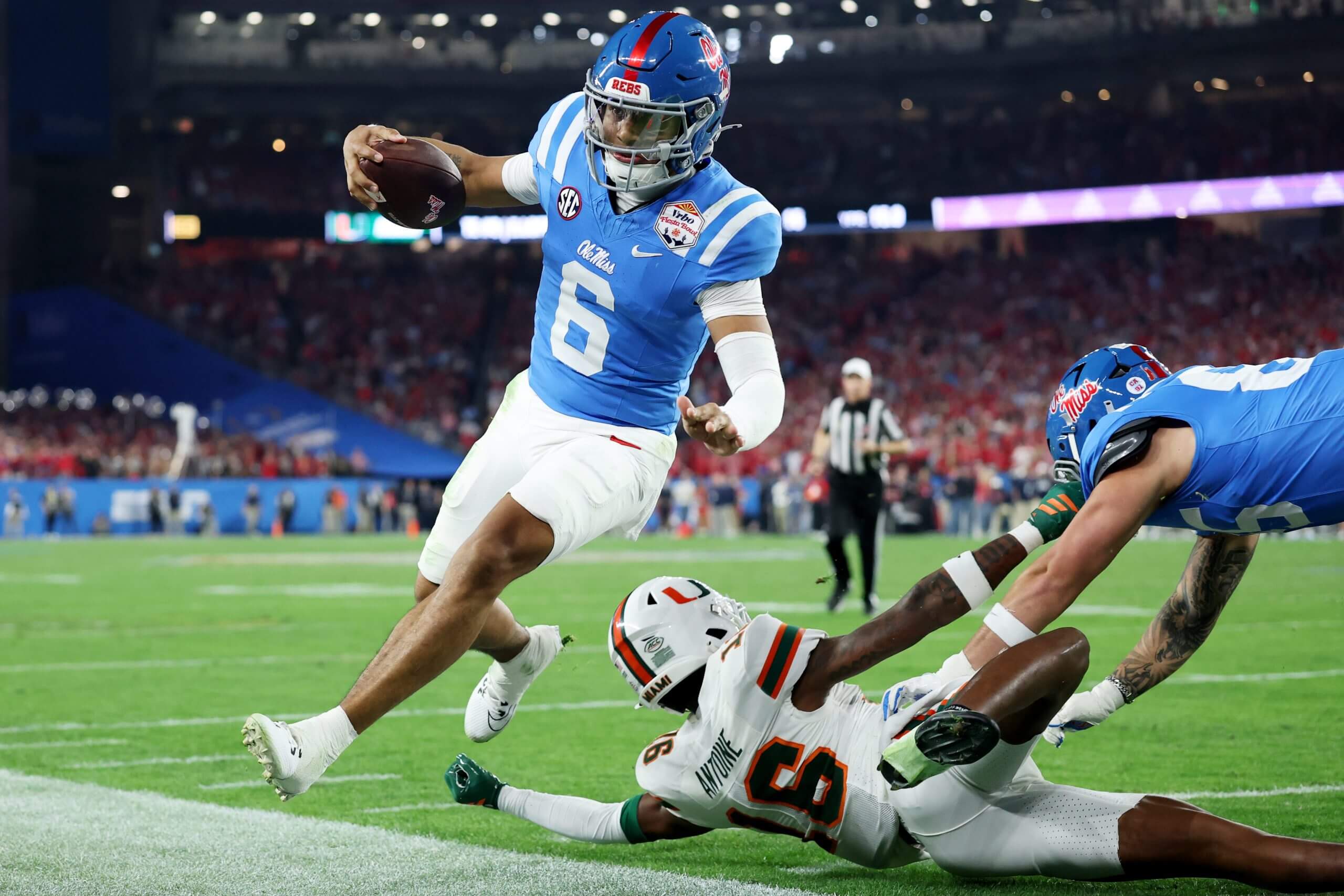
Trinidad Chambliss will return for Ole Miss after a College Football Playoff run, but much of the team will be new. (Christian Petersen / Getty Images)
What’s happening with the bowl affiliations for next year? —Reggie C.
Due to the uncertainty over College Football Playoff expansion, the conferences and bowls are expected to extend their previous agreements for another year, though some details remain up in the air. Unfortunately, we’ve also seen a few bowl casualties: RIP the Bahamas Bowl, which technically ended last year; Detroit’s GameAbove Sports Bowl (previously the Quick Lane Bowl); and the LA Bowl.
I assume those won’t be the last of them. While non-CFP bowls remain big TV draws, those three were usually conspicuously absent of spectators.
Your suggested 10 commandments as czar of college football were terrific. How do we get at least partway there? Which improvements can you see being implemented in the next three years? — John
Thank you!
Most of them are admittedly unrealistic, but there has been some recent progress on a few.
Thou shall have a 12-team Playoff for at least the next decade. And the event shall be moved up by a week to allow the season to end on or around Jan. 8, as it did when there were four Playoff teams.
There’s been some real momentum lately to move both the regular season and the Playoff earlier. Alabama AD Greg Byrne and Georgia coach Kirby Smart recently came out in favor of scrapping the SEC championship game. Texas AD Chris Del Conte said the same thing earlier this offseason. While their stated rationale is that the game lost its meaning in a 12-team Playoff (I disagree, but that’s another matter), it would certainly make it easier to move the whole event up by at least a week if all of them went kaput.
Separately, an NCAA committee has been discussing a move to have everyone start their season in Week 0 in years when the calendar only allows for one bye week. If approved, it could begin as soon as 2027. Combine the two, and you could see a new calendar where the Playoff begins no later than the second Saturday in December, and the championship game is held two weeks earlier than it is now.
There shall be no limits on how much players can earn from outside NIL opportunities, and no need to send anything through NIL Go. In return, players shall only be allowed to transfer and play immediately once in their careers.
A key moment is coming up soon when an arbitrator will hear the cases of 18 Nebraska football players who had their deals denied with the Cornhuskers’ multimedia rights partner, Playfly Sports. The College Sports Commission deemed Playfly an “associated entity,” akin to collectives, and struck down the deals. If the players win, it will open the floodgates to a free market. And even if they lose, someone’s going to sue in an attempt to open the floodgates.
As for the latter part, both Sen. Tommy Tuberville’s recent proposed bill and President Donald Trump’s recent executive order call for that exact one-time limit. Whether it would be deemed legal without a collective bargaining process is another story.
Players shall have five years to play five full seasons. No redshirts, no waivers.
Tuberville/Trump also included this idea. Same disclaimer. And on Wednesday, Yahoo reported that the NCAA is now discussing a similar five-year, no-redshirts, no-waivers concept. They must have read my column.
Sometimes QBs transferring up to a Power 4 school works out (Trinidad Chambliss from Ferris State to Ole Miss) and sometimes not so much (Mikey Keene from Fresno State to Michigan). Who will be this year’s success story, and who should have stayed at their school? — Zac N.
It’s crazy to think that Chambliss may have never seen the field last season if Lane Kiffin’s original starter, Austin Simmons, hadn’t gotten hurt in Week 2. Obviously, things could not have worked out better for Chambliss, but it speaks to why it’s nearly impossible to predict these things in advance.
Meanwhile, I think we need a better example of the converse than Keene, who went to Ann Arbor for his graduate season knowing he’d likely be backing up Bryce Underwood. May I instead nominate Zach Calzada, who left Incarnate Word after two great seasons to return to the SEC for a seven-figure payday at Kentucky, only to last two games?
The obvious answer here is Oklahoma State’s Drew Mestemaker. After throwing for 4,379 yards and nearly leading North Texas to the Playoff, he followed coach Eric Morris to Stillwater, where he’ll be running the same offense. That’s shades of Devon Dampier following OC Jason Beck to Utah last year and thriving for the Utes, though Oklahoma State is starting from rock bottom in its rebuild.
It’s the same situation for Byrum Brown leaving USF for Auburn to reunite with coach Alex Golesh. I’m a little less bullish on Brown just because I don’t think he’ll be able to run as much in the SEC, but he’s certainly a game-changer.
On the flip side, I’m skeptical of Anthony Colandrea at Nebraska. He had a big season at UNLV last year, throwing for 3,459 yards and 23 TDs while running for another 649 yards and 10 TDs. But we saw him for two seasons at Virginia before that, where he was more like a scary roller-coaster. He’s thrown 29 interceptions in three seasons, including a three-game stretch in 2024 where he threw seven picks and one TD.
But I hope for Huskers fans’ sake he proves to be the next Dampier, not the next Jeff Sims. They’ve suffered enough.
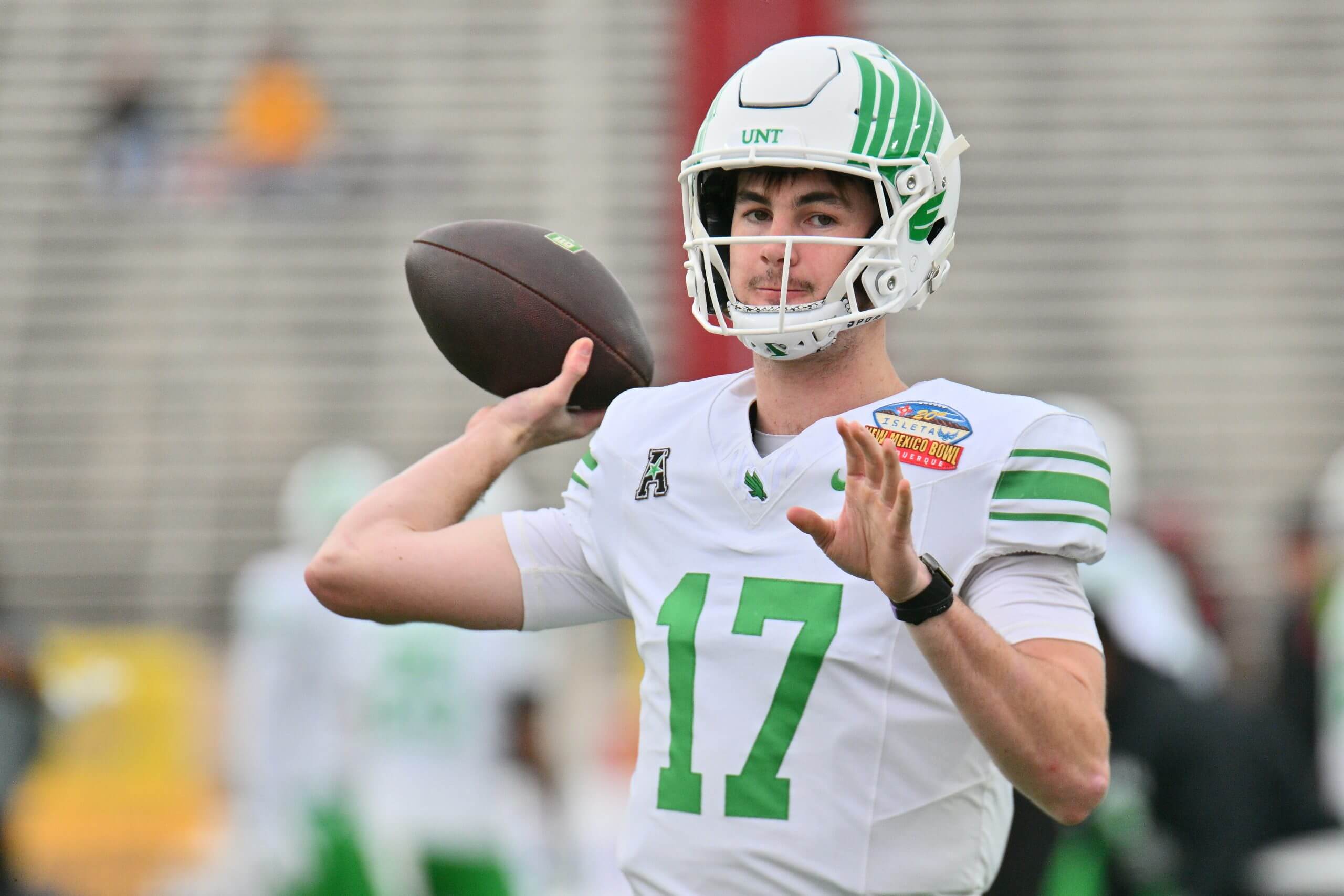
Drew Mestemaker could help spur a rebuild at Oklahoma State under head coach Eric Morris. (Sam Wasson / Getty Images)
Two years into the 12-team Playoff, it seems like taking a third loss before the conference championship game is a disqualifier — i.e., Bama in 2024 and Texas in 2025. In ’25, we were left debating between some two-loss teams. As the SEC moves toward a nine-game schedule, do you envision continued end-of-year debates among two-loss teams, or will we start to see some teams with three losses getting in? — John C.
I always assumed there would be a 9-3 Playoff team at some point, and with the SEC’s nine-game schedule, it now feels inevitable. Half the conference’s teams are going to take an extra loss, and there are only so many candidates.
We’ve already seen how the committee treats those teams relative to the ACC and Big 12. In 2024, 9-3 Alabama was ranked above 10-2 Miami and three 9-3 SEC teams — the Tide, Ole Miss and South Carolina — finished higher than 10-2 BYU and 10-3 Iowa State. Last year, 9-3 Texas was above a 10-2 SEC team, Vanderbilt, but also 10-2 Utah. And of course, Steve Sarkisian was indignant the Horns weren’t above more two-loss teams, like Miami, Notre Dame and BYU.
So this year, you will almost certainly hear Finebaum Nation proclaim that a 9-3 SEC team that played nine conference games faced a tougher road than not just 10-2 ACC or Big 12 teams but most 10-2 Big Ten teams as well. And they’ll come armed with data. Bill Connelly’s first preseason SP+ rankings at ESPN have Ohio State, Oregon and Notre Dame Nos. 1, 2 and 3, but six of the next nine hail from the SEC.
It’s unfortunate timing, then, that the SEC had its worst postseason performance in decades the year before moving to nine games. Perception of the conference has shifted. I wouldn’t expect its teams to get default benefit-of-the-doubt treatment from the committee this year. Save for Alabama, of course.
To be clear, I would never say the teams should be ranked solely by order of losses. If a 9-3 team in one league is more accomplished than a 10-2 team in another league, so be it. I just hope, in this age of imbalanced schedules, the committee closely scrutinizes who drew whom. Two 9-3 teams from the same conference may have wildly different resumes, both in who they beat and who they lost to.
Stewart: Indiana, Michigan and UCLA combined to win national titles in football, men’s basketball and women’s basketball this year. If you just woke up from a 10-year coma, how many guesses would it take for you to correctly guess which team won which title? — Brian S.
Ha. So, my last memories were from 2016?
I would have guessed football first for Michigan, but I would have gotten to basketball relatively quickly. John Beilein had taken them to the national title game three years earlier. I’d be lying if I claimed to remember how UCLA was doing in women’s basketball 10 years ago (answer: they reached the Sweet 16), but UCLA is good at pretty much every women’s and Olympic sport. So while I would have guessed men’s hoops first, I would have gotten there eventually.
But as I’ve said many times, an Indiana football national championship was inconceivable. At some point, I would have thrown up my hands and said, this whole thing must be a practical joke.
Next, you’re going to tell me I now work for something called “The Athletic.”