

On any given day, Moran Transportation Corporation’s fleet of trucks covers some 34,000 miles.
Though the 46-year-old Elk Grove Village trucking company prides itself on being more efficient than ever, it still takes a whole lot of diesel to see a day’s work through.
Those 34,000 miles start to add up, especially when fuel prices surge — let alone during an unprecedented disruption to the global energy market.
For weeks now, the war that the U.S. and Israel launched against Iran in late February has destabilized worldwide energy production, culminating in what industry leaders are saying is the largest disruption to the global oil market in history. And while the conflict lies halfway around the planet, Illinoisans are feeling the weight of the supply shock.
Since the start of the war, the average cost of gas has gone up more than 25% in Chicago. That stat, which reflects the change in prices from February to March, is the single biggest month-over-month increase on record for the city, according to a Tribune analysis of data from the U.S. Energy Information Administration.
The average cost of diesel has spiked to an even greater degree, going up nearly 40% in the Midwest over the past six weeks. Nationally, fuel prices are higher than they’ve been in four years, since Russia invaded Ukraine. The shock, which is affecting most countries, has sent global leaders scrambling to contain the rising costs while, locally, gas giveaways offering a moment’s relief from the surge have cropped up from the city to Indiana.
The impact spans everyday drivers filling up their tanks ahead of work to companies like Moran Transportation that rely on affordable fuel to turn a profit. And experts warn the pressure will only compound the longer the conflict stretches on, something that’s increasingly possible despite a shaky two-week ceasefire.
Already, Moran Transportation is looking at a monthslong road to recouping losses ahead.
“This is a six-month, eight-month life cycle that we’re going to feel,” company President Mike Moran said, “maybe even longer.”
Causing much of the economic pain is the Strait of Hormuz, a crucial waterway off Iran’s coast through which a fifth of the world’s oil passes that was effectively shut down after the U.S. and Israel attacked Iran on Feb. 28. Missile strikes have also damaged key oil and gas facilities in the Persian Gulf.
What’s heightening the crisis is that stopgaps typically used to offset supply shocks have been rendered moot. A bulk of the world’s oil reserves are held by the countries around the Persian Gulf and usually, they can bring extra production online to keep costs steady amid emergencies, according to Sam Ori, executive director of both the Institute for Climate and Sustainable Growth and the Energy Policy Institute at the University of Chicago.
But with the strait closed, reserves are bottled up. Some oil-producing nations in the Middle East have also halted production because they can’t ship fuel out of the Gulf and their storage tanks are full.
The combination has made for “an unprecedented heart attack for the global oil market,” Ori said.
Though the U.S. is a major oil producer, being part of the global oil market means that when there’s a disruption, the effect is felt here at home, Ori said. The most immediate way that’s seen is the price at the pump. This week, gas prices in Chicago averaged $4.23 per gallon of regular — about 11 cents higher than the national average.
“Gasoline expenditures are the largest energy expenditure for your typical household in the United States … (and) it’s not like when gasoline prices go up you can switch to something else,” Ori said. “So that means household budgets will come under additional strains.”
At a BP gas station in Humboldt Park Thursday afternoon, where the cost for regular fuel was $4.49 per gallon, Margaret Barnes called the price hike “ridiculous.” The lifelong Chicagoan said she’s had to pick up extra shifts at her hospital job to afford gas and has had to be more cognizant about how she’s spreading her paycheck since the Iran war started.
“I don’t know what’s going on, but it’s a mess,” she said. “I’ll be glad when they resolve whatever they need to do, so life can get back to normal again.”
It will be some time before the market starts to stabilize, even if tensions abate soon. There’s been enough damage and disruption that there’s going to be a lasting impact measured in months, Ori said. Just how lasting it will be will depend on the coming days.
Tuesday night, the U.S., Israel and Iran reached a tentative two-week ceasefire. But that deal hung in the balance Thursday after Israel pounded Lebanon with airstrikes and Iran maintained its grip on the Strait of Hormuz.
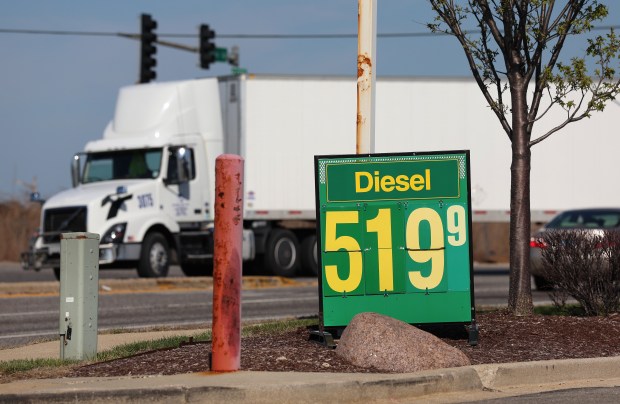 A diesel fuel price sign outside a Thorntons gas station in Elk Grove Village, April 8, 2026. (Chris Sweda/Chicago Tribune)
Speaking Tuesday as news of the fragile ceasefire started to circulate, Ori said, “We’re at the moment of truth here.”
“If the strait doesn’t reopen tonight,” he continued, “and this keeps going into April … I think you’re going to start to see oil prices that go, you know, really, really, really, really high.”
Moran Transportation is no stranger to supply shocks and financial challenges. Through the trucking company’s 46-year history, Mike Moran estimates the business has weathered at least four or five — but this one has hit harder than any of the others, he said.
Operating 13 service centers across the Midwest, the regional freight carrier runs about 375 to 400 trucks a day. With 500 employees, labor is the company’s biggest expense, but fuel isn’t far behind.
“It’s a massive cost to us,” Moran said.
As of this week, the average price per gallon for diesel — which powers 18-wheeler trucks — was $5.30 in the Midwest, the highest it’s been dating back to 2022, according to EIA data. Nationally, diesel was priced slightly higher at $5.64 per gallon.
Though Moran Transportation does impose fuel surcharges to help with some cost recovery, it’s “surely nowhere near a dollar per dollar coverage,” Moran said. That dives into the business’ cash flow, an already narrow operation.
“We’re lucky to generate 5-8% in profit and out of all that comes all of our mistakes,” Moran said. “So our net profit gets down to 3%, 4%. … (And) this thing just eats away at our margins significantly.”
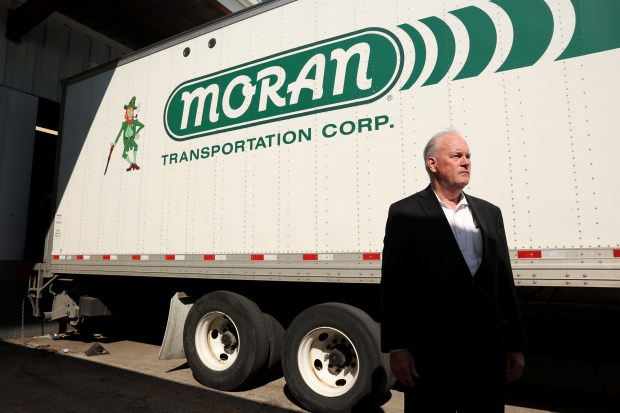 Mike Moran, president of Moran Transportation Corporation in Elk Grove Village, April 8, 2026. The company has felt the weight of the surge in fuel prices amid the war in Iran. (Chris Sweda/Chicago Tribune)
Timing has also aggravated the problem. The trucking industry in general has been struggling to bounce back for years after experiencing an unprecedented boom, then bust, through the COVID-19 pandemic. Spring is also a critical time for truckers following sluggish winter months — this year especially after the winter the Midwest has had.
Add in the market challenges, “fuel prices have eroded any profit that we might have seen,” Moran said.
As a midsize, longstanding company, Moran thinks they’ll be able to weather what’s to come, he says, but it has and will continue to take “cutting back, squeezing, adjusting and tightening our belt to kind of ride out this wave.”
He more so worries for businesses smaller than his that might not have as much wiggle room to stay afloat.
“We all face an already super costly market,” Moran said, “so it’s going to have a detrimental effect on anybody that hauls people or hauls freight.”
For longtime ride-share driver Lisa McGee, the rising gas prices have put the 54-year-old in panic mode. McGee, who lives about 73 miles south of Chicago in Kankakee County, has been a full-time Uber driver for nearly 10 years. She chose ride-sharing because she loves meeting people, doesn’t mind driving, and the gig work offered her the flexibility and income to support her family. But since gas prices have soared, she’s had to work extra to make ends meet.
“What I’m spending in gas is a couple utility bills,” she said. “It’s affecting our livelihood and my work-life balance.”
In recent weeks, Uber and other ride-share platforms have offered ways to help drivers save on fuel costs. But McGee said she hadn’t heard of any promos to offset prices.
It’s been stressful managing the pressure of paying increasingly more to fill up her tank. Seeing prices change so rapidly is scary, she said, and it’s made her wonder if she can continue to be an Uber driver long term.
“It’s not been easy,” she said.
The Tribune’s Claire Malon and Talia Soglin and the Associated Press contributed.