
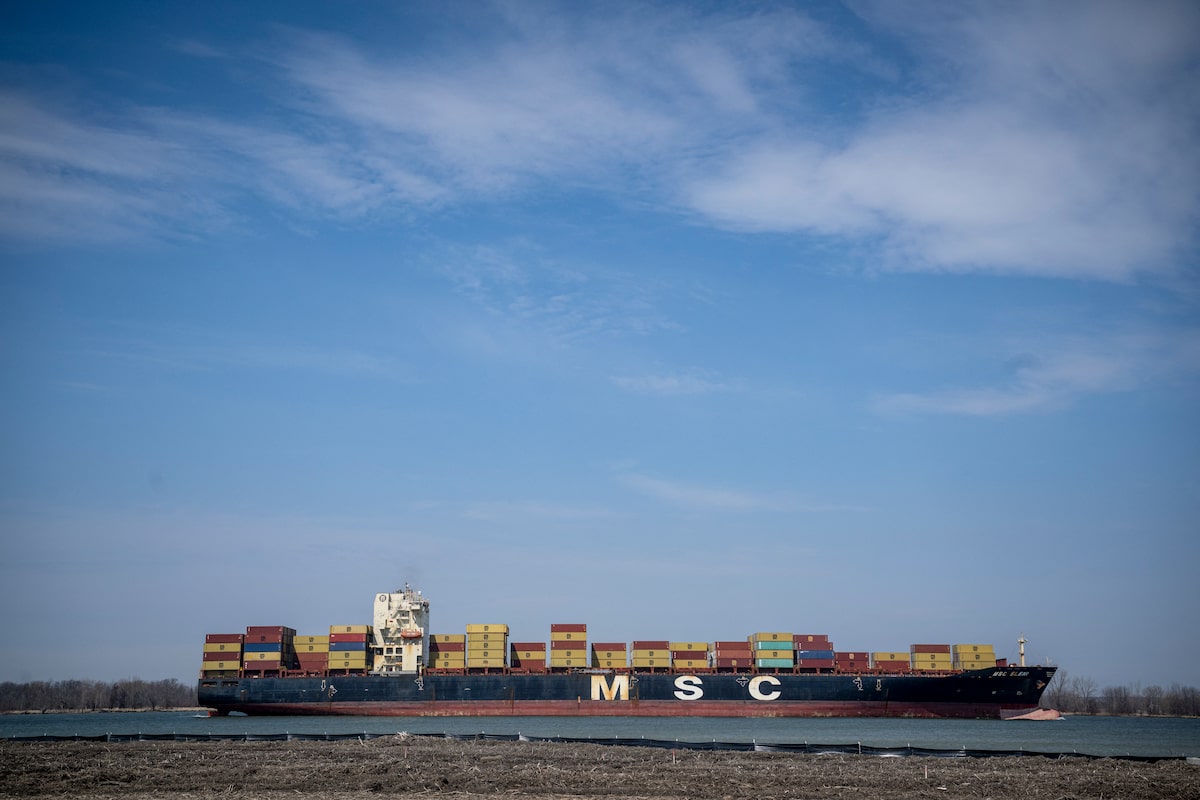
A container ship on the St. Lawrence River in Contrecoeur, Que., on Thursday.ANDREJ IVANOV/AFP/Getty Images
The Port of Montreal will get a $1.16-billion cash injection for a new container terminal, making it the first fast-tracked project to launch under the Carney government.
The expansion, which is estimated to cost $2.3-billion overall, will more than double the container handling capacity for the port. Prime Minister Mark Carney announced the new funding Thursday at the Contrecoeur, Que., site, about 45 kilometres northeast of Montreal, where construction is set to begin. He called it a “big, ambitious” project that will be transformative for the country.
The Canada Infrastructure Bank will provide a $1.16-billion loan to the Montreal Port Authority for the project, according to information released by the Crown corporation, significantly increasing the amount of its previous loan from $300-million. Transport Canada has also pledged $150-million and Quebec $130-million, with the balance to come from the port authority and the terminal operator.
The 60-per-cent increase will allow the port to handle up to 1.15 million standard shipping containers carrying everything from food to furniture per year. The target date for first shipments is 2030.
The announcement speaks to the urgency with which Ottawa wants to push forward with major projects like Contrecoeur, which was first pitched as an idea in 1988 before it stalled. Mr. Carney has pledged to double Canada’s non-U.S. exports in the next decade and expand its ports system.
“War in the Middle East, Russia’s illegal invasion of Ukraine, and the new trade regimes are all reshaping the global economy in real time,” Mr. Carney said Thursday during a news conference at the project site. “Canada is focused on what we can control – building a stronger more independent more resilient economy … bolstered by international trade, with a diverse set of reliable partners.”
Prime Minister Mark Carney broke ground on the long-planned Port of Montreal expansion and said the project is an example of how Canada can become more independent and resilient in an uncertain time for the global economy.
The Canadian Press
But industry specialists say it’s also a big bet that traffic at the terminal will justify the investment.
“It’s like an act of faith,” said Jacques Roy, professor emeritus at HEC Montréal’s department of logistics and operations management. “My concern is that the Montreal Port Authority is borrowing money that eventually they will have to repay with future earnings and there’s a lot of uncertainty about those earnings.”
Bank officials sought to ease those worries Thursday, saying the repayment schedule is flexible and linked to the port’s overall growth. The CIB will get paid out of a share of the cash flows from the Port of Montreal’s consolidated business, bank chief executive Ehren Cory said, noting repayments will go up or down according to revenue.
“We’ve created a shared incentive for the port and the private operator on the port to drive volumes because they have skin in the game, too,” Mr. Cory said. “We see this as a way to get a major port expansion done in the way that’s lowest cost to taxpayers.”
The bank and the port authority have worked with credit ratings firm S&P Global to review the loan and believe they will view it positively, Mr. Cory said. The bank’s loan last year to Aéroports de Montréal to support infrastructure improvements at Montreal Trudeau International Airport has a similar design, he added.
The Montreal Port Authority is an autonomous federal agency that operates as a financially self-sufficient organization, generating revenues by leasing its facilities to terminal operators among other things. The agency has tapped global logistics giant DP World Ltd. to build Contrecoeur’s land-based operations and run the cargo facility for the next 40 years, though talks are still under way on a final contract with the company.
Container volumes at the port have risen and fallen over the past 10 years, influenced by labour disruptions and other issues. As measured by weight, the port moved 12.3 million metric tons of container cargo in 2025, a decade low. It moved more actual boxes (called 20-foot equivalent units) last year than in 2024, though many heading outbound were empty.
What are Prime Minister Mark Carney’s four newly announced Northern major projects?
In January, the port won authorization from Fisheries and Oceans Canada to proceed with the Contrecoeur project, which calls for a 675-metre-wide docking platform with berths for two ships, eight loading cranes and a container storage yard linked to a rail line.
The nature protection non-profit group SNAP Québec has vowed to challenge the project in the Federal Court, saying proponents are circumventing environmental laws. The group commissioned a study that concludes the development could become a white elephant that’s likely to be underutilized and unprofitable, “representing a costly strategic mistake for taxpayers and an irreversible blow to biodiversity,” according to Henri Chevalier, the study’s co-author. One issue the group identified is the project area overlaps at least partly with the habitat of the copper redhorse fish, an endangered species.
Port Authority executives and federal political leaders reject that view. “Canada’s trade future depends on infrastructure that is ready before demand arrives,” Montreal Port Authority chairperson Nathalie Pilon said in a statement. “The Contrecoeur terminal is exactly that kind of forward-looking investment.”