
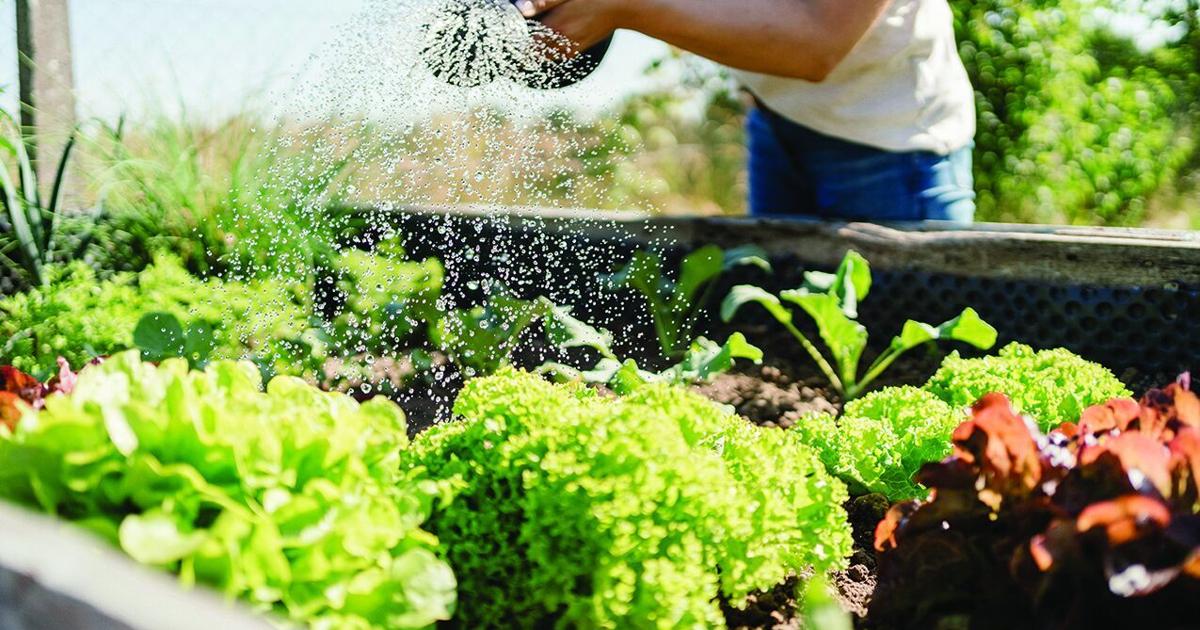
COLUMBIA — South Carolina is facing widespread drought as planting season begins, leaving gardeners to adapt their practices to conserve water while maintaining healthy plants.
According to the state Climatology Office, 35 counties are in the early stages of drought, while 11 counties are experiencing moderate drought conditions. The office also reported the state saw its third-lowest rainfall totals for November through January in the past 131 years. A March 5 update from the state Drought Response Committee indicates the entire state is at risk.
Here are some tips for gardening during a drought.

After an unusually dry winter, all of South Carolina is at risk of drought. Counties marked in orange are under a “moderate” drought levels, while yellow counties are facing “incipient” drought conditions.
SC Drought Commission/Provided
Understanding how plants work
Augustus Jenkins Farmer, a South Carolina author, farmer and garden designer behind the botanical gardens at Columbia’s Riverbanks Zoo, said understanding basic plant science can help gardeners make better decisions in dry conditions.
Leaves contain tiny pores called stomata that open and close to exchange gases, including water vapor. In humid environments, stomata open more readily, allowing plants to absorb moisture. In dry conditions, they close to conserve water.
“That is what a lot of our techniques are aimed at,” Farmer said. “The technique in a drought is that you want to help those plants conserve water in the air and in the soil.”
Gardeners can reduce water loss by adding shade and managing airflow around plants.
“That doesn’t have to be anything complicated,” Farmer said. “A lot of times, what I’ll do is find a branch that I can cut off a bush or something and just stick it over that plant like a little umbrella.”
Water delivery methods also matter. Farmer recommends misting and drip irrigation systems to help relieve air loss.
“You can get a kit like that at a garden center or online,” Farmer said. “Those often come with a little timer, so … every day at 2 o’clock, give a little squirt.”
Soil conditions are equally important. Plants purchased from nurseries are often in soil mixes designed for temporary growth, not long-term planting.
“The soil in that pot is not necessarily the best soil for your plant to be growing in once you get it home,” Farmer said.
He also advised checking soil moisture before watering to prevent overwatering, which can cause plants to rot.
“My tip is before you go out with your hose, put your finger in the soil and see if it’s moist,” Jenkins said. “Because if it’s moist, even if that plant looks a little rough, you don’t want to add more water to it.”
Augustus “Jenks” Farmer trims sage in his Beech Island greenhouse Dec. 3, 2024.
Range in the Midlands
The Midlands region has a long growing season, with the last frost typically occurring in early April. Summers are hot and winters are mild, supporting crops such as tomatoes and cucumbers.
The U.S. Department of Agriculture assigns growing zones based on the coldest temperatures in each region and what plants are best suited for them. With a range from one to 13, lower scores represent cooler climates and higher scores indicate warmer climates. The Midlands falls in zone 8a to 8b with soil types ranging from clay to sandy.
In the Sandhills, where sandy soil drains quickly, Jenkins recommends watering plants twice daily to maintain moisture.
Sand in the Lowcountry
The Lowcountry has the state’s longest growing season, with the last frost usually in late March. The region falls within zones 8b to 9a and features sandy soils that drain well but often lack nutrients. There are also silty soils that help increase water retention.
The warm, humid climate supports tropical plants, palms and year-round vegetable production.
“That’s beautiful agricultural land,” Jenkins said. “If you have that, awesome — you’re lucky. You’re going to water that plant minimally.”
Clay in the Upstate
The Upstate has higher elevations, cooler temperatures and a slightly shorter growing season, with the last frost typically in mid-April. The region falls within zones 7b to 8a and is dominated by heavy red clay soil. Overwatering can be a concern in this region, because clay retains moisture.
“If you water too much, you’re going to cause that plant to rot,” he said.
Jenkins explores additional planting strategies in his 2025 book, “Secrets of Southern Gardening: Pro Tips for Success.”
“It’s the basics,” Jenkins said of the book. “It’s like if you’re just starting … you just bought a house. Here’s what you need to know based on my work in Columbia and Charleston.”