
Ismael Ayala-Uribe was in agony.
The pain started soon after immigration agents seized the bespectacled 39-year-old man, who had lived in the United States since he was 5, at the Orange County car wash where he worked last August.
They took him to the Adelanto ICE Processing Center in San Bernardino County, where he developed an abscess under the skin on his left buttock. It filled with pus and bacteria, rotting muscle and fat as it pushed into his pelvis and abdomen, threatening to flood his bloodstream with toxins.
Ayala-Uribe complained to medical staff about rectal pain, rating it “10 out of 10,” Immigration and Customs Enforcement records show, but documents do not indicate he was ever physically examined by staff members at Adelanto. On Sept. 18, a nurse gave him over-the-counter painkillers and fiber supplements used to relieve digestion problems, then sent him back to his cell.
Three days later, sweating and trembling, Ayala-Uribe was finally taken to a hospital. While waiting for treatment, he suffered septic shock caused by the abscess, according to a coroner’s report, and his heart stopped.
“This case is just absolute medical malpractice,” said Dr. Barbara Ogur, an associate professor of medicine at Harvard Medical School who reviewed his treatment records at the Chronicle’s request.
Ayala-Uribe is one of at least 48 people who have died in ICE custody since President Donald Trump returned to office on Jan. 20, 2025, and launched an aggressive immigration crackdown. Last year’s death toll of people in ICE custody — 33 — was the highest since the agency’s creation in 2003, federal records show.
Reporters spent six months obtaining detention data, ICE death reports, which record medical care a person received in custody, and, when available, autopsies, toxicology reports, coroner’s investigations and detailed medical records for all 48 cases.
The Chronicle analyzed 32 cases in which some revelatory documents were available, sending individual patient records to doctors with specialties related to the medical conditions cited in the detainees’ cause of death — including emergency room physicians, addiction specialists and psychiatrists. Reporters sent documents from each case to at least two doctors and relied on 14 doctors in total.
In all, at least 17 people in ICE custody died after medical staff delayed or failed to provide critical care that might have saved their lives, multiple doctors who reviewed their cases told the Chronicle. In some deaths, physicians’ opinions were not unanimous; some said they did not have enough information to make an evaluation.
In the 15 remaining cases, doctors either said that there was not enough information to comment or that the person was so medically frail that detention likely hastened their death. In one of these cases, a 75-year-old heart attack survivor, near-blind from cataracts, died from a heart attack weeks after being detained.
Ismael Ayala-Uribe loved his close-knit family, from left: nephew Anthony Ayala, 10, brother Jose Ayala, 31, father Eusebio Ayala, 68, niece Sophia Ayala, 4, mother, Lucia Ayala, 64, and sister Mayra Ayala, 37. Philip Cheung/For the S.F. Chronicle
People routinely died in custody without ever being seen by doctors, even as they begged for help while gasping for air or hallucinating. Their life-threatening symptoms were often evaluated only by lower-level nurses, who are not trained or authorized to make diagnoses.
ICE facilities’ medical staff repeatedly failed to diagnose critical illnesses, misdiagnosed patients and did not call 911 in time for people experiencing emergencies, according to the Chronicle’s review.
One 44-year-old man died after detention staff waited more than an hour to call emergency medical transportation after witnessing him suffer a series of seizures. A 45-year-old man died from complications of AIDS after not being tested or treated for HIV for months. Two people died in cells from drug and alcohol withdrawal, despite an ICE policy requiring staff to send detainees experiencing severe withdrawal to an emergency department.
Eight men died by suicide at the facilities, including one at Stewart Detention Center in Georgia, which had been faulted for failing to complete suicide prevention training, and another who detention staff witnessed having a psychotic breakdown.
Deaths in ICE custody from 2025 to April 1, 2026
Select a row for more information
Data as of April 8, 2026.
Table: Nami Sumida/S.F. Chronicle · Source: Immigration and Customs Enforcement, Chronicle research
The Chronicle did not review cases in which people died in violent acts while in ICE custody. Two people were killed in a shooting at a Texas facility, one was shot in a skirmish with an ICE officer, another was suffocated by a guard (ICE initially claimed he had died by suicide), and one was hit by a car on a highway while fleeing from ICE officers.
ICE did not respond to repeated requests for comment or to detailed, written questions submitted for this story. The agency has said detainee health care is one of its “highest priorities,” stating that its facilities “provide comprehensive medical, dental and mental health care” and offer “the best healthcare that many aliens have received in their entire lives.”
But Dr. Amy Zeidan, an emergency physician and professor at Emory University School of Medicine in Atlanta who was among those who reviewed the detainee death cases, said, “If you’re not able to provide quality medical care or let people choose when they need to go to the emergency department, then I don’t think you can claim to have appropriate medical care and detain people.”
The Adelanto ICE Processing Center in San Bernardino County is one of many run by the private contractor Geo Group. Jenna Schoenefeld/For the S.F. Chronicle
Under federal law, immigration detention is not supposed to be a form of punishment. It’s a civil process, meant to ensure people show up for hearings or to protect the public from people deemed dangerous. ICE has broad power to decide who to detain, though many of those decisions have been successfully challenged in court. A majority of the people who died in ICE custody since 2025 didn’t have a violent criminal history, based on information the agency released.
Regardless, said Oscar Michelen, an attorney for a deceased detainee’s family, “When you take someone into custody, you’re responsible for their well-being. Even sentenced murderers are entitled to medical care.”
The Chronicle analysis found that the record fatalities were not solely due to the surge in people being arrested and detained by the Trump administration. The deaths have occurred at the highest rate per average daily population of people in detention since at least 2009, with the exception of 2020, when death rates soared due to COVID-19.
People are also dying in far less time at the facilities than in years past: after a median 27 days in custody in 2025, compared with 74 days from 2018 to 2024.
ICE deaths per 10K average daily population
2026 rate is projected from deaths reported through March 10
*2026 is projected from data through March 10 and converted to an annual death rate to allow comparison with prior years. Average daily population data is only available through March 10.
Chart: Nami Sumida/S.F. Chronicle · Source: Immigration and Customs Enforcement via Vera Institute of Justice and Chronicle research
The federal government houses immigration detainees in a network of jails and facilities, some operated by public agencies and others by for-profit contractors. Most of the deaths occurred in facilities managed by private companies, the two largest of which are CoreCivic and Geo Group. CoreCivic posted record revenues in 2025 while Geo Group boasted of record new business as it secured federal contracts.
Health care in detention facilities is provided by these third-party contractors, ICE Health Service Corps employees, or federal or county agencies.
Just nine of the more than 220 immigration detention facilities across the country accounted for half the deaths since the beginning of 2025, the Chronicle found, despite holding no more than 16% of the national detainee population on three dates across that period. Five of these facilities were cited for medical care deficiencies after their most recent inspections by ICE’s Office of Detention Oversight. CoreCivic and Geo Group each operate two of the eight facilities.
Asked for comment, Geo Group referred the Chronicle to ICE. CoreCivic spokesperson Brian Todd declined to comment on individual deaths, citing medical privacy laws, but stated that “nothing matters more to CoreCivic than the health and safety of the people in our care” and that it provides high-quality medical and mental health care for all detainees, following company and government standards.
Information about the quality of care in ICE custody is increasingly limited. Under the Trump administration, two detention watchdog agencies have been gutted, and inspections by a third oversight body, ICE’s Office of Detention Oversight, have plummeted.
ICE detainee death reports have in the past few months become shorter and less detailed in describing the medical care a person received before they died, which doctors said made it difficult to evaluate that care. The Chronicle requested fuller records, called mortality reviews, but the agency did not respond by the legally required Freedom of Information Act deadline.
Michelle Brané, who was immigration detention ombudsman under President Joe Biden’s administration, when 26 people died in ICE custody over four years, said she believes that poor medical care offered at detention facilities under the Trump administration is by design.
“They want the circumstances in custody to be so bad that people take removal and give up their rights,” said Brané, who now directs Together and Free, a nonprofit organization that helps families navigate immigration enforcement.
“Migra here,” Ayala-Uribe texted his sister at 9:30 a.m. on Aug. 17, referring to immigration agents. Border Patrol agents were raiding the Fountain Valley car wash where he’d worked for 15 years. Ten minutes later, his friend called to tell the family that the agents had taken him.
The oldest of three, Ayala-Uribe loved playing the role of adoring son and uncle, said his mother, Lucia Uribe-Martinez. He relished being chosen as godfather for his niece’s baptism, treating her like his own daughter.
Though he didn’t make much money, he was quick to share what he had, his mother said.
“He took care of me,” Uribe-Martinez said in Spanish. “Whatever little thing we wanted, he’d buy it for us.”
A relative had brought Ayala-Uribe to the U.S. from Mexico in 1991. Over the years, his parents and younger sister became citizens. His brother was born in the United States. Ayala-Uribe received Deferred Action for Childhood Arrivals status in 2012, but lost it in 2016 after he was convicted of driving while intoxicated. In June 2019, he was convicted again for the same offense.
Ismael Ayala-Uribe holds his niece, Sophia Ayala, at her baptism. He died at age 39, the month after ICE agents detained him. Courtesy Jose Ayala
Five days after the raid, ICE transferred Ayala-Uribe to the Adelanto center, run by Geo Group. Ayala-Uribe had been fairly healthy, his family said, apart from high blood pressure.
Initially, Ayala-Uribe called home daily to talk to his nephews. Soon, however, his mom noticed something was wrong. First a cough, then a fever. He said he had a spot on his buttock that had started to hurt and just kept getting worse.
Fountain Valley Auto Wash in Orange County where Ismael Ayala-Uribe worked for 15 years before he was taken during an ICE raid in August 2025. Santiago Mejia/S.F. Chronicle
“He started having pains,” his brother, Jose Ayala, said, “but they really didn’t want to do anything.”
The pain grew so bad that when Ayala-Uribe visited the detention infirmary on Sept. 18, staff took him there in a wheelchair, according to ICE records. He told a nurse it was unbearable. A physician ordered pain medications, anti-inflammatory ointment, a fiber supplement and twice-daily wellness checks for 10 days.
When Uribe-Martinez made the two-hour drive to see her son on Sept. 20, she was shocked by how sick and pale he looked.
“Don’t stress,” she told him. “Be calm.”
Hours later, Ayala-Uribe returned to the infirmary vomiting, records show. Staff sent him to a local hospital, where doctors found the abscess and a serious blood infection. They considered surgery — but before they took action, he stopped breathing.
Ismael Ayala-Uribe’s sister, Mayra Ayala, and niece Sophia visit his grave at Westminster Memorial Park. Santiago Mejia / S.F. Chronicle Anthony Ayala, age 10, cleans the headstone of his uncle, Ismael Ayala-Uribe. Santiago Mejia / S.F. Chronicle
In a press release after he died, ICE said, “At no time during detention is a detained illegal alien denied emergent care.”
Geo Group declined to comment on Ayala-Uribe’s case, referring the Chronicle to ICE, which did not respond to detailed questions about the death.
Five doctors who reviewed Ayala-Uribe’s case said he could have survived if a physician had examined him earlier, because they would have diagnosed and drained the abscess and treated the infection.
“This was a young man who never should have died,” said Dr. William Weber, a Minneapolis-based emergency physician and medical director of the prison health care advocacy nonprofit Medical Justice Alliance who reviewed Ayala-Uribe’s case.
Dr. William Weber, an emergency physician, stands near his home in Minneapolis. He focuses on community health and medical rights and helped found the Medical Justice Alliance, a nonprofit organization that reviews the medical care of incarcerated individuals. Jenn Ackerman/For the S.F. Chronicle
Instead, Dr. Weber said, he suffered “an excruciating death, in an unfamiliar location, away from his family, after he’d tried as hard as he could to get support from people constitutionally required to care for him.”
Physicians who reviewed the records of immigration detainee deaths since Trump’s inauguration identified at least 13 people who died after medical staff misdiagnosed or failed to evaluate and diagnose them for conditions that later killed them.
Francisco Gaspar-Andrés, a 48-year-old Guatemalan man with no criminal history, was diagnosed with liver cirrhosis at a hospital days after he was arrested in Florida in September. But when he was transferred to Camp East Montana in Texas days later, detention staff noted that he had “no significant medical history,” according to ICE’s detainee death report.
Joseph Nwadiuko, an internal medicine physician and professor at the University of Pennsylvania, has researched health care in detention settings. He reviewed detainee medical records at the Chronicle’s request, including for Francisco Gaspar-Andrés. Phobymo/For the S.F. Chronicle
Over the next two months, he went to the medical unit nine times, complaining of symptoms including bloody stool and bleeding gums that, according to four doctors that reviewed his case, likely resulted from severe liver deterioration.
Yet there is no indication in ICE records that he received treatment for the condition at Camp East Montana. He was sent back from visits to the medical unit with allergy, heartburn and indigestion medications and diagnosed with influenza despite repeatedly testing negative.
The facility operator, Acquisition Logistics, did not respond to a request for comment. The Virginia-based company had no experience in detention management when it was awarded the $1.2 billion contract last year.
At ICE’s first and only inspection of the facility in February, inspectors found 49 deficiencies, including a failure to isolate or notify ICE of detainees with tuberculosis symptoms, a failure to test them for HIV, a lack of appropriate sexual abuse and assault response policies, and a failure to respond to detainee complaints about medical care promptly. Though required to respond within five business days, staff members responded to complaints in six to 14 business days in a number of cases, inspectors found.
Inspectors graded the facility as “acceptable,” the lowest passing rating. ICE has very rarely failed facilities in inspections.
When Gaspar-Andrés was finally sent to a hospital in November, he had liver failure. He died from the condition two weeks later. All four doctors who reviewed his case said they thought he could have survived if he’d been treated for liver disease earlier.
“This person is telling you they’re dying for two months, and you ignored it,” said Dr. Zeidan, the Emory professor and physician.
In many cases, immigration detainees died after receiving either delayed care or no treatment after detention staff learned of their medical conditions, or after they complained to staff about symptoms of a condition that then killed them, physicians told the Chronicle.
Luis Beltran Yanez Cruz, a 68-year-old Honduran construction worker, had just finished breakfast at a New Jersey McDonald’s when he was arrested in an ICE operation alongside other day laborers.
He’d come to the U.S. illegally 26 years earlier, and had no criminal history. A father of three, he adored his six grandchildren, whom he affectionately called his “cocolitos,” his daughter Josselyn Yanez said.
Days after being transferred to Imperial Regional Detention Center, run by Management and Training Corp. in the California border city of Calexico in late November, Cruz began experiencing stomach pain, acid reflux and shortness of breath. He sought medical attention over several weeks, ICE records show, “receiving symptomatic treatment and dietary advice from nursing staff.”
Three doctors who reviewed his case said that his symptoms signaled early stages of a heart attack or an impending heart attack and that he should have been sent to an emergency room for treatment.
When he called his daughter, he told her he felt like he was suffocating and was vomiting up his meals.
On Jan. 4, he visited the detention medical clinic again complaining of chest pain. A nurse told him to return to his cell and to come back “if symptoms worsened,” ICE records state.
That night, as Cruz’s condition deteriorated, he was finally transferred to a hospital. By then, he was critically ill from an untreated, massive heart attack and congestive heart failure. He died two days later.
Three physician reviewers said that if not for the delayed care, his death could have been prevented.
“I would call that very poor care, and it strongly appears to be negligent care,” said Dr. David Baron, a Cambridge, Mass.-based internal medicine physician of 35 years. Registered nurses are not qualified to evaluate or give medical advice on life-threatening symptoms like chest pain, Baron said, and should have escalated his case to a doctor.
“Either their policies and practices are not to refer life-threatening symptoms to a doctor, or they’re just frankly incompetent.”
Emily Lawhead, a spokesperson for Management and Training Corp., said Cruz was “treated quickly and promptly by medical staff before being sent to the hospital for further, more comprehensive care.” Complaints of chest pain are taken seriously, she said, and “outside commentators do not have access to complete medical records.”
Yanez told her son that Grandpa had gone to heaven. His body was sent to his brothers in Honduras to be buried.
“What hurts the most is that they didn’t help my dad,” Yanez said in Spanish. “And knowing that he died alone, without family.”
Three people who died of alcohol or drug withdrawal could have survived if they had received appropriate, timely treatment, two addiction medicine specialists said. In each case, detention staff appeared to violate ICE standards that require detainees experiencing “severe, life-threatening” alcohol or drug withdrawal symptoms to be transferred “immediately” to an emergency department.
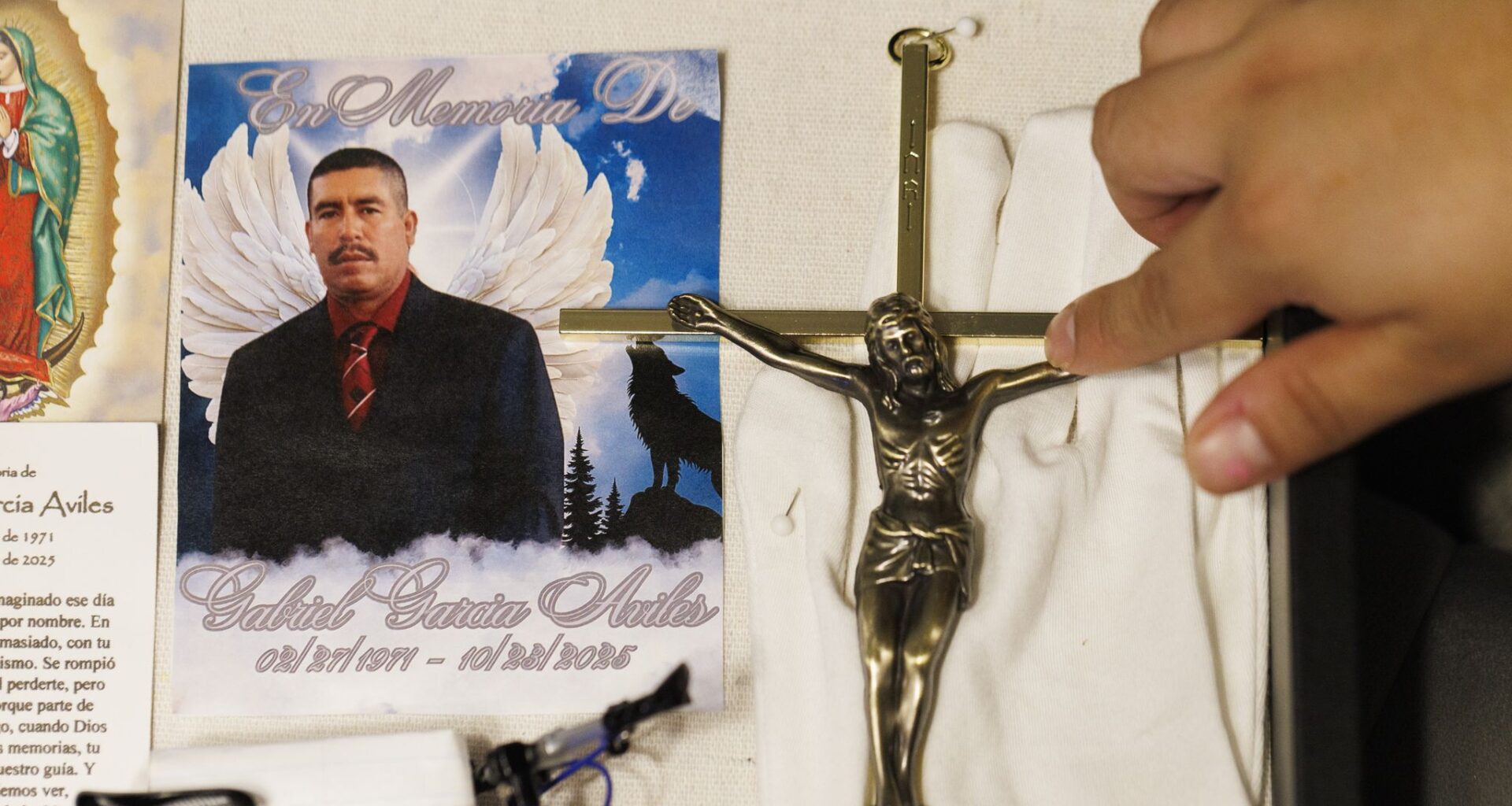
Only one of the three, Gabriel Garcia Aviles, was ever transferred to a hospital. Even then, staff took six hours to do so.
Aviles, a 54-year-old day laborer from Mexico who loved riding his bicycle with his children, died in October, nine days after being detained at the Adelanto center while suffering alcohol withdrawal.
Mariel Garcia keeps a memorial for her father, Gabriel Garcia Aviles, at her home in Los Angeles. Santiago Mejia/S.F. ChronicleMariel Garcia and her daughter Sophia Rodriguez visit her father’s grave at Eternal Valley Memorial Park in Santa Clarita (Los Angeles County). Aviles died last October following his detention at Adelanto ICE Processing Center. Santiago Mejia/S.F. Chronicle
“He never committed any big crime or anything like that,” said Aviles’ son, Gabriel Alejandro Garcia. “I think his crime was just to cross over here for his kids and give us a better life.”
Shortly after ICE arrested Santos Banegas Reyes, a 42-year-old Honduran father working as a day laborer in New York on Sept. 17, 2025, he was trembling and suffering from abdominal pain. He told a nurse he drank daily. A doctor diagnosed him with alcohol withdrawal and sent him to his cell with a “low bunk pass for seizure precautions.”
ICE records do not provide any indication that staff checked on him over the next 17 hours. By the time a detention officer found Reyes the next morning, his body was cold. ICE records listed the preliminary cause of death as apparent “liver failure complicated by alcoholism.”
Dr. Jose Luis Gonzalez, an addiction medicine specialist, said that someone should have been evaluating Reyes every two hours if he had severe alcohol withdrawal. With careful monitoring and treatment, alcohol withdrawal is survivable, he said.
“How was it that he was just found unresponsive?” he said. “It’s almost 24 hours, 17 hours, presumably, with no vital signs.”
Dr. Jose Luis Gonzalez, who reviewed documents related to ICE detainee deaths at the Chronicle’s request, at his home in Los Angeles. Santiago Mejia/S.F. Chronicle
The third man, Parady La, was a 46-year-old Cambodian refugee. His 23-year-old daughter remembered him for his love of tennis, which he taught her to play. He was diagnosed with severe opiate withdrawal soon after being detained and was found unresponsive, in critical condition, in a cell at Federal Detention Center in Philadelphia.
Federal Bureau of Prisons spokesperson Emery Nelson declined to comment on La’s case, but said that it provides “urgent and emergent evaluations when needed.”
Dr. Ryan Marino, an emergency medicine and addiction medicine physician and an assistant professor at Case Western Reserve University in Cleveland, said that if the three men received proper medical care, “all those people should be alive, based on the information DHS put out.”
At least 10 people died after staff members at detention centers did not call 911 or send patients to an emergency room in situations that doctors who reviewed their cases said should have warranted a more urgent response.
Lorenzo Antonio Batrez Vargas, 32, was living in Arizona, taking care of his mom as she battled cancer, when he was arrested by local police on suspicion of drug possession in August. ICE picked him up from Coconino County Jail and placed him in removal proceedings.
In custody at a Central Arizona detention facility run by CoreCivic, he contracted COVID-19. He recovered but soon complained to a facility nurse of dizziness and difficulty breathing, and he had an abnormally fast heart rate. An advanced practice provider, a lower-level medical provider than a licensed doctor, sent him back to detention with a fever reducer, decongestant medication and an inhaler.
He returned the next day, Aug. 31, 2025, still struggling to breathe and with shoulder pain. Three doctors who reviewed his case said he should have been sent to an emergency room. Instead, a nurse “advised him to notify medical staff of any changes to his condition,” records show.
An hour later, he was dead. His cause of death was acute bronchopneumonia from influenza, according to the coroner’s report.
“It’s as if you see someone floundering and drowning,” said Dr. Weber, the Minneapolis emergency physician, “and you say, ‘OK, well just let me know if anything changes,’ and you wait until they go under and they’re drowned.”
Maksym Chernyak, 44, had fled to the U.S. in August 2024, leaving his home country of Ukraine and the war that had consumed it. He and his girlfriend, Oksana Tarasiuk, were granted humanitarian parole under the Biden-era Uniting for Ukraine program and hoped to make a new start in Miami.
Instead, in January 2025, neighbors called the police when they overheard the couple arguing. Neither Chernyak nor Tarasiuk spoke English. In the subsequent misunderstanding, Tarasiuk said, police arrested Chernyak.
Tarasiuk, who’d met Chernyak at a restaurant near Kiev in 2021, said it was love at first sight. After her boyfriend’s arrest, she posted his bail. But ICE agents lodged a detainment request and Broward County deputies took Chernyak to Krome Detention Center, run by Akima Global Services LLC, on Miami’s western outskirts. Akima did not respond to a request for comment.
Tarasiuk said Chernyak soon called her from the lockup and told her that he was being kept in frigid conditions and forced to sleep on concrete — and that he started getting sick.
During three medical appointments, detention staff found Chernyak had high blood pressure, according to records provided to the Chronicle by his attorney. Those levels, if sustained, can put someone at increased risk of a stroke, said neurologist Dr. Laura Boylan, who served as a New York University School of Medicine adjunct professor for 25 years.
However, medical records show Chernyak received no blood pressure treatment. ICE records referred to “slightly elevated blood pressure.”
The couple usually spoke by phone in the afternoon, Tarasiuk said. But one day, she didn’t hear from him. That night, around 2:30 a.m. on Feb. 18, 2025, detention staff witnessed Chernyak having a seizure, vomiting and passing out.
A detention nurse took him to the facility’s clinic. Records show that the nurse practitioner on call thought he was intoxicated and called for nonemergency medical transportation to a hospital. Staff tried to put him in a wheelchair, but he slid out. Over the next hour and 13 minutes, staff members witnessed him suffering six more seizures before they finally called 911, according to ICE records.
By the time he was evaluated at the hospital two hours after his first seizure, he was comatose. Doctors diagnosed the episode as a massive stroke caused by uncontrolled high blood pressure and said he had “irreversible brain damage,” according to his hospital records. He died two days later.
“That was clearly inappropriate triage,” said Dr. Elizabeth Burner, a University of Southern California associate professor and emergency physician. “A seizure is an immediately life-threatening event, especially a first-time seizure.”
Four doctors who evaluated the available records from his case said Chernyak’s death could have been prevented if 911 had been called after the first seizure and three doctors said his high blood pressure increased his risk of stroke.
Four deaths since Trump returned to office occurred at Krome, which ICE inspectors faulted in 2025 for a shortage of medical staff and overcrowding. Inspectors discovered that medical staff weren’t giving new detainees health screenings, a “repeat deficiency,” and failed to test them for tuberculosis.
While doctors unsuccessfully tried to save Chernyak, Tarasiuk was begging hospital staff to let her see him. They refused, citing that he was in ICE custody. On Feb. 20, 2025 she drove to her attorney’s office to pay for Chernyak’s deportation legal defense. Her lawyer walked over to her and whispered in her ear — her partner was dead.
Tarasiuk plans to return to Europe in a few months and scatter his ashes in the Alps, the mountains where he loved to hike and ski. The experience has changed her opinion of the United States, she said.
“We heard that the United States respects the human rights and freedom of people who live in it,” Tarasiuk said in Ukrainian. “So we hoped that we would be able to start our new stable life without war. Now I have a fear of being here in this country as well.”
Two psychiatrists said that of the eight people who died by suicide in ICE detention, they were most troubled by the case of Leo Cruz Silva, a 34-year-old Mexican man arrested in Missouri in September 2025 on suspicion of public intoxication.
From the moment an ICE officer detained him at a county jailhouse, records show, officials knew he was paranoid and hearing voices. The next day, a nurse saw him “hiding under his bed” and reported he was experiencing “audio and visual hallucinations.”
Dr. Joanne Ahola, a psychiatrist and medical director emeritus of the Weill Cornell Center for Human Rights, said the symptoms pointed to an acute psychotic crisis or acute delirium, which was “as much of an emergency as a heart attack,” requiring a 911 call and close monitoring for suicidality.
Instead, staff members kept Cruz Silva in his detention cell, prescribed antipsychotic medication and planned to evaluate him “the following week.”
The next day, staff found him dead in his cell. He had hanged himself. Dr. Jacob M. Appel, an emergency room psychiatrist at Mount Sinai Hospital in New York, said Cruz Silva’s treatment “defies any reasonable standard.” Suicides in ICE detention, he said, can be prevented with better screening, monitoring and “suicide-proofing” facilities such as by ensuring nothing can be hung from ceilings.
“In a confined environment, the number of suicides should be close to zero,” Dr. Appel said.
Four of the people who died in ICE custody were extremely medically frail before being detained and had no violent criminal history. Five doctors said these individuals likely would not have died as quickly had they not been in detention.
Federal regulations allow ICE to release detainees if they “have serious medical conditions in which continued detention would not be appropriate.”
Isidro Perez was a 75-year-old grandfather who fled to Florida from Cuba when he was 16 and was granted entry to the U.S. He was convicted of two drug possession charges in the early 1980s, and sentenced to a total of 28 months in prison. It’s not clear what his immigration status was at the time.
After his release, he continued living in the U.S., working as a mechanic and fisherman and living on a boat, said his former partner, Maria Alaniz, 83.
He developed coronary heart disease and had stents placed in his heart. Then in June 2025, ICE officers arrested him, asserting he was present without admission or parole. He couldn’t see well due to cataracts and needed help getting in and out of his boat, Alaniz said. He’d also recently broken his shoulder in a fall, she said.
Perez called and told her that there were no beds for him to sleep on at the detention center and that the facility was kept at a frigid temperature. As the days passed, Perez reported in his calls that he was suffering from increasing pain, she said. “I can’t take it anymore,” she recalled him saying.
Perez died of a heart attack three weeks after being detained.
“The way they kept him wasn’t right,” Alaniz said. “It wasn’t humane. It was very hard.”
Two doctors who reviewed his case questioned why ICE detained him, given his poor health.
“You have a frail elderly man,” said Dr. Baron. “Putting him in a stressful environment, you put him at greater risk of a heart attack.”
Two of the 48 people who died in immigration detention since last year passed away just days after President Trump took office, following care they received under the Biden administration.
One was Serawit Gezahegn Dejene, a 45-year-old Ethiopian man who was arrested near the U.S.-Mexico border in August 2024. He was taken to Eloy Detention Center in Arizona, run by CoreCivic, which since 2004 has the highest number of fatalities of any immigration detention center.
During his intake screening at Eloy, a nurse wrote that Dejene denied having a history of any medical conditions. But over four months, he lost 20% of his body weight, complained to medical staff four times of back pain, had an elevated heart rate and was diagnosed with lymphoma.
Three doctors who reviewed his case said those symptoms should have prompted staff to test him for HIV. If they had, they could have started Dejene on antiretroviral therapy, likely prolonging his life.
It wasn’t until after he was transferred to a hospital intensive care unit at Banner-University Medical Center in Phoenix on Dec. 31, 2024, that physicians identified Dejene’s “immunocompromised status,” records show. Dejene was HIV-positive.
Doctors at the hospital found he had pneumonia, sepsis and lymphoma that had spread to his lungs, and had suffered a stroke. They removed him from life support on Jan. 29, 2025, according to ICE records. He died hours later, 9 days into Trump’s new term.
Physicians questioned why it took so long to determine Dejene had HIV, when testing adults for sexually transmitted diseases, including HIV, is standard medical practice.
“He never should have reached this stage,” said Dr. Salim S. Abdool Karim, a Columbia University professor and the director of the Centre for the AIDS Programme of Research in South Africa. “He died of multiple opportunistic infections. The sad part is all of them are eminently preventable with timely AIDS treatment.”
Across the country and beyond, detainees, their families and advocates are seeking reforms for what they argue are broad failures of health care in immigration lockups.
Detainees have sued ICE multiple times, including in a January lawsuit seeking class action status over conditions in Adelanto, where four people have died in custody under the Trump administration. Plaintiffs alleged they were denied medication and subjected to mold infestation and outbreaks of chickenpox and staph infection.
ICE has argued in legal filings that plaintiffs did not show “irreparable harm” and rebutted their legal grounds for suing.
Officials from Mexico’s Ministry of Foreign Affairs issued a statement March 30 calling for an investigation into conditions at the facility “due to grave omissions and evident deficiencies in medical care provided to detainees.”
At the national level, California Sen. Alex Padilla is co-sponsoring a bill seeking to improve the conditions and oversight of ICE detention centers. “It’s unthinkable that people are dying from preventable causes while in federal custody in the United States, but that’s the cruel reality of Donald Trump’s America,” Padilla said.
In California, immigrants at the state’s largest ICE detention center, in Kern County, sued the government over delayed medical treatment in November, prompting a federal judge to install an independent medical monitor.
Masuma Khan, 64, who was detained at the California City facility the previous month, is now working with state lawmakers on a bill to fine private operators up to $25,000 per day for violations of an array of health, safety and labor standards.
Khan, who is fighting deportation, said in an interview that she requested blood pressure medication, asthma inhalers and medicated eye drops after being detained. But she didn’t receive them for six days, medical records show. She didn’t get pills to manage her asthma until 28 days into detention.
From left, Isteak Khan, Masuma Khan and Riya Khan at Masuma and Isteak Khan’s home in Altadena (Los Angeles County). Masuma Khan is now advocating for a bill to fine private operators of detention facilities for violations of an array of health, safety and labor standards. Jenna Schoenefeld/For the S.F. Chronicle
Masuma Khan holds some of her medications at her home in Altadena in December. While in ICE detention, Khan said she was denied access to the medication, putting her at risk of a stroke, according to a doctor who reviewed her case at the Chronicle’s request. Jenna Schoenefeld/For the S.F. Chronicle A figurine of the Statue of Liberty sits on a table at Masuma and Isteak Khan’s home, a gift from their daughter, Riya Khan. Jenna Schoenefeld/For the S.F. Chronicle
Khan’s daughter, Riya, visited her six days in and said Khan struggled to breathe and speak and had bruised, swollen legs. Based on the blood pressure reading Khan saw when a nurse took it, she was bordering on a hypertensive crisis and at risk of a stroke, a doctor who reviewed her case at the Chronicle’s request said.
She and her daughter said they complained until Khan finally received some of her medication. Khan, who was soon ordered released by a federal judge who said her detention was illegal, said in an interview, “I was putting sick calls two, three times every day, asking them for my medicine. They didn’t care.”
The spokesperson for CoreCivic, which operates the facility, declined to comment on Khan’s case, citing medical privacy, but said detainees have access to a “continuum of health care services,” including a pharmacy.
Since Ayala-Uribe’s death, his family’s home in Huntington Beach has felt empty, Jose Ayala said. In the bedroom the brothers once shared, their mother placed a candle and photo of Ismael close to his former bedside. Every Sunday, the family drives to the cemetery to visit his grave.
His father and mother can’t speak about Ismael’s death without choking up.
The family filed a wrongful death lawsuit against Adelanto operator Geo Group, which did not respond to questions about the litigation. The suit, filed Dec. 31, argues that Ayala-Uribe’s death was due to “deliberate indifference” to the poor conditions at the facility and the “callous disregard” for his rights.
“I want justice,” his mother said. “They’re not animals. … This was a sin.”
Ismael Ayala-Uribe’s niece, Sophia Ayala, blows flowers over her godfather’s grave at Westminster Memorial Park in March. Santiago Mejia/S.F. ChronicleAbout this story
The Chronicle focused reporting on 32 detainee death cases in which some revelatory documents were available.
Reporters then asked 14 doctors with specialties relevant to the detainees’ causes of death — including emergency room physicians, addiction specialists and psychiatrists — to review ICE death reports and, when available, autopsies, toxicology reports, coroner’s investigations and medical records for these cases. These documents were either obtained by the Chronicle through records requests, were publicly available, or were provided by families or attorneys.
The doctors practice all over the U.S. Some previously conducted research into health care in immigration detention settings, or advocated for higher-quality care.
At least two physicians and as many as five reviewed each of the cases. There were 23 medical fatalities that occurred in ICE custody in which the agency had published a legally required detainee death report, which details medical care a person received in custody. Doctors also reviewed one drug withdrawal death in which the report had not been published. Two psychiatrists reviewed each of the eight suicides in ICE custody.
In each case, the Chronicle asked doctors whether the person did not receive appropriate and timely medical treatment that could have saved the person’s life.
The Chronicle then conducted further reporting on 17 cases in which at least two doctors said medical staff delayed or failed to provide this potentially lifesaving care. In these cases, the physicians’ opinions were not necessarily unanimous. Some said they did not have enough information to make an evaluation, which the Chronicle indicated in its database.
The Chronicle did not ask doctors to review five deaths from fatal violence, nor deaths that occurred outside a detention facility though in ICE custody.
 The Chronicle’s most popular stories and best reads of the moment.
CreditsReporting and data by St. John Barned-Smith and Ko Lyn Cheang. Graphics and development by Nami Sumida. Photography by Santiago Mejia, Jenna Schoenefeld, Philip Cheung and Phobymo. Editing by Caleb Pershan, Dominic Fracassa, Demian Bulwa and Ryan Gabrielson. Data editing by Dan Kopf. Photo editing by Emily Jan. Copy editing by Linda Houser.