
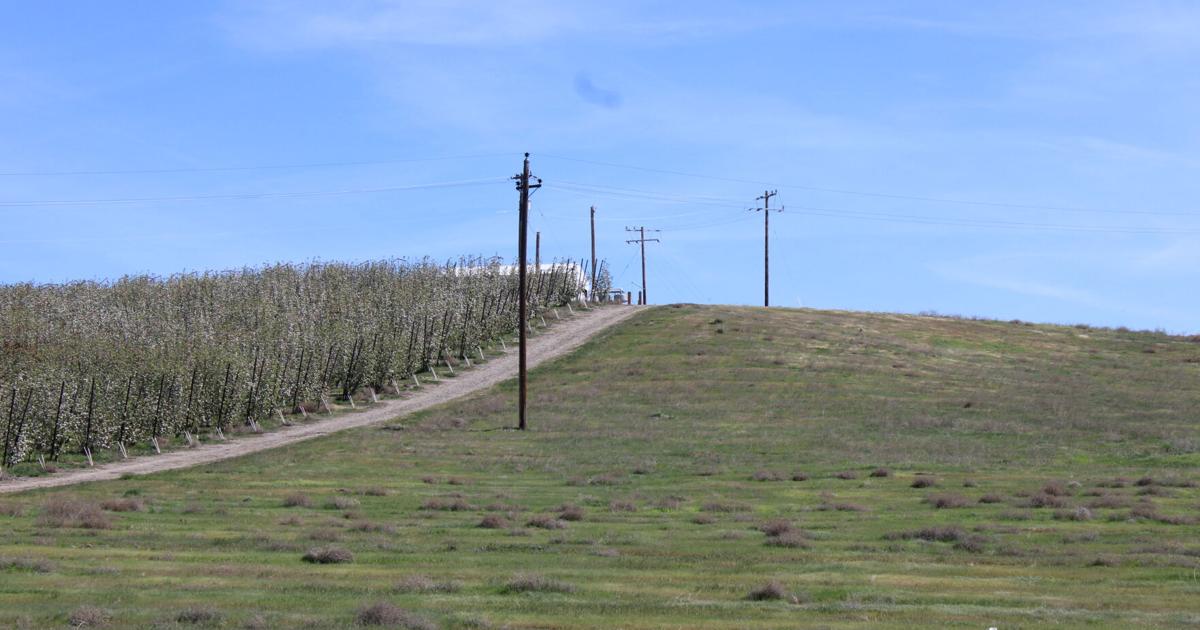
UNION GAP — It is the fourth year in a row of drought conditions in the state and the Yakima Valley, a grim record with consequence for the multibillion-dollar agricultural economy, wildfire risks and the Yakama Nation’s generational effort to restore salmon populations.
Top state officials declared a statewide drought emergency Wednesday following a winter of poor snowpack in the Cascades.
They made the announcement in the Yakima Valley for a reason.
“This is where the impacts are felt first and most acutely,” said state Department of Ecology Director Casey Sixkiller, speaking at the agency’s office in Union Gap.
Drought is declared when water supply is below 75% of normal and “undue hardships” are anticipated for water users. It can be declared in one or more particular watersheds, or the state as a whole. It is the first time on record, dating to 1895, that there has been a drought somewhere in the state four years in a row.
“This year, every watershed in the state has met this threshold,” Sixkiller said.
Making the emergency declaration allows the agency to provide $3 million in drought response grants for public entities.
Sixkiller noted the potential for confusion as to why there would be a drought after multiple rain and flooding events this winter. “The reservoirs are full, storing every drop of water they can, but the hillsides are bare.”
In normal years, snow makes up the difference in a basin that has about 2.4 million acre-feet in allotted water rights. U.S. Bureau of Reclamation reservoirs at Cle Elum, Kachess, Kacheelus, Bumping and Rimrock store about 1 million acre-feet.
Sixkiller also mentioned the Yakima Basin Integrated Plan, which he said strengthened the region for this exact scenario.
“As challenging and alarming as it is for us to declare four years of a drought, you come to a place like Yakima and you realize the power of partnership,” Sixkiller said. “Folks here in the Yakima Basin are as well-prepared as any could be to take on the issue in front of them.”
Background
The state is missing about half of the snowpack it would normally have this year because of high winter temperatures, said Karin Bumbaco, deputy state climatologist. It’s the third lowest snowpack on record and the third warmest winter on record.
“Our climate today is warmer than it used to be, and that warming likely played some role,” Bumbaco said.
Snowpack droughts are becoming more common and now occur about 40% of the time. In the 1990s, they occurred about once every five years, Ecology spokesperson Emily Tasaka said in an email.
Climate models predict that in the 2050s, snow drought will occur 70% of the time, Bumbaco said.
Despite a wet winter with 104% of normal precipitation from October to February, warm temperatures meant it fell as rain, not snow. Snowpack levels are about half of normal for this time of year.
Statewide temperatures from October to February were the third highest on record since 1895. Ecology anticipates the limited snowpack to melt early, with above normal temperatures and below normal precipitation this spring.
Irrigation
South of Yakima in the Roza Irrigation District, rows of fruit trees are blossoming. A sulfuric smell is in the air.

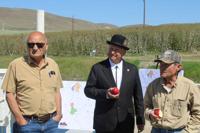
From left, Fruit grower Ric Valicoff; Urban Eberhart, manager of the Kittitas Reclamation District; and fruit grower Jim Willard are pictured on April 8, 2026.
Questen Inghram / Yakima Herald-Republic
“That’s the lime sulfur,” said Ric Valicoff, a fruit company owner and Roza board member. It’s used to destroy blooms to intentionally reduce the amount of fruit a tree might produce.
Valicoff estimates his company has fallowed about 50 acres in the last two years due to the ongoing drought. While patches of torn out trees can be seen throughout the Yakima Basin this spring, a variety of things could be at play — drought, market conditions favoring other varieties, disease or a combination of factors.
Valicoff said that the drought declaration is a good time to renew calls for more surface storage.
An often-cited statistic at water meetings is that 84% of the Yakima River Basin does not drain into a reservoir, meaning the Bureau of Reclamation is unable to capture water that runs off in the majority of the region.
At the U.S. Bureau of Reclamation’s monthly water supply update meeting on Thursday, the water allotment forecast for non-senior water users was raised to 52% following a wet March.
As of Thursday, Reclamation’s reservoirs were at 93% capacity.
Teresa Hauser, senior supervisory hydrologist, said the precipitation in March helped the reservoirs and led historic high flows in the river. She stressed that the rain was still not enough to make up for the lack of snow.
Urban Eberhart, manager of the Kittitas Reclamation District, said that he anticipates a tough year, similar to last year, but remains optimistic that late spring weather can make a positive difference.
At the last Bureau of Reclamation water supply update meeting, the water supply estimate for non-senior irrigation districts in the Yakima River Basin was 44% of allotment for the water year.
Jaclyn Hancock, a Washington State Department of Agriculture water resources scientist, said that the agency is paying close attention to the Yakima Basin.
Crop yield and quality have been affected in years similar to this one, Hancock said. The agency will continue to monitor for the drought’s economic impacts on farms.
Washington State University will release a report this summer about the effects of back-to-back droughts on farms, she said.
Scott Revell, manager of the Roza Irrigation District, said the district has been preparing.
“We’re ready with lots of contingency plans,” Revell said. “Our district prepares relentlessly in the good years for the bad years, and our growers do the same.”
Revell said he is grateful for $5.6 million in the recent state budget for canal repairs. By end of summer, its pilot program to start pumping water into the ground to store for later use should be up and running.
After dealing with many years of drought in the past, the Roza Irrigation District has become very efficient.
“Our water masters are proud to operate with nearly no spill over,” he said.
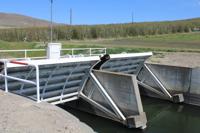
A gate that can divert the flow of water in the event of repairs to the Roza canal is pictured on April 8, 2026.
Questen Inghram / Yakima Herald-Republic
Fish
Joe Blodgett, project manager for Yakima Klickitat Fisheries Project, said even though there is a drought, he is optimistic for fish recovery with other achievements made for passage along the river, namely the start of the operation of the Cle Elum fish passage helix and the removal of the Bateman Island causeway.
“As we go into the fourth year, it takes a toll on the entire basin,” Blodgett said. “Collaboration is the only way we will see success in the future.”
Blodgett said additional storage is important not just for farms, but also for pulse flows for fish migration.
Municipal water supplies
Last October, Ecology took an unprecedented step of curtailing nearly all surface water use in the Yakima River Basin. For cities like Yakima that have groundwater wells, not too much changed.
But for the Kittitas County communities of Ronald, Roslyn and Cle Elum, which rely on surface water use year round for drinking water, it created a lot more uncertainty. Ecology used discretion in enforcement, focusing instead on education to reduce water use there.
Arden Thomas, water resources manager for Kittitas County, said that conversations are happening among partners on how those communities can reduce water use now, should there be curtailments again in October to make sure necessary drinking water use is legal.
“I want municipal water users to know that preserving water use now can make a difference,” Thomas said.
Jeff Bond, water treatment plant supervisor for the City of Yakima, said the city urges residents to conserve water to help reduce demand and system strain.
It is not anticipating any particular challenges delivering water this year due to the ongoing drought, he said. The city has four groundwater wells that can supplement its drinking water supply.
“We’re pretty used to it,” Bond said.
Wildfire
Commissioner of Public Lands Dave Upthegrove praised the Legislature for restoring $60 million in funding for wildfire preparations and response. The agency anticipates an active fire season spurred on by the drought.
“Fires will be more prone to start and will spread faster,” Upthegrove said.
Upthegrove stressed the need for residents to comply with fire safety rules, as the vast majority of wildfires are human-caused, often through burn piles, campfires, fireworks and driving vehicles in dry grass.
“Everyone in Washington has a role to play,” he said.