
The video above is a live stream of WBTV and affiliated programming, and may not be directly related to the article below.
CHARLOTTE, N.C. (WBTV) – Extreme drought conditions in the Carolinas were expected to persist and expand across the region over the next few weeks.
Most of North Carolina, about 77%, was experiencing a severe drought as of early April 2026, according to the U.S. government’s drought map.
Some parts of the state were experiencing “extreme drought,” including: several counties in Western North Carolina, the Charlotte area and northward, and northeastern counties near the border in the Raleigh area. Some northwestern and southwestern counties in South Carolina were also seeing an extreme drought.
Here’s a look at the drought conditions in the region, according to data from the U.S. drought map:
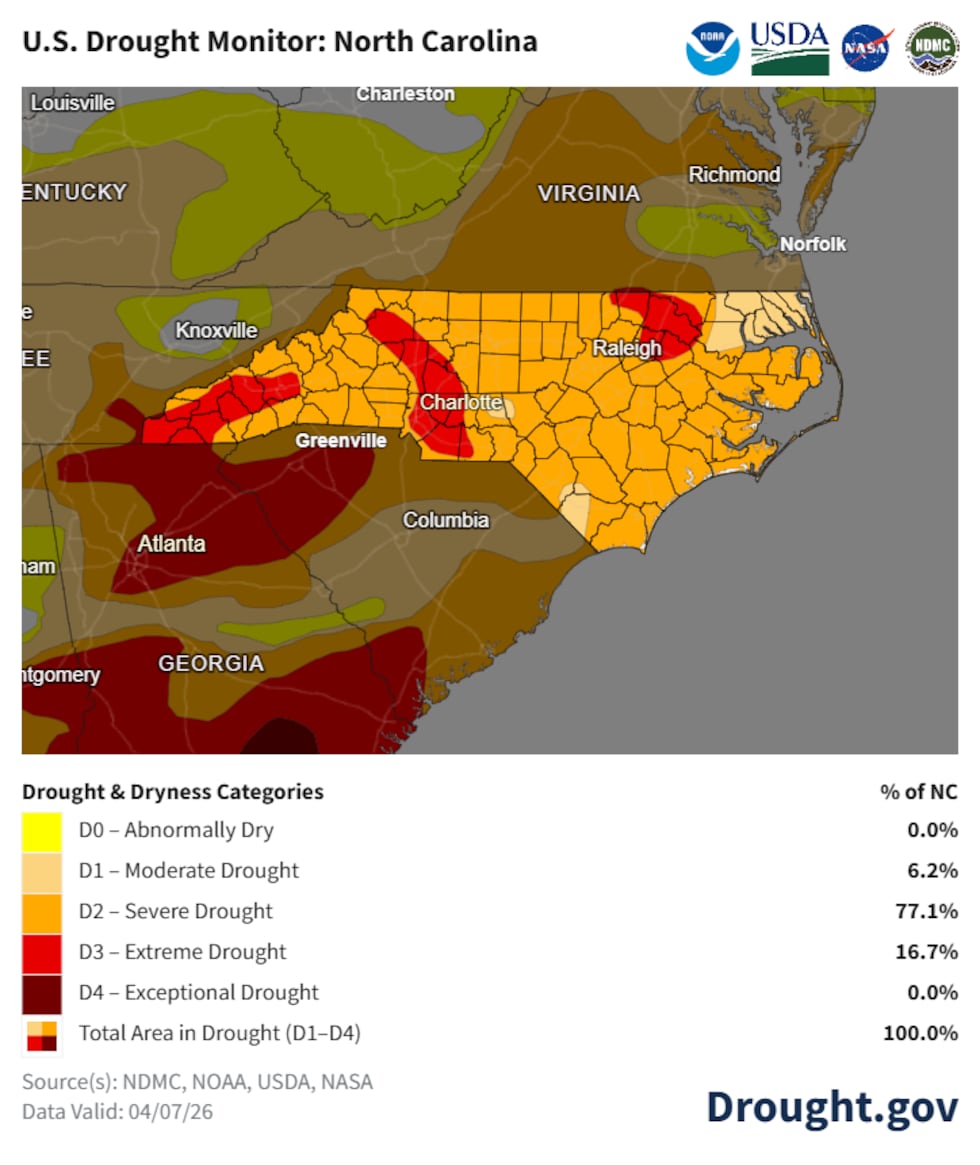 A look at drought conditions in North Carolina as of early April 2026, according to data from drought.gov.(drought.gov)Weather forecast won’t help drought
According to our First Alert meteorologists, that extreme drought was expected to expand across the Carolinas over the next two weeks, at least.
The U.S. drought map showed that drought conditions would persist for most of the Carolinas through the end of April. Only parts of the North Carolina coast, and parts of central South Carolina, were expected to see improvement.
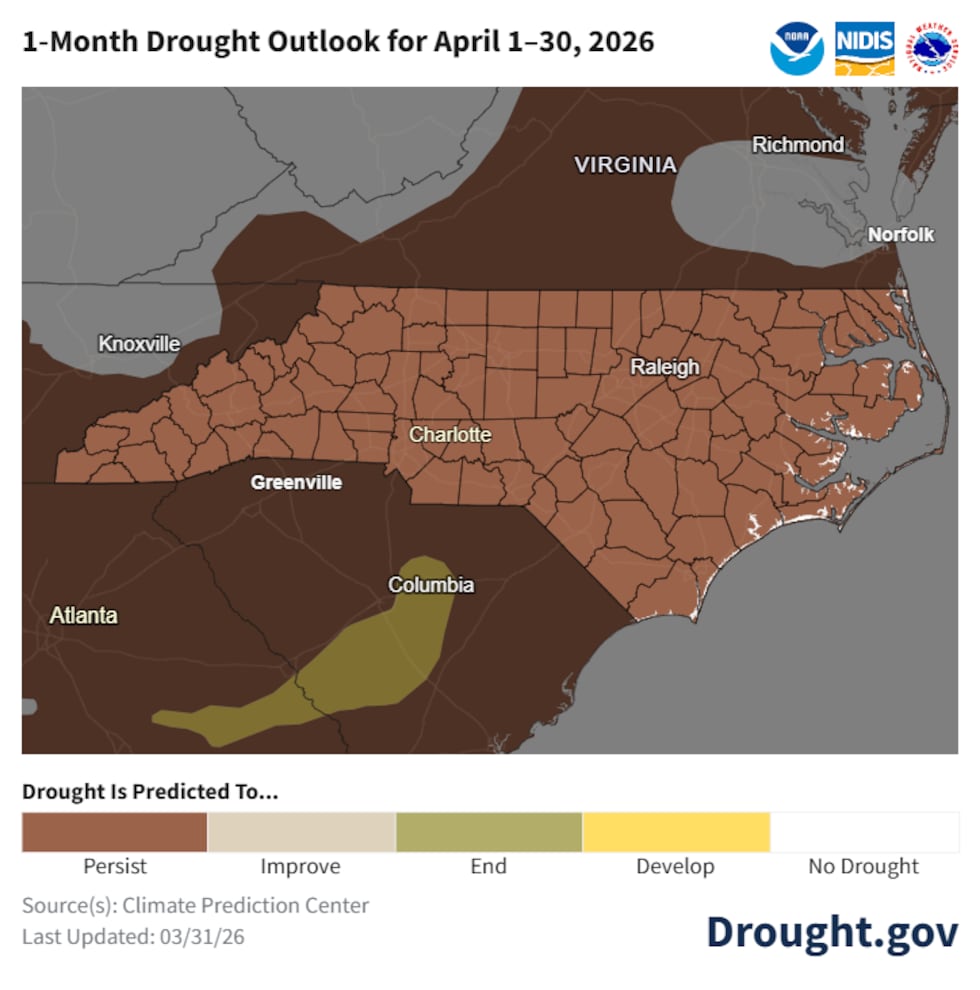 A look at drought conditions in North Carolina as of early April 2026, according to data from drought.gov.(drought.gov)
Drought conditions in North Carolina appeared to be worse so far in 2026, compared to data from recent years.
The graph below, from drought.gov , depicts drought conditions based on land area between 2000 and 2026. So far in 2026, there appears to be more severe drought coverage, compared to any year after 2009.
Some of the most significant drought conditions can be seen from 2001-2002, and from 2008-2009.
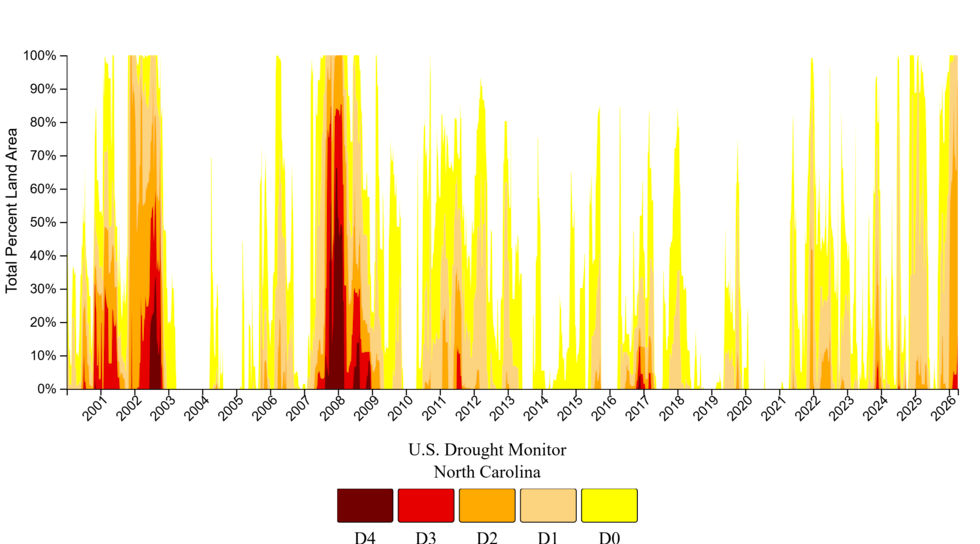 A look at drought conditions in North Carolina as of early April 2026, according to data from drought.gov.(drought.gov)Rainfall deficit in Charlotte region
The Charlotte region desperately needs rain, but it will be hard to come by in the near future, according to our First Alert meteorologists.
No rain was in the forecast for at least the next week, as of Friday, April 10.
“This is really bad news for the drought,” said First Alert meteorologist Eric Garlick. “Our rainfall deficit jumps about a quarter of an inch every two days this time of year.”
The Charlotte region was down nearly six inches of rainfall already this year. And record warmth was in the forecast for the Charlotte area next week.
High temperatures were expected to hit 90 degrees at least one day next week. If that happens, it would be the seventh-earliest 90-degree day in recorded Charlotte history.
Click here to see the latest First Alert Weather forecast.
Fire a serious concern due to dry conditions
Weather conditions were forecast to remain dry in the region through the upcoming weekend, and into the start of next week.
Humidity levels were forecast to range from 20% to 30% each afternoon, in that time period.
The mix of dry air, dry vegetation, and the ongoing drought create perfect conditions for fire to spread quickly. The fire risk was expected to remain high across the Carolinas for the immediate future.
A burn ban was active across North Carolina, and a red flag alert was issued this week for South Carolina. That alert was lifted for several counties, but remained active for several more as of Friday, April 10, the South Carolina Emergency Management Division said.
A burn ban was also issued for South Carolina at the end of March, but was lifted last week.
With the red flag alert or warning, people are urged to avoid outdoor burning and to practice fire safety. The National Weather Service says you should avoid throwing cigarettes or matches out of moving vehicles.
The issuing of a red flag warning does not automatically mean that a burn ban is issued for an area, but it does mean that burning is largely unsafe.
If burning is allowed in your area despite a red flag warning, cover burn barrels with a weighted metal cover, extinguish outdoor fires with plenty of water until cold, and never leave a fire unattended.
From last week: Dozens of North Carolina fires still igniting daily, despite statewide burn ban in place, officials say
Copyright 2026 WBTV. All rights reserved.