
Moneywise and Yahoo Finance LLC may earn commission or revenue through links in the content below.
While Wall Street has been rattled by one of its worst quarters in years, Warren Buffett is shrugging it off — and shopping for deals.
The U.S. and Israel’s war in Iran battered markets hard in early 2026. The Nasdaq fell 7% in Q1, the S&P 500 dropped close to 5%, and the Dow shed 4% (1) — the worst quarterly performance since 2022 (2).
CNN reported that both the Dow and Nasdaq entered correction territory, with the Nasdaq closing more than 12.5% below its October record high, as oil prices surged (3).
For many investors, that’s the kind of environment that triggers panic. For Buffett, it barely registers.
“This is nothing to make you get excited,” he said in a CNBC interview.
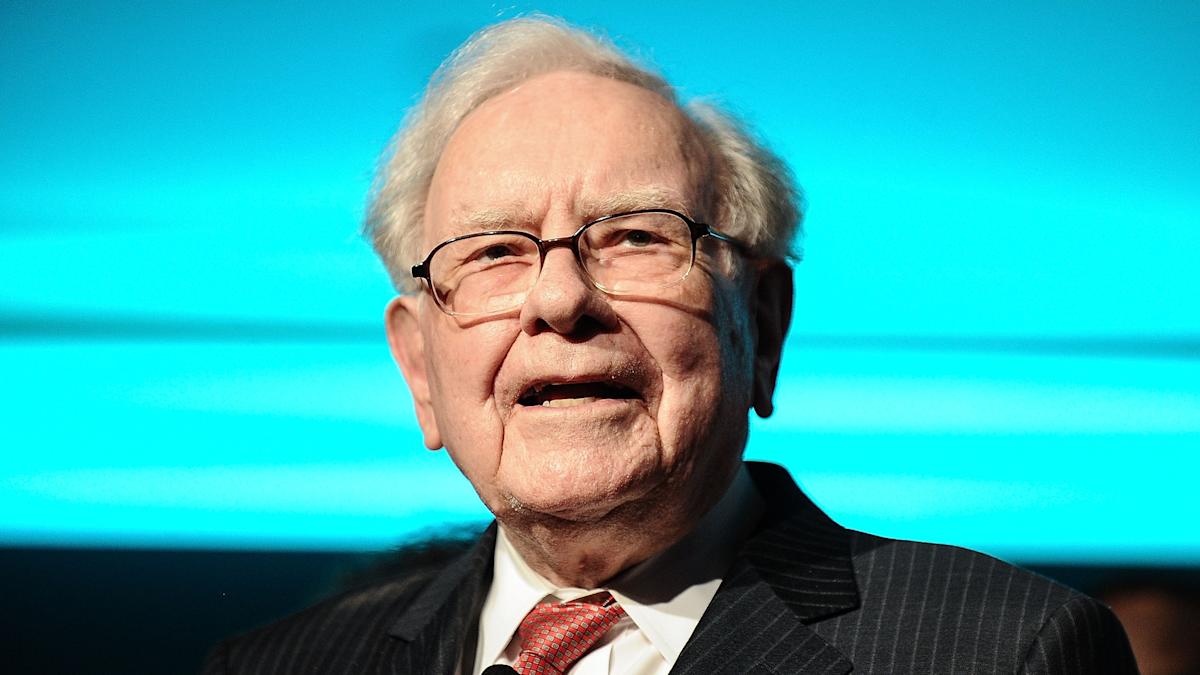
The 95-year-old “Oracle of Omaha” revealed that despite handing the CEO role at Berkshire Hathaway to Greg Abel on Jan. 1, 2026, he still comes into the office every day and remains hands-on with investment decisions.
Buffett described his routine: he calls Mark Millard, Berkshire’s director of financial assets, before the market opens each morning to talk through developments. Based on their chat, Millard then executes trades, although “I won’t make any (investments) that Greg thinks are wrong,” Buffett explained to CNBC. “Greg gets the (updates) sheet every day.”
He also disclosed that he recently made “one tiny purchase” — without revealing what the investment was (4). The mystery buy has sparked immediate speculation among investors, given Berkshire’s record cash and U.S. Treasury holdings of more than $370 billion at year-end 2025 (5).
What’s more, the company recently purchased $17 billion in Treasury bills at the weekly auction, Buffett shared in the interview.
Even though Buffett doesn’t like cash holdings, he deems a certain amount as necessary as the air we breathe.
“You do need oxygen, and if you’re ever without it for four or five minutes, you will learn,” Buffett said during an interview with CNBC (6), adding, “And cash is that way. So you always need to have it available, because you do not know what will happen.”
Recent price trends reflect that need. Gas prices have risen by roughly 30% since the start of the Iran war, topping over $4 per gallon according to the American Automotive Association (7). For those without adequate cash reserves, the price hike could strain their finances.
But you can still find ways to make your cash work harder for you behind the scenes.
For instance, a high-yield account like a Wealthfront Cash Account can be a great place to grow your uninvested cash, offering both competitive interest rates and easy access to your money when you need it.
A Wealthfront Cash Account currently offers a base APY of 3.30% through program banks, and new clients can get an extra 0.75% boost during their first three months on up to $150,000 for a total variable APY of 4.05%.
That’s ten times the national deposit savings rate, according to the FDIC’s March report.
Additionally, Wealthfront is offering new clients who enable direct deposit ($1,000/mo minimum) to their Cash Account and open and fund a new investment account an additional 0.25% APY increase with no expiration date or balance limit, meaning your APY could be as high as 4.30%.
With no minimum balances or account fees, as well as 24/7 withdrawals and free domestic wire transfers, your funds remain accessible at all times. Plus, you get access to up to $8M FDIC Insurance eligibility through program banks.
Buffett put today’s volatility in historical context.
“Three times since I took over, for sure it’s gone down more than 50%,” he said, pointing to crashes that dwarfed the current pullback.
In his view, a market that’s a few percentage points cheaper than its recent peak doesn’t fundamentally change the investment calculus for a firm like Berkshire.
“We aren’t in it to make five or six per cent,” he said (4).
That’s a clear distinction from retail investors who might measure opportunity in short-term percentage moves. Buffett’s investment horizon is decades, not quarters.
Buffett’s position offers a useful framework for anyone tempted to make dramatic portfolio moves right now. The same Iran war that drove benchmark Brent crude to almost $113 a barrel and sent CNN’s Fear and Greed Index to “extreme fear” is exactly the kind of headline-driven volatility that has historically led ordinary investors to sell near the bottom (3).
Buffett has lived through Black Monday in 1987, the 2000 dot-com crash, the 2008-2009 financial crisis, and the COVID collapse — all of which felt catastrophic in the moment and all of which eventually recovered (8).
And his approach hasn’t changed: Unless valuations drop to levels that create genuinely outsized long-term returns, patience beats action.
“American business will do fine over time,” Buffett wrote in Berkshire Hathaway’s 2013 shareholder letter (9).
“Periodic setbacks will occur, yes, but investors and managers are in a game that is heavily stacked in their favor.”
In fact, he recommends retail investors to put their money in a low-cost S&P 500 index fund — advising that people should “keep buying it through thick and thin, and especially through thin.” (10)
Rather than trying to time the markets or waiting until you have ample funds, consider automating the process by investing small amounts regularly.
For instance, investing just $30 each week could add up to over $93,000 in 20 years, assuming it compounds at 10% annually (11).
Platforms like Acorns allow you to turn your spare change from everyday purchases into an investment opportunity.
Once you link all your cards, Acorns will automatically round up all expenses to the nearest dollar and set aside the difference. Once your savings hit $5, they are automatically invested in a smart investment portfolio.
So, when you buy your morning coffee for say $4.25, Acorns deducts $5 from your account and invests the difference in a diversified portfolio of ETFs managed by experts at firms such as Vanguard and BlackRock.
The best part? You can get a $20 bonus investment when set up a recurring monthly deposit.
The legendary investor has repeatedly stressed that what you pay in fees can be just as important as the returns you earn.
“Costs really matter in investments,” Buffett claimed in a CNBC interview (12), “If returns are going to be 7 or 8 percent and you’re paying 1 percent for fees, that makes an enormous difference in how much money you’re going to have in retirement.”
Opting for a discount broker with minimal commission fees could help you save thousands in the long run. That’s where platforms like SoFi come in.
Their easy-to-use DIY investing platform lets you buy stocks, ETFs and more with no commission fees and no account minimums.
SoFi is designed for both beginners and seasoned investors, with real-time investing news, curated content and the data you need to make smart decisions about the stocks that matter most to you.
Plus for a limited time you can get up to $1,000 in stock when you fund a new account.
If you want to try a more hands-on approach to investing but don’t know where to start, consider using recommendations from Wall Street experts.
Moby offers expert research and recommendations to help you identify strong, long-term investments backed by advice from former hedge fund analysts.
In four years, and across almost 400 stock picks, their recommendations have beaten the S&P 500 by almost 12% on average. They also offer a 30-day money-back guarantee.
Moby’s team spends hundreds of hours sifting through financial news and data to provide you with stock and crypto reports delivered straight to you. Their research keeps you up-to-the-minute on market shifts and can help you reduce the guesswork behind choosing stocks and ETFs.
Plus, their reports are easy to understand for beginners, so you can become a smarter investor in just five minutes.
— With files from Emma Caplan-Fisher
Join 250,000+ readers and get Moneywise’s best stories and exclusive interviews first — clear insights curated and delivered weekly. Subscribe now.
We rely only on vetted sources and credible third-party reporting. For details, see our editorial ethics and guidelines.
AOL Finance (1); Morningstar (2), (8); CNN (3); CNBC (4), (6), (10), (12); American Automotive Association (7); Acorns (11); Berkshire Hathaway (5), (9)
This article provides information only and should not be construed as advice. It is provided without warranty of any kind.