
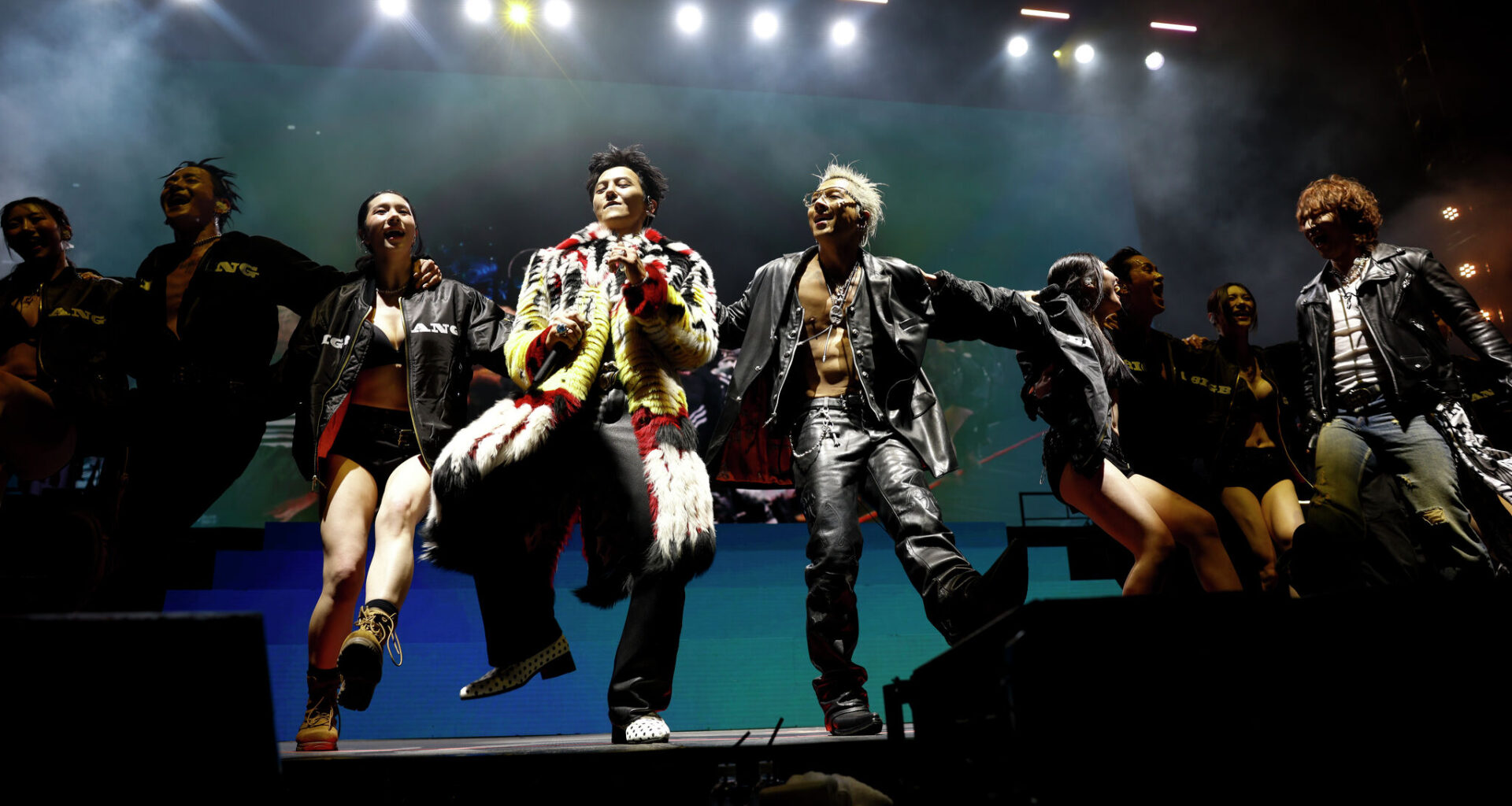
INDIO, Calif. — BigBang knows how to make an entrance. On Sunday night, moments before the boy group took the stage at Coachella, fireworks blasted from the stage and lights flashed. Amid a haze of smoke, dancers waved flags bearing the group’s logo. Then, as synth pulses blared out of the speakers, the group’s members rose up from below the stage, three silhouettes.
They wasted no time, starting with one of their biggest hits, “Bang Bang Bang.” Singer Taeyang, who was flocked by a crew of backup dancers, sounded pristine as he sang his opening verses.
It was an explosive start to BigBang’s set, and fitting for the occasion. The group’s Sunday night performance at Coachella was a special event for K-pop fans, an occasion on par with Justin Bieber’s long-awaited return to the stage the night prior. BigBang went on hiatus for mandatory military service at the end of the 2010s; the group hasn’t released new music since 2022 and hasn’t toured since 2017.
In the mid-2010s, BigBang was one of the biggest boy groups in the world, going toe-to-toe with One Direction. It was formed as an idol group in 2006, but thanks to its unusual degree of creative freedom — G-Dragon, the leader, writes and produces the songs — the outfit has enjoyed a long shelf life. Twenty years after the group’s public debut, BigBang’s members are in their mid-30s.
Within the K-pop genre, BigBang remains enormously influential. The members of BTS cite BigBang as one of their primary inspirations. (“It wouldn’t be an exaggeration to say that BigBang practically made BTS,” Suga, a BTS member, once told Taeyang, a member of BigBang. “You were musicians that I aspired to be like as a kid.”)
In 2025, BigBang looks different than before. What was once a five-piece group has shrunken down to a trio. Rapper T.O.P. left the group after controversies related to cannabis use, and Seungri retired after the Burning Sun nightclub scandal. The group’s three remaining members are Daesung, Taeyang and G-Dragon.
This onstage reunion marked a hard end to BigBang’s hiatus. The anticipation was palpable; although most of the audience members seemed to be in their 20s, they seemed to know every hit. When BigBang launched into the piano-driven intro of “Haru Haru,” a group of young women near me covered their mouths and began tearing up. Near the front of the crowd, somebody waved a South Korean flag.
The group’s hourlong set involved several phases, with accompanying outfit changes. BigBang cycled through some of its biggest hits, with pyrotechnics and backup dancers in tow: “Bang Bang Bang,” “Fantastic Baby,” “Sober.” The emotional high point was “Home Sweet Home,” a G-Dragon song featuring Taeyang and Daesung. After running through their solo material, the group members reunited onstage.
The track’s climax was euphoric. “Well, I said I would be back / And I’d never let you go,” G-Dragon sang, over a blaring synth line that sounded like it was pulled out of an old Avicii song.
In BigBang’s future 2026 performances, the track is likely to be a staple. After all, it’s hard to think of a more fitting statement for the group. On Sunday, it made it clear: BigBang is back for good.