
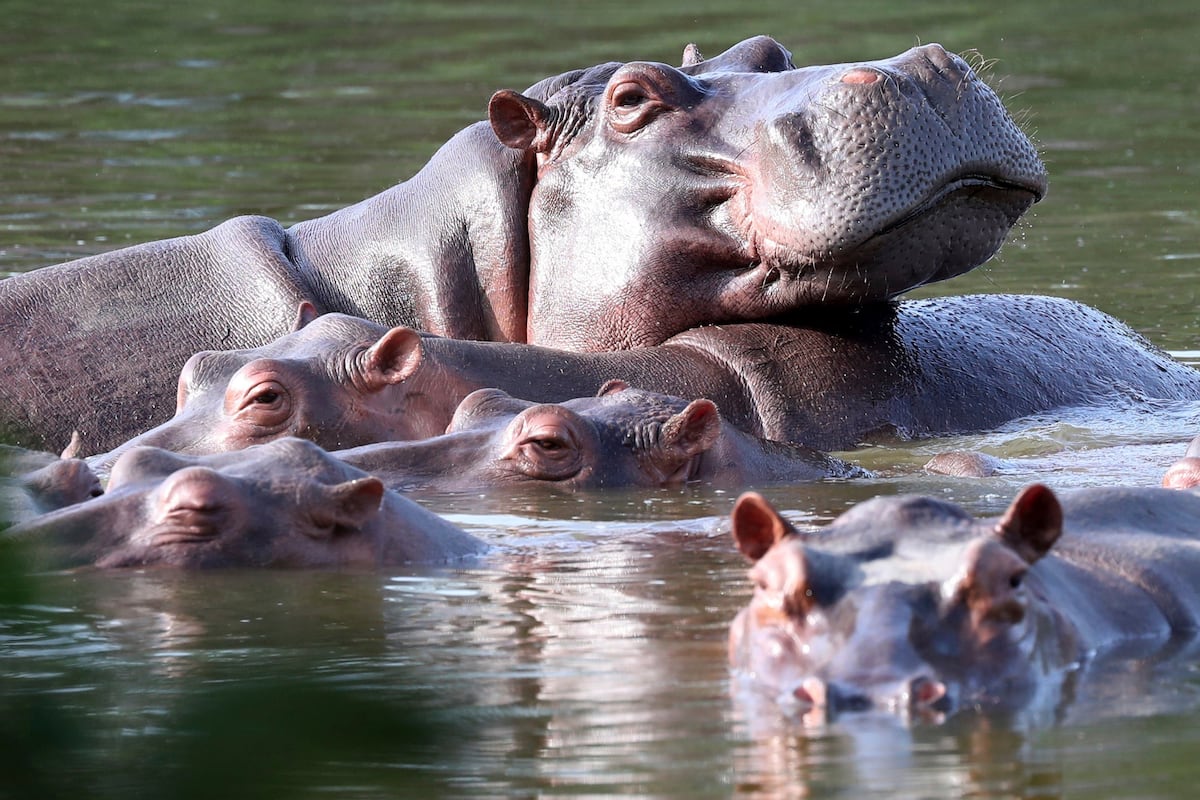
No country has been willing to take in Colombia’s hippos, descendants of the four animals that drug trafficker Pablo Escobar illegally brought from Africa in 1981. “The administrative silence tells us there is no interest in receiving them,” Environment Minister Irene Vélez acknowledged on Monday at a press conference.
Colombia will therefore resort to euthanasia to curb the expansion of this invasive species, of which there are around 160 specimens in the South American country. “Without that action, it is impossible to control the population. Estimates indicate that by 2030, we would have at least 500 hippos affecting our ecosystems and our native species, such as the manatee and the river turtle,” the minister stressed.
The story of Colombia’s hippos began at Hacienda Nápoles, 93 miles from Medellín, where Escobar built a private zoo with rhinoceroses, elephants, and other animals purchased on the international illegal market. The original three females and one male began to reproduce in an environment with a favorable climate and no predators. Over time, they reached the Magdalena River, the largest in the country, and spread through Antioquia and the neighboring departments of Santander and Bolívar. Reports grew of farmers encountering them on the roads and, in some cases, being attacked.
Hippos, which can weigh up to three tons and consume 70 kilos of food per day, cause all kinds of impacts on the ecosystem. The decomposition of their waste produces bacteria that, in turn, release carbon dioxide into the ponds and rivers where they spend much of the day. When they move, they also affect the soil: they displace earth, minerals, and small organisms. Vélez stressed on Monday that Colombia’s priority must be to protect native species: “It is out of responsibility to our ecosystems that we must take these actions.”
For years, the scientific community has debated how to rein in the hippos’ uncontrolled reproduction, especially in light of projections indicating that there could be 1,000 animals by 2035 if nothing were done. Although there is consensus on the need to reduce the population, there is disagreement on how to do so. Animal‑rights and progressive groups have long questioned the use of hunting or euthanasia and have called for alternatives such as capture and surgical sterilization. The problem is that it is too costly and not very feasible for a population that already exceeds 100 animals. Nor has it been possible to confine them in a designated area, as it is highly likely that the hippos would escape.
The government of President Gustavo Petro had proposed an intermediate solution in 2024, after decades of inaction. It put forward a “management plan” with four avenues: surgical sterilization and confinement as well as relocation to other countries and, “as a last resort,” euthanasia, more commonly known in the field as control hunting.
The transfer to countries such as Mexico or the Philippines was a key element of a program that sought not only to address the environmental problem but also to keep Colombia’s hippos alive. As Vélez explained on Monday, several sanctuaries expressed interest in receiving some animals, but no government approved the permits needed to make it possible.
Sign up for our weekly newsletter to get more English-language news coverage from EL PAÍS USA Edition