
Over tonight’s two episodes, The Fall And Rise Of Reggie Dinkins concludes its first season by putting its focus back on its premise. The series began as a high-concept sitcom about a disgraced former NFL star’s attempt at image rehabilitation, but quickly (owing to the brief episode order) split its attention among its more or less fantastic ensemble.
Reggie wants to get into the Hall Of Fame, despite his gambling habits (think Pete Rose but Reggie actually did only bet on himself to win) turning him into New Jersey’s richest pariah. Documentarian Arthur Tobin similarly needs to redeem his once-promising career (following a hubris-based MCU flameout) by turning Reggie’s self-serving vanity project into an actual film as powerful as his Oscar-winning A Rose For Joshua. And ambitious sports agent Monica Dinkins wants to launch her own career into the big time while dealing with the burden of keeping her infamous ex-husband’s baggage from weighing her down.
Ready to sub in, there’s also Reggie and Monica’s sensible teen son Carmelo, Reggie’s influencer fiancée Brina, and Reggie’s former teammate and permanent house guest Rusty, who all provide vivid if fleeting color. The Fall And Rise Of Reggie Dinkins has done an admirable job of establishing and variously nurturing its characters through 10 brisk and eventful episodes, finding room to turn what on paper looked like a two-hander odd-couple clash between the delightfully disparate styles of Tracy Morgan and Daniel Radcliffe into a reliably charming and clever hangout comedy.
Still, there’s been the creeping sensation of Reggie’s titular journey getting lost. Which, honestly, hasn’t been a terrible thing. While the “Will Reggie get into the Hall Of Fame?” arc came out strong, subplots about, say, Arthur’s love life, Monica’s career struggles, and the various C-plots serving Rusty, Brina, and Carmelo have been amusing and engagingly performed enough to supplant the series supposed central narrative nicely.
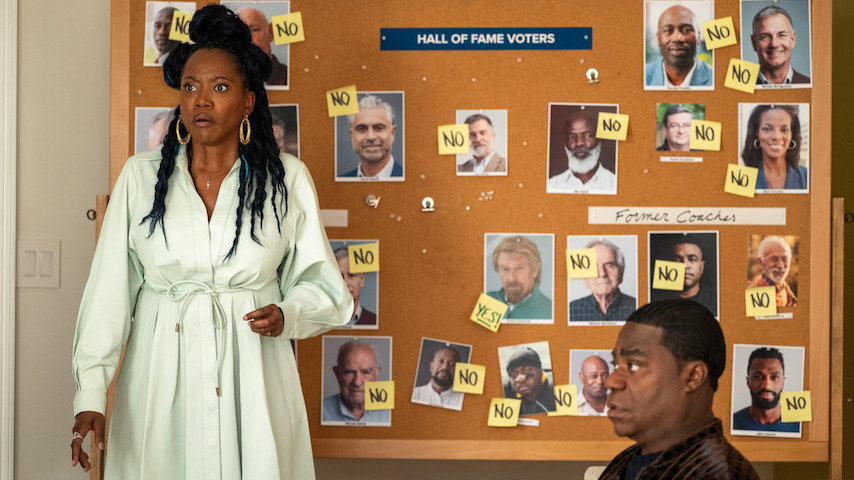
But this two-part season finale grabs hold of that wayward premise and drives the show back on its stated course, as Reggie and Monica mount a concerted effort to finally score him at least one “yea” in the upcoming Hall Of Fame voting process. (They have a big cork board complete with photos of prospective voters and everything.) The big stumbling block is, of course, Reggie’s scandal, a major plot point that the series has never truly reckoned with. While there have been nods to the creeping hypocrisy of sports leagues having a zero-tolerance policy for a practice they now reap billions of dollars promoting, Reggie’s transgression has been chalked up mainly to his erratic but innocent self-obsession.
Indeed, the season has sanded down the initially prickly Reggie into a cuddly sort who’ll not only put a blanket over sleeping guests but also surreptitiously brush their teeth. (Cue Erika Alexander’s Monica shooting another killer Jim Halpert look to Arthur’s camera.) Betting on games you take part in is, for all the cynicism, a real danger to pastimes whose value rests in fans’ faith. Reggie, for all the show’s done to wave away his transgression, did violate that faith. Is the NFL hypocritical in shunning him? Maybe. (“Gambling is a sin, right? But only if you play sports?” Heidi Gardner’s self-righteous Tisha Basmati attempts to untangle at one point.) But The Fall And Rise Of Reggie Dinkins is so dedicated to making this another comfy ensemble watch that a lot of what was initially complex gets neutered.
Look to the actual obstacles Reggie and Monica must overcome in this finale. First up is Corbin Bernsen’s Duck (real name Duckery) Donovan, Reggie’s dissolute former head coach who’s now a shell of a guy reliant on his support cat and refereeing singles flag football. From staring at his toupeed head shot on their big board, Monica and Reggie easily manipulate the newly appointed HOF voter by convincing him that a vote for Reggie will absolve Duck of the mess he’s made of his post-NFL life. (Reggie was so good that only his exile could explain why the Jets imploded and Duck went viral for his drunken Golden Bachelor audition tape.)
But once the grasping Duck is taken out by the machinations of returning rival and hater Jerry Basmati (Craig Robinson, still glinting with charismatic menace), Reggie and Monica’s effort to similarly manipulate the preening media darling hits a wall. Sure, Hall Of Famer Jerry needed a great on-field rival to cement his playing legacy, but, as Jerry notes, his resentment at always being linked to the more talented Reggie has turned him into the manufactured egomaniac happy to interview 911-dialing lizards for daytime TV.
And that’s when Arthur Tobin arrives to save the day—or at least abandon all pretense of documentary objectivity to majestically tell off the sneering Jerry for daring to call Reggie Dinkins a bad person. Radcliffe’s tortured artist had spent all of “Mischief And Memories” hilariously withdrawing (via camo clothes and a potted plant) from his place at the heart of the Dinkins mansion antics once he realized just how far he’d strayed. (Footage of a raucous family game night reveals that both Oliva Colman and Gary Oldman spit in his mouth at BAFTA after parties.) Watching the undeniably tiny Arthur make the imposing Jerry back down is a big moment that nearly lands. (Arthur, being Arthur, retorts that he can’t be an “Elijah Wood-looking-ass bitch” since he’s actually three days older than him.)
Like Reggie’s scandal, Arthur’s lapsed professionalism has, as shown in miles of compromising footage, been largely overlooked until now. Monica’s solution (and the show’s) is, again, almost brilliant, as she pitches that Arthur’s “participatory” and “reflective” approach constitutes a whole new genre. (Arthur fake demurs at the creation of the “Tobinumentary” as a source of cinematic study.)
I mean, filmmakers inserting themselves into their supposedly hands-off documentaries is hardly new. But the show treats it as if it were a big intuitive and comic leap, which feels unsatisfying. Same goes for the whole substance of episode 10, where the thwarted Jerry (now a Hall Of Fame voter himself) pitches a Hail Mary scheme to have Rusty elected to the esteemed body just to get Reggie’s goat.
There’s plenty of funny stuff for Bobby Moynihan to do in the most Rusty-centric episode yet, which isn’t a bad thing. Rusty, whose 83-percent field-goal percentage Jerry neglects to mention stems from the backup kicker only ever attempting 12 field goals, wants no part in betraying his best friend, even going so far as to hijack an interview by starting an unsuccessful rap beef with none other than Kendrick Lamar. (Lamar, voiced by Reggie Dinkins writer Phil Augusta Jackson, is so impressed by Rusty’s sweaty chutzpah that he starts wearing Rusty’s Jets gear onstage.)
It’s not that Jerry plan is silly (Rusty’s only recorded highlight was killing a bird with one of his three misses) so much as the show treats the whole caper as if it weren’t. I remember my initial objections that 30 Rock wasn’t making use of Tina Fey & co’s intimate familiarity with late-night live comedy as much more than window dressing. In the end, the characters and their wacky interrelationships were the show’s real heart. Here, it might be pedantic to quibble over Rusty’s plan to scuttle his improbable HOF candidacy by deliberately misinterpreting the football rule book (he hurls his old helmet into Jerry’s breadbasket, earning a real-life disqualification) as lazy. And it is the sort of lazy twist that’d skate by on a lesser show.
Reggie ends up nabbing four votes, and Monica gets a foot in the door with promising college running back Slacks Madison. By quoting Monica’s initial pitch that his film could be a win-win-win (Arthur tosses in three more wins to encompass the assembled Rusty, Brina, and Carmelo), the filmmaker, now possessed of a portrait of incremental growth rather than the phony Rudy crowd-pleaser he was hoping for, sets our expectations where they’ve been intended to be all along. “I actually think this is just the beginning,” Arthur tells his unlikely new family, each basking in their own mini triumphs. “We are not those same people,” he says. And if The Fall And Rise Of Reggie Dinkins made its characters’ transformations gentler and less ambitiously complex than it first appeared they would be, it’s still a very welcome place to end.
Stray observations
• As for that ending, the ratings for this short season have been good enough that it looks like everyone will be back—hopefully with more episodes.
• A few last 30 Rock in-jokes. Sports Shouting exists in both universes. Also, like Jack Donaghy, Reggie thinks bird owners are super weird.
• The show can still bring on the absurdity. Carmelo’s #SupportRD social media campaign is co-opted by a drug treating “rectal dementia.” One of Sports Shouting’s oldest shouters dies on air, his body remaining draped under a sheet. Reggie’s favorite sub shop owner has an existential crisis about just what he’s been slicing up all these years.
• “He died doing what he loved: shouting on TV about how he was being silenced.”
• “You can’t refer to yourself in the third and the first person, man.”
• “I talked to my fellow kickers, and they don’t think any hand-touchers should be in the Football Hall Of Fame.”
• The show’s usually clever unpacking of the documentary sitcom formula is undermined in one shot, when we see Duck’s abduction (by minions from Jerry’s scam “men’s retreat”) via ATM surveillance footage without any sense that Arthur got hold of it.
• Bobby Moynihan in the washing machine spin cycle is some prime “vanity is the enemy of comedy” stuff.
• Arthur pitches a replacement: “Now that PBS is gone, Ken Burns is just doing quinceañera videos.”
• Brina and Carmelo don’t get much to do, sadly, with Carmelo’s Romeo And Juliet revelation that he’s dating Jerry Basmati’s daughter closing out the season on a limp cliff-hanger.
• And that’s it for my coverage of The Fall And Rise Of Reggie Dinkins season one. It’s been, as ever, an honor.
Dennis Perkins is a contributor to The A.V. Club.