
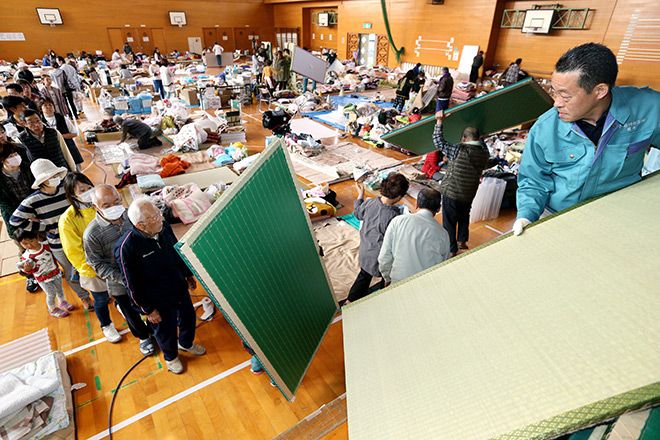
While experts have long advocated learning from the past to reduce disaster-related deaths, few municipalities are taking advantage of the lessons passed down, an Asahi Shimbun survey found.
The results showed that officials have not sufficiently utilized meeting minutes from review boards that certify such deaths.
The minutes can serve as a valuable resource that records the causes and circumstances of disaster-related deaths.
However, only 26 percent of the major cities and wards that responded to the survey said the documents “could be utilized” when examining measures to reduce those fatalities.
Disaster-related deaths refer to fatalities that have a causal link to a disaster, such as those caused by deteriorating health while living in evacuation or by suicide.
In recent large-scale earthquakes, the number of these indirect fatalities has often exceeded direct death tolls.
The survey targeted 109 municipalities nationwide: ordinance-designated cities, prefectural capitals, core cities and Tokyo’s 23 wards. Responses were received from 102 municipalities.
Many respondents were cautious about utilizing the review panels’ minutes.
They citied reasons such as, “They are not used as is because they contain personal information” or “The committee meetings themselves are closed to the public.”
The retention period for the documents was also short, typically five to 10 years.
The city of Matsuyama, which responded that the records are “in principle preserved permanently as historical public documents,” was an exception.
Lawyer Fumiyasu Zaima compared disaster-related deaths to the “final voices” of disaster victims and described the minutes as “public assets” packed with clues on how to save lives.
An expert on disaster-related deaths, Zaima said the survey results indicate that this awareness has yet to take hold, which is highly problematic.
Generally, disaster-related deaths refer to cases other than direct deaths for which disaster condolence grants of up to 5 million yen ($31,000) are awarded.
When bereaved families apply for these payments, municipalities examine whether the death qualifies as disaster-related through a review board in accordance with the Law on Provision of Disaster Condolence Grant.
Disaster-related deaths accounted for about 80 percent of the 278 fatalities in the twin Kumamoto Earthquakes in 2016 and made up about 70 percent of the 727 deaths in the Noto Peninsula Earthquake in 2024.
In the event of a long-feared Nankai Trough megaquake in the Pacific Ocean, the number of such deaths is projected to reach between 26,000 and 52,000.
The Asahi Shimbun survey also found that 15 percent of the responding municipalities have not set up review panels.
Under the disaster condolence grant law, establishing such bodies is a non-binding obligation that municipalities are expected to make efforts to fulfill.
Only 16 percent of the respondents said they have provided training for relevant personnel.
According to an analysis by the Cabinet Office of 127 cases certified as disaster-related deaths, respiratory diseases were the leading cause of death at 33 percent, followed by cardiovascular diseases at 29 percent.
As for the “factors leading to the cause of death,” the physical and mental strain of evacuation life was the largest, accounting for 53 percent.
In the Kumamoto Earthquakes, where the first temblor struck Kumamoto Prefecture on the southern island of Kyushu on April 14 a decade ago, poor conditions at evacuation centers, such as unsanitary toilets and insufficient food and water, emerged as critical issues.
The problems remained largely unchanged for survivors of the powerful earthquake that rocked the Noto Peninsula in Ishikawa Prefecture on New Year’s Day two years ago.