
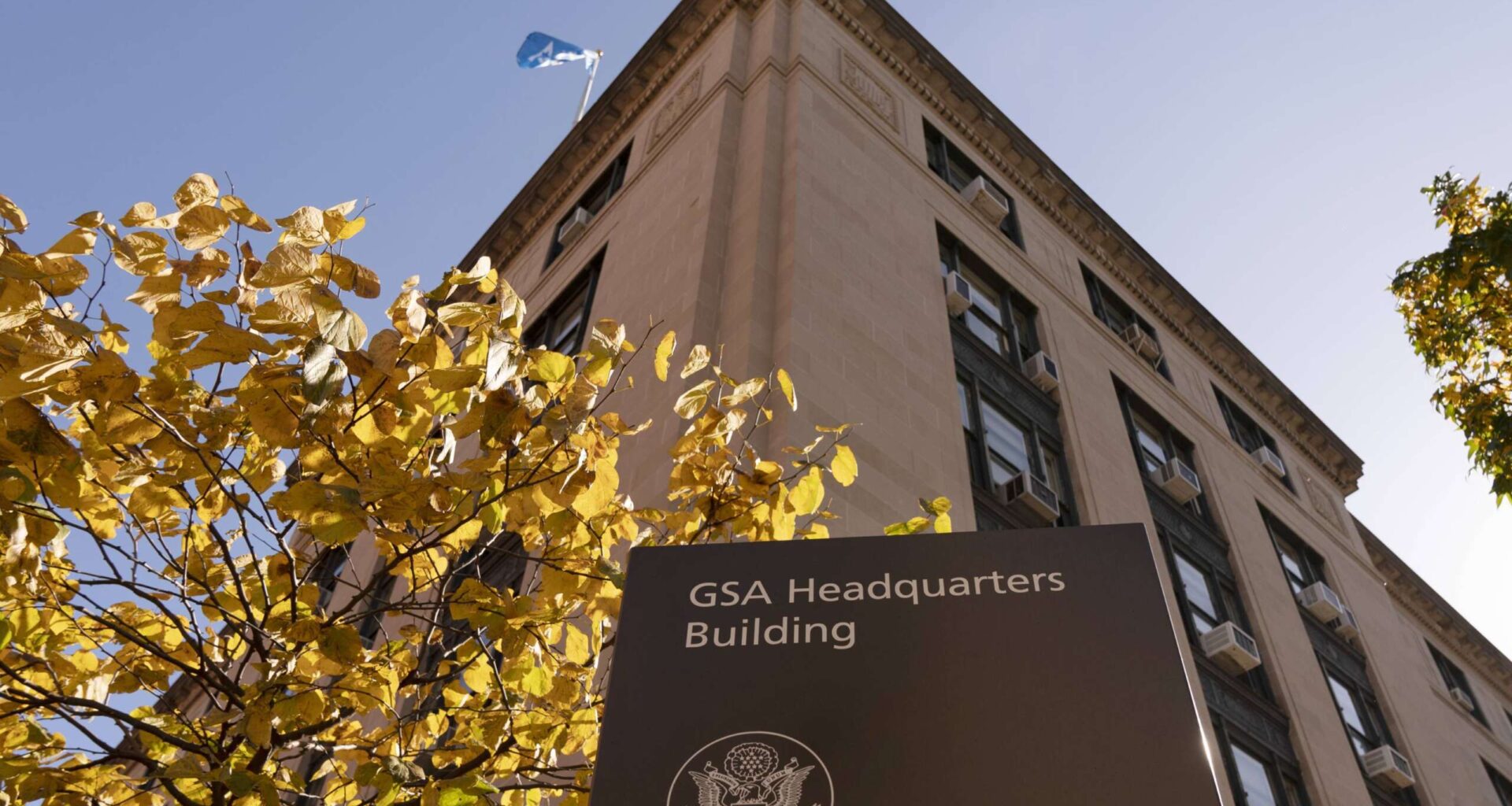
The General Services Administration is planning to use artificial intelligence to automate a significant portion of its internal work, after losing nearly 40% of its total workforce under the Trump administration.
GSA Deputy Director Michael Lynch said at an industry conference Tuesday that GSA has launched a “million hours challenge” for its internal AI tool USAi to automate a portion of the work done by federal employees and contractors.
“We have about 400,000 hours that are currently identified in ways that we could not replace people, but remove that non-high-value-added time and replace it by putting people on more high-value opportunities within the agency,” Lynch said at the OpenText Government Summit on Tuesday.
GSA is nearly halfway to its goal, and began this work internally. But Lynch said the project could expand outside GSA if deemed successful.
]]>
“We want to start with ourselves and expand as we go forward,” he said.
Several other agencies that saw deep staffing cuts last year, including the Environmental Protection Agency and the IRS, have also announced plans to rebuild capacity through AI. The Trump administration proposed further staffing cuts to the IRS in its budget proposal for fiscal 2027, but suggested those cuts could be offset by “utilizing technology improvements to help focus the IRS on providing high-quality customer service while ensuring the tax laws are fairly administered.”
For context, a million work hours translates into roughly a year of 500 employees working standard eight-hour workdays.
During Tuesday’s keynote, Lynch said GSA is following an “EOA” playbook for this work, which stands for “eliminate, optimize and automate.”
Since October 2024, GSA has lost nearly 40% of its total workforce. As part of last year’s cuts, GSA eliminated its digital services agency 18F. In a class-action appeal to the Merit Systems Protection Board last year, former 18F employees claimed they were fired after being targeted by former Department of Government Efficiency head Elon Musk.
Before joining GSA last year, Lynch served as an executive at several private-sector companies, including Musk’s aerospace and AI company SpaceX.
“GSA, like most parts of the federal government, is reduced in size from where we were at the start of the administration. So we’re now looking at everything we do to say, ‘Where are there areas where we can be more efficient and better use technology to go faster?’” Lynch said.
]]>
Lynch said that a small cohort of GSA employees is helping the agency’s leadership identify ways to automate and modernize internal work.
“We did a call-to-action for all of our senior leaders to say, ‘What are the problems that exist within automation, technology, workforce, things that you want to dedicate resources to, [but] you just don’t have the staff to do it?’ And then we put out a call to our workforce to say, ‘Hey, you’re kind of mid-career talent. Would you be interested in doing a second job, in addition to your day job?’ Not a second paid job, but you’ll be part of this programming,” he said.
According to Lynch, about 300 GSA employees applied to join GSA Labs. The first cohort of about 30 employees, he added, is doing this work “largely internally right now,” but could scale up beyond GSA.
“We have 30 individuals from around GSA that are going to be kind of almost our internal McKinsey consulting group that’s going to come in and help us solve those problems in partnership with the leaders,” he said. “Then the hope would be that it further develops the workforce, further develops great outcomes for our agency. And then where the program goes in year two and beyond is a bit up in the air.”
Lynch said GSA leaders identified 17 problems for GSA Labs to tackle, but narrowed the list down to five focus areas.
“It creates exposure to all aspects of our mission and what GSA does. It’s helping our talent, and I think it’s helping to solve real meaningful problems across the government,” he said.
Early in the Trump administration, GSA was a hotbed of DOGE activity and sought to cut its governmentwide real estate portfolio in half. Under new leadership, GSA is still looking to dispose of underutilized federal buildings.
But the Government Accountability Office recently reported that deep staffing cuts at GSA’s Public Buildings Service have “created challenges in accessing and preparing properties for sale.”
According to GAO, PBS lost about 45% of its employees between September 2024 and November 2025.
]]>
Agency officials told GAO that they would not provide timely access or allow tours of a property being sold, because it no longer had staff in the area. In another case, a property sale stalled because the team managing the sale left GSA, and the remaining staff were unsure if steps to help an agency tenant relocate had been completed. As a result, GSA had to restart the disposal process for the property.
GSA officials also told GAO that about a third of the staff responsible for processing disposals of GSA-owned properties left the agency, “creating uncertainty on whether properties were properly vetted and approved to begin the process.”
PBS recently told staff that it’s looking to hire 400 employees over the next six months. Last fall, Federal News Network first reported that PBS offered another 400 laid-off employees the opportunity to come back to their jobs.
If you would like to contact this reporter about recent changes in the federal government, please email jheckman@federalnewsnetwork.com, or reach out on Signal at jheckman.29
Copyright
© 2026 Federal News Network. All rights reserved. This website is not intended for users located within the European Economic Area.